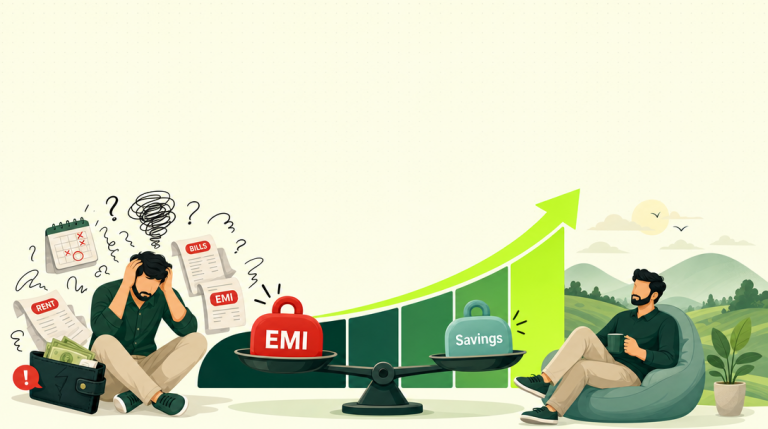






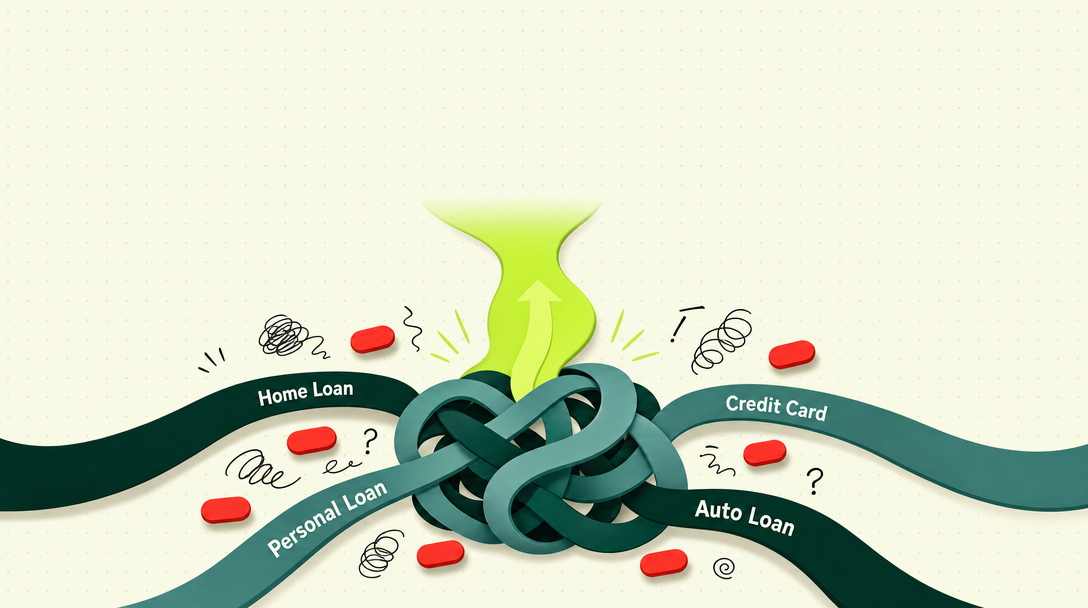
Debt consolidation in India is a structured way to combine multiple high-interest debts into a single, lower-cost loan. If you are managing a credit card at 36% interest, a personal loan at 18%, and a consumer durable EMI at 24%, you are not just paying more you are juggling multiple due dates and increasing your risk of default.
India’s personal loan market processed Rs. 3.8 lakh crore in unsecured retail credit in 2024-25. A significant portion of that was individuals refinancing expensive debt into a single, lower-cost loan. This guide explains exactly how debt consolidation works in India, which lenders offer genuine value, and how the process plays out from application to disbursal.
What Is Debt Consolidation (And What It Is Not)?
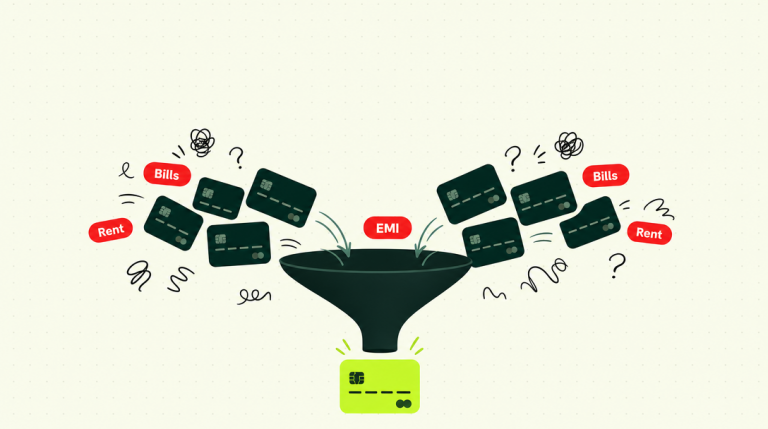
Debt consolidation means taking a single personal loan to repay all your existing debts — credit card balances, personal loans, consumer EMIs and replacing them with one monthly payment at a lower interest rate.
What it is not: debt settlement, debt waiver, or a government relief scheme. Consolidation does not eliminate your debt. It restructures it, typically at a lower rate and with a longer tenure, reducing the monthly burden while potentially lowering the total interest paid.
For consolidation to work financially, the new loan’s interest rate must be meaningfully lower than the weighted average rate of your existing debts. If your debts average 22% per annum and you consolidate at 13%, you save 9% annually on the outstanding principal, which is significant money over a 5-7 year repayment period.
When Debt Consolidation Makes Financial Sense
Consolidation is the right move when all of the following are true:
- You are paying interest above 18% p.a. on credit cards or NBFC personal loans
- Your CIBIL score is 700+, and you qualify for a bank-rate consolidation loan at 11-14%
- Your total debt does not exceed 50-55% of your annual gross income
- You have stable employment or a consistent business income that will support the new EMI
- You are not planning to take additional credit (home loan, car loan) within 12 months
Consolidation does not make sense if your credit score is below 680 (you will not get a low enough rate to justify the exercise) or if the processing fees and foreclosure charges on your existing loans eliminate the interest savings.
How Debt Consolidation Works: The Mechanics
The process in India follows this sequence:
- 1. Map your existing debt: List every outstanding loan and credit card balance with the outstanding principal, current interest rate, and remaining tenure.
- 2. Calculate your weighted average interest rate: Multiply each balance by its rate, sum the results, and divide by the total outstanding principal.
- 3. Apply for a consolidation loan: Seek a personal loan equal to your total outstanding debt from a bank or NBFC offering rates below your weighted average.
- 4. Use disbursal to close existing accounts: Many lenders require you to demonstrate that the funds were used to close the consolidated debts.
- 5. Maintain a single EMI: Your new loan replaces all previous obligations with one predictable monthly payment.
Which Banks and NBFCs Offer Debt Consolidation Loans in India?
Most major lenders in India offer personal loans that can be used for debt consolidation, though not all market them explicitly under that label. In 2026, the most competitive options are:
- HDFC Bank: Personal loan rates from 10.50% p.a.; strong approval process for salaried applicants with 750+ CIBIL score
- IDFC FIRST Bank: Rates from 9.99% p.a.; zero foreclosure charges — particularly useful for borrowers who may want to prepay
- Poonawalla Fincorp: Rates from 9.99% p.a.; strong approval rates for self-employed borrowers
- Bajaj Finserv: Rates from 11% p.a.; flexible flexi-loan structure; up to Rs. 55 lakh
- Muthoot Finance: Competitive for gold-backed consolidation; strong in Tier 2/3 cities
- SBI (Xpress Credit): Best rates for government employees; limited to existing account holders
Rate comparison alone is not sufficient. Processing fees (typically 1-3% of the loan amount), prepayment penalties on existing loans, and the tenure offered together determine the true financial benefit of consolidation.
How Much Can You Actually Save? A Real Calculation
Consider a borrower with the following debt structure:
- Credit card balance: Rs. 3,00,000 at 36% p.a.
- Personal loan (NBFC): Rs. 2,50,000 at 22% p.a., 24 months remaining
- Consumer durable EMI: Rs. 50,000 at 20% p.a., 8 months remaining
Total outstanding: Rs. 6,00,000. Weighted average interest rate: approximately 28.5% p.a. Current combined EMI: approximately Rs. 22,500/month.
Post-consolidation via a personal loan at 13% p.a. for 60 months: New EMI = approximately Rs. 13,620/month. Monthly savings = Rs. 8,880. Total interest saved over the loan tenure (compared to maintaining current debt at current rates): approximately Rs. 3.8 lakh.
TapTap’s savings calculator on taptaploans. It allows borrowers to model their own debt consolidation scenarios in real time before committing to any application.
Common Pitfalls: When Consolidation Makes Things Worse
- Extending tenure too aggressively: A 96-month consolidation loan may lower EMIs dramatically but increase total interest paid over the full period
- Not closing consolidated accounts: If you consolidate credit card debt but keep the cards open and spend on them, you double your debt
- Ignoring foreclosure charges: Some existing NBFC loans charge 3-4% of outstanding principal for early closure; factor this into your savings calculation
- Applying to multiple banks simultaneously: Each rejected application generates a hard enquiry; a 3-rejection run can drop your CIBIL score by 20-30 points
- Choosing consolidation over income growth: If the root problem is insufficient income, consolidation buys time but does not solve the underlying issue
How TapTap Loans Approaches EMI Reduction
TapTap’s EMI reduction service is built specifically for borrowers who are over-committed on monthly obligations. The process:
- You share your current outstanding debt amounts and interest rates
- TapTap assesses your credit profile and income through a soft enquiry
- The platform identifies the lender within its 20+ bank network, most likely to approve a consolidation loan at the lowest viable rate for your profile
- TapTap submits a single application and follows up with the lender directly
- Upon approval, funds are disbursed, and TapTap guides you through closing existing obligations
The entire process involves zero bank visits and is completed with zero advisory fees to the borrower.
Key Takeaways
- Debt consolidation works by replacing multiple high-interest debts with a single lower-rate personal loan
- It makes financial sense when the new rate is at least 5-7% lower than your weighted average existing rate
- Leading banks offer consolidation personal loans from 9.99% p.a. in 2026; the rate you get depends on your CIBIL score and income
- Always factor in processing fees and foreclosure charges on existing loans before deciding to consolidate
- The most common mistake post-consolidation: keeping credit cards open and running up new debt
- TapTap’s EMI reduction service matches your profile to the right lender without triggering multiple hard credit enquiries.
Frequently Asked Questions
Will debt consolidation hurt my CIBIL score?
Short term: A single hard enquiry for the new loan may lower your score by 5-8 points. Medium term: Closing multiple existing accounts and maintaining a single on-time EMI typically improves your score within 6-12 months.
Yes. A personal loan can be used to repay any combination of credit card dues, personal loans, and consumer EMIs. The consolidation loan amount should cover the total outstanding across all accounts you want to close.
Most banks cap unsecured consolidation at Rs. 25-40 lakh. Some lenders allow up to Rs. 55 lakh (Bajaj Finserv) or higher for top-tier credit profiles. The amount is ultimately bounded by your repayment capacity.
No. Debt consolidation via a personal loan is unsecured no property, gold, or other assets are required as security.
Conclusion
Debt consolidation is not a magic solution it is a financial restructuring tool that works when applied to the right debt profile at the right time. The difference between consolidation working and failing often comes down to two decisions: choosing a lender with a genuinely lower rate than your existing debt, and not accumulating new debt after consolidation.
For borrowers who qualify, the monthly cash flow improvement can be substantial and in the Indian context, that freed cash can be redirected toward a systematic investment plan, an emergency fund, or simply financial stability. TapTap Loans exists to make this process simple, cost-free, and genuinely in the borrower’s interest.