





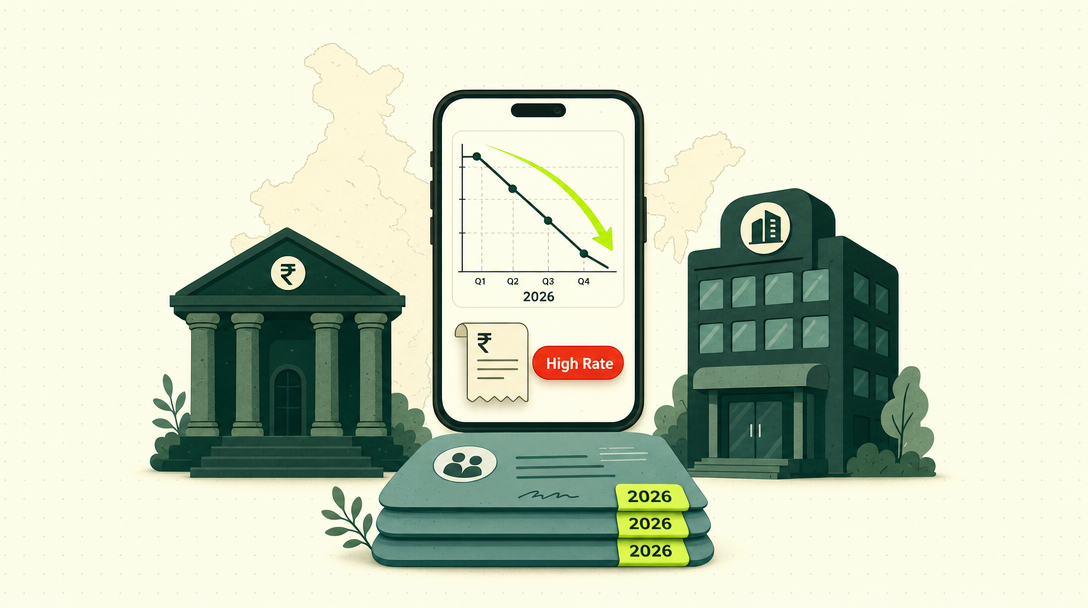
The personal loan interest rate in India starts at 9.99% per annum in 2026. That number, however, means very little without context. The rate you actually receive depends on your CIBIL score, your employer category, your existing debt load, and — critically — which lender you approach first. A 3% rate difference on a Rs. 10 lakh loan over five years is roughly Rs. 1 lakh in extra interest. In other words, choosing the wrong lender costs far more than most borrowers expect. This guide compares current personal loan interest rates across all major banks and NBFCs in India, explains the hidden fees that change your real borrowing cost, and tells you exactly how to qualify for the lowest possible rate.
Why Personal Loan Interest Rates in India Vary So Much
The Structural Reason: No Collateral, Full Risk
Personal loans carry no collateral. Because a borrower who defaults leaves the lender with nothing to recover from, that structural risk is priced into every personal loan interest rate in India. However, that risk is not the same for every borrower. As a result, lenders use several filters to assign a rate, and understanding those filters is the first step toward getting a better one.
The Five Factors That Determine Your Rate
- CIBIL score: The single largest driver. A borrower with a 750+ score can receive a rate 3 to 6 percentage points lower than a borrower at 680, at the same bank, for the same loan amount.
- Employer category: Central government and PSU employees receive rates 2 to 4% below what small private company employees pay. MNC employees typically fall between the two.
- Income-to-loan ratio: Requesting a loan that equals more than 10 to 12 times your net monthly income raises lender risk flags and shifts you into a higher rate band.
- Existing EMI obligations: A Fixed Obligation to Income Ratio (FOIR) above 50% signals limited repayment capacity and attracts higher rates consistently.
- Existing banking relationship: Salary account holders, fixed deposit customers, and existing loan customers often receive 0.5 to 1% preferential rates without needing to negotiate.
Personal Loan Interest Rate Comparison India 2026
Government Banks
Government banks remain the most competitive for PSU and salaried government employees. Moreover, their processing fees tend to be lower than those of private banks on comparable loan amounts.
| Lender | Rate Range (p.a.) | Max Loan | Best For |
|---|---|---|---|
| SBI Xpress Credit | 11.00% – 14.00% | Rs. 35 lakh | Government staff, SBI account holders |
| Bank of Baroda | 11.40% – 18.75% | Rs. 10 lakh | Existing BoB customers |
| Punjab National Bank | 11.40% – 16.95% | Rs. 20 lakh | Government and PSU employees |
Private Banks
Private banks offer faster processing and larger loan amounts. However, their rate ranges are wider — meaning a weak profile pays significantly more than a strong one at the same institution.
| Lender | Rate Range (p.a.) | Max Loan | Best For |
|---|---|---|---|
| HDFC Bank | 10.85% – 24.00% | Rs. 40 lakh | Private sector employees |
| ICICI Bank | 10.75% – 19.00% | Rs. 50 lakh | Existing ICICI customers, MNC staff |
| Axis Bank | 11.10% – 22.00% | Rs. 40 lakh | Digital-first borrowers |
| IDFC FIRST Bank | 9.99% onwards | Rs. 1 crore | Wide eligibility; zero foreclosure charges |
| Kotak Mahindra Bank | 10.99% – 36.00% | Rs. 40 lakh | Premium banking customers |
NBFCs
NBFCs often approve profiles that banks reject, particularly self-employed borrowers. In exchange, their upper rate limits are higher. As a result, the right NBFC for a strong profile can still beat a bank’s mid-range rate.
| Lender | Rate Range (p.a.) | Max Loan | Best For |
|---|---|---|---|
| Bajaj Finserv | 11.00% – 35.00% | Rs. 55 lakh | Flexi loan structure; large amounts |
| Poonawalla Fincorp | 9.99% – 30.00% | Rs. 30 lakh | Self-employed borrowers |
| Muthoot Finance | 14.00% – 22.00% | Rs. 15 lakh | Tier 2 and Tier 3 cities |
Source: Lender rate cards and official websites as of Q1 2026. Rates are subject to change based on RBI repo rate movements and individual lender credit policies.
Hidden Fees That Change Your True Personal Loan Cost
Why the Interest Rate Is Only Half the Picture
The interest rate is the most visible number on a personal loan. However, it is rarely the only number that matters. On a Rs. 10 lakh loan, fees can add Rs. 20,000 to Rs. 60,000 in upfront and ongoing costs. Therefore, always evaluate these before signing any agreement.
The Four Fees That Change Your Real Cost
- Processing fee: Most lenders charge 1 to 3% of the loan amount. On Rs. 10 lakh, that is Rs. 10,000 to Rs. 30,000. GST at 18% applies on top of this figure.
- Foreclosure charges: If you plan to repay early, charges of 2 to 5% on the outstanding principal significantly increase the total cost. IDFC FIRST is one of the few major lenders that offer zero foreclosure charges.
- Part-prepayment fees: Some lenders charge 1 to 4% on any prepayment made during the first 12 months. This directly disincentivises early paydown for high-interest borrowers.
- EMI bounce charges: Missed auto-debit payments attract charges of Rs. 300 to Rs. 1,000 per incident, plus potential penal interest and CIBIL impact.
The most accurate way to compare total borrowing cost is the Annual Percentage Rate (APR) or Internal Rate of Return (IRR). Both include all fees amortised over the tenure. Always ask the lender for this figure, not just the flat interest rate.
Fixed vs Floating Rates on Personal Loans in India
Why Almost Every Personal Loan Uses a Fixed Rate
Nearly all personal loans in India carry a fixed interest rate. Your rate is locked at disbursement and does not change over the tenure. This differs from home loans, which typically link to the lender’s benchmark rate (RLLR or MCLR) and fluctuate with RBI rate changes.
What That Means for Your EMI
The fixed rate structure gives borrowers full predictability — your EMI is known from day one. However, it also means you do not benefit from RBI rate cuts once your loan is disbursed. If the RBI reduces the repo rate mid-tenure, new applicants may receive lower rates, while existing borrowers stay locked in. This matters now: the RBI cut the repo rate in February 2025, and analysts expect further cuts through 2026.
How to Qualify for the Lowest Personal Loan Interest Rate
Actions You Can Take Before You Apply
Getting to the bottom of the rate range at any lender requires deliberate preparation. Specifically, these steps taken before applying have the most impact on the rate you receive.
- Build your CIBIL score to 750 or above. Even a 30-point improvement can move you to a lower rate tier. Check your score at cibil.com and dispute any inaccurate negative entries before applying.
- Use your existing banking relationship. Salary credit and fixed deposit customers routinely receive 0.5 to 1% better rates without asking. Start with your own bank’s mobile app before approaching any new lender.
- Reduce your existing FOIR. Closing a small outstanding loan or credit card balance before applying lowers your Fixed Obligation to Income Ratio and improves your rate band.
- Show a competing quote. If Lender A offers 13.5%, sharing that quote with Lender B during negotiation can prompt a matched or better offer. This works best for salaried borrowers with strong credit scores.
- Apply at the right time. Lenders near their quarterly disbursement targets sometimes offer rate concessions to close volume. Early Q1 (April) and early Q3 (October) are typically the most favourable windows.
How TapTap Loans Finds the Best Rate Across 20+ Lenders
Why the Lender You Approach Changes the Rate You Receive
The same borrower profile can receive rates that differ by 3 to 5% depending on which lender is approached. The reason is straightforward: different lenders have different risk appetites, different target employer categories, and different CIBIL score thresholds. Consequently, approaching the wrong lender first is one of the most expensive mistakes a borrower can make.
How TapTap Solves This
TapTap Loans checks a borrower’s full profile through a soft credit enquiry — with zero CIBIL score impact. It then matches the profile to the lender in its 20+ bank and NBFC network, most likely to offer the lowest rate and approve the loan on the first application. One application. One hard enquiry. No comparison fees and no branch visits required.
Key Takeaways
- Personal loan interest rates in India range from 9.99% to 36% p.a. in 2026. The minimum rate applies only to the highest-scoring borrower profiles.
- CIBIL score, employer category, and existing FOIR are the three biggest drivers of your personal loan interest rate.
- Processing fees of 1 to 3% and foreclosure charges of 2 to 5% significantly change the total borrowing cost. Always compare APR, not just the interest rate.
- Almost all personal loans in India use fixed rates. Your EMI does not change with RBI rate movements post-disbursement.
- Matching your profile to the right lender can save 3 to 5% on your interest rate — equivalent to Rs. 75,000 to Rs. 1.5 lakh on a Rs. 10 lakh 5-year loan.
Frequently Asked Questions
IDFC FIRST Bank and Poonawalla Fincorp both start at 9.99% p.a. SBI offers the most competitive rates for government and PSU employees. However, the lowest rate available to any individual depends on their CIBIL score, employer category, and banking relationship — so no single answer applies to all borrowers.
Rarely. The advertised minimum applies to borrowers in the highest credit tier — typically 780+ CIBIL, Tier 1 employers, and existing bank customers. Most applicants pay 2 to 5% above the advertised minimum. Therefore, always request a personalised rate quote before committing.
Yes, but the conditions are narrow. You generally need a CIBIL score above 760, employment with a central government body or large MNC, and an existing account with the lender. For most salaried borrowers, 12 to 16% is the realistic rate range in 2026.
Not directly. Personal loans use fixed rates, so existing EMIs do not change with repo rate movements. However, new applicants typically see rate reductions within 2 to 3 months following an RBI rate cut, as lenders reprice their loan products in response.
TapTap runs a soft credit check across your full profile and matches you to the lender in its 20+ bank and NBFC network, most likely to offer the lowest rate for your employer type, income, and CIBIL score, with no hard enquiry during the assessment phase.
Conclusion
The personal loan interest rate market in India in 2026 rewards borrowers who prepare before they apply. A higher CIBIL score, a lower debt load, an existing lender relationship, and — above all — the right lender match are the levers that determine whether you pay 10.75% or 18%. For most borrowers, the difference across a 5-year tenure exceeds Rs. 1 lakh. As a result, spending two hours optimising your approach before submitting an application is among the highest-return financial decisions available to any borrower in India this year.