





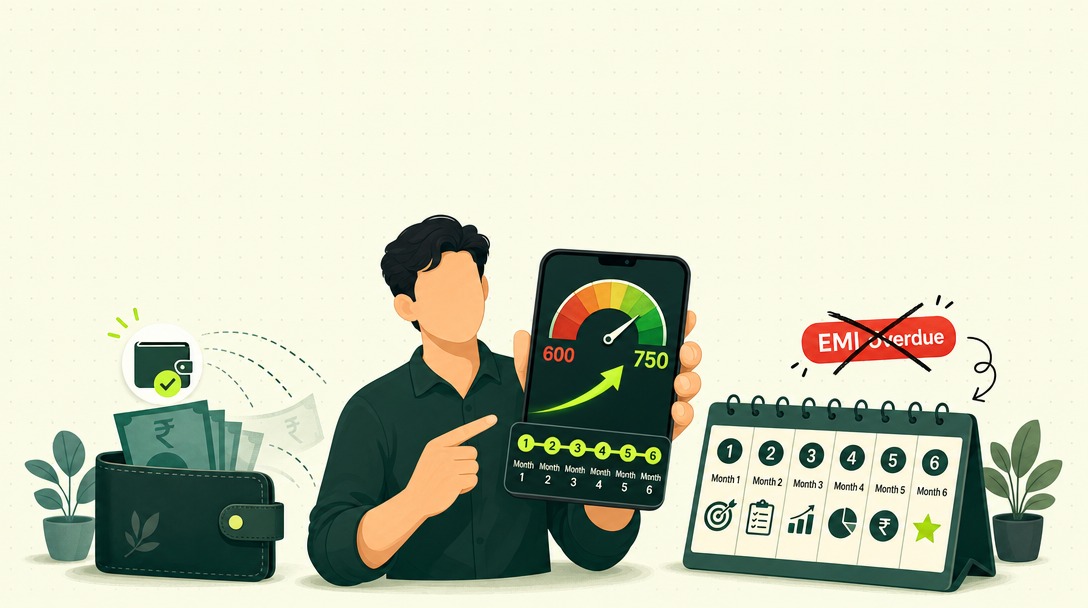
A CIBIL score of 600 sits in a frustrating zone. Not bad enough to be hopeless, not good enough to qualify for the loans and credit cards you actually want. If you’re looking to increase your CIBIL score from 600 to 750, this 6-month action plan shows exactly what steps to take and what results you can realistically expect.
The internet is full of advice on “how to improve CIBIL” — but most of it is vague (“pay your bills on time”), unrealistic (“clear all debt”), or just wrong (“close your old credit cards”).
This guide gives you a month-by-month playbook to move from CIBIL 600 to 750 in 6 months. The actions are specific. The expectations are realistic. We have walked dozens of TapTap Loans clients through this exact sequence, and the average movement is +120 to +160 points if every step is followed.
What Goes Into Your CIBIL Score
Before we touch the playbook, you need to know what you are optimising. CIBIL weighs five factors:
| Factor | Weight | What It Tracks |
|---|---|---|
| Payment History | 35% | Whether you pay EMIs and credit card bills on time |
| Credit Utilisation | 30% | Ratio of credit used to credit available (especially on cards) |
| Credit Age | 15% | How long your oldest credit account has been open |
| Credit Mix | 10% | Variety of credit types (cards, loans, secured, unsecured) |
| New Credit / Inquiries | 10% | How many recent loan/card applications you have made |
Payment history and credit utilisation together are 65% of your score. Most CIBIL improvement comes from optimising these two.
The 6-Month CIBIL Playbook
Month 1: Audit and Dispute
Pull your CIBIL report from cibil.com (free annual download) and Experian (free monthly). Review every line. Look for:
- Loans you never took (identity errors).
- Credit cards are still showing as active despite the closure.
- Wrong overdue amounts.
- Settled accounts that should be marked Closed.
- Hard inquiries you do not recognise.
File disputes for errors via the CIBIL Online Dispute Resolution portal. Each dispute is resolved within 30 days. Errors are surprisingly common — around 1 in 5 reports have at least one. A successful dispute can lift your score by 20–60 points in a single month.
Expected movement:
+10 to +40 points if you find any errors. 0 if your report is clean.
Month 2: Crush Credit Utilisation
This is the fastest lever in your entire score. Credit utilisation is the percentage of your card limit you are using when CIBIL pulls its monthly snapshot.
If your total card limit is ₹1,00,000 and you usually carry ₹70,000 outstanding, your utilisation is 70%. This silently costs you 40–80 CIBIL points.
The 30% rule:
Keep utilisation under 30% of the total card limit, and ideally under 10% on each individual card.
How to do it:
- Pay your card bill BEFORE the statement date, not the due date. The bill amount on the statement date is what CIBIL sees.
- Ask your bank for a credit limit increase. A limit increase from ₹1L to ₹2L immediately halves your utilisation ratio without you spending less.
- Spread spends across multiple cards instead of maxing one.
- Pay down the highest-utilisation card first.
Expected movement:
+30 to +70 points within 30–45 days of the new utilisation showing on your CIBIL report.
Month 3: Set Up Auto-Pay for Everything
Payment history is 35% of your score. Even one missed EMI can drop your score by 50–120 points. The fix is mechanical — remove human memory from the equation:
- Set NACH mandate or standing instruction for every loan EMI to auto-debit on the date.
- Set auto-pay for every credit card’s minimum due (never let it miss).
- Schedule full credit card payment 2 days before the due date manually.
- Keep your salary account funded enough that auto-debits never bounce.
This month is about defence, not offence. The action keeps your score from going backwards while the other months push it forward.
Expected movement:
0 to +10 points (prevents future damage).
Month 4: Build Credit Mix
CIBIL likes to see variety. If your only credit is one credit card, adding a different credit type can lift the score 15–30 points.
If you have only credit cards:
- Take a small consumer durable loan or a small personal loan and repay on time.
- Or take a secured loan against Fan D (very safe, builds score).
If you have only loans:
- Get one credit card and use it for small purchases, paid in full each month.
If you have neither:
- Get a secured credit card backed by an FD. This is the fastest, safest CIBIL builder for first-timers and those rebuilding.
Expected movement:
+15 to +30 points over 60–90 days.
Month 5: Stop New Applications and Manage Old Accounts
Every new credit application triggers a hard inquiry, which drops your score 5–10 points. Multiple inquiries in a short window signal “credit hungry” behaviour and compound the damage.
Action:
- No new credit applications for the rest of the 6-month plan.
- Do NOT close old credit cards. Older accounts increase your average credit age, which helps your score. Keep them open with a small monthly transaction (₹100 minimum) so the bank does not close them for inactivity.
- If you have unused old cards, set a small recurring subscription (Netflix, Spotify) on autopay and clear the card monthly.
Expected movement:
+5 to +15 points (mostly recovery from earlier inquiries fading).
Month 6: Verify and Lock In
Pull your CIBIL report again. By now, you should be in the 720–760 range if you have followed each step. Some borrowers reach higher. A few reach lower if there were complications (an old default still on file).
Final actions:
- Confirm all earlier disputes have been resolved correctly.
- Re-pull your report from all 4 bureaus (CIBIL, Experian, Equifax, CRIF) — lenders may pull from any.
- Make a list of which loans/cards you can now qualify for and apply strategically (1–2 at a time).
Credit Utilisation: The 30% Rule, Explained.
This rule trips up most borrowers, so it deserves its own section.
CIBIL pulls a snapshot of your credit usage on a specific date each month — usually the day your card statement is generated. Whatever balance you owe on that exact day is what shows in your report.
Example:
Your card limit: ₹1L. Your statement date: 15th of the month. Your due date: 5th of the following month. If you spend ₹70K and pay in full on the 4th, you still showed 70% utilisation on the 15th — the snapshot date.
The fix:
Pay before the statement date, not the due date. On the 14th, bring your card balance to under ₹30K. Your snapshot on the 15th shows 30% utilisation. CIBIL sees a healthy borrower.
This single change has lifted scores by 50–80 points for borrowers we have worked with.
Why Closing Old Credit Cards Hurts You
A common mistake: “I don’t use this card anymore, let me close it.” Closing a 7-year-old card does two things to your CIBIL:
- Reduces your average credit age (15% weight).
- Reduces your total available credit, which increases your utilisation ratio on remaining cards (30% weight).
If you have a 7-year-old card with a ₹1L limit you are not using, keep it open. Use it for one small auto-debit (₹99 Spotify subscription) and let it sit. Your CIBIL thanks you silently.
How to Dispute CIBIL Errors
Step-by-step:
- Go to cibil.com → “Dispute Resolution.”
- Select the disputed entry from your report.
- Choose the dispute reason (incorrect amount, not my account, account closed, etc.).
- Upload supporting documents (bank closure letter, NOC, statement).
- CIBIL forwards the dispute to the reporting member (bank/NBFC), who has 30 days to investigate.
- If the dispute is upheld, CIBIL updates your report and triggers a score recalculation.
Most disputes are resolved in 30–45 days. If the bank does not respond, CIBIL is required to update the entry to your stated position by default.
What NOT to Do (CIBIL Myths)
- Myth: “Checking my own CIBIL drops my score.” Wrong. Self-checks are soft pulls and have zero impact.
- Myth: “Closing credit cards improves CIBIL.” Wrong. It usually hurts (see above).
- Myth: “Having zero debt is best for CIBIL.” Wrong. CIBIL needs to see active credit being managed responsibly.
- Myth: “Settling a loan is fine if I have the cash to pay it off.” Wrong. If you can pay in full, do so — a closed status is far better than settled.
- Myth: “CIBIL improves overnight with paid services.” Wrong. No service can speed up CIBIL beyond what the underlying behaviour earns.
Realistic Expectations: 600 to 750 Timeline
With disciplined execution of this 6-month plan, here is what we typically see:
| Month | Cumulative Movement | Typical Score |
|---|---|---|
| Start | 0 | 600 |
| Month 1 (after disputes) | +10 to +40 | 610–640 |
| Month 2 (utilisation fixe) | +30 to +70 more | 640–710 |
| Month 3 (auto-pay setup) | 0 to +10 | 640–720 |
| Month 4 (credit mix) | +15 to +30 more | 660–740 |
| Month 5 (no new apps) | +5 to +15 more | 670–750 |
| Month 6 (verify) | 0 to +10 | 680–760 |
Some borrowers move faster, especially if they start with errors on file. Some move more slowly, especially if there is an old default still active. The 750 target is realistic for the vast majority of disciplined followers.
Frequently Asked Questions
Yes, by 30–80 points if you reduce credit utilisation or successfully dispute an error. Bigger movements take 90–180 days.
Reducing credit card utilisation below 30%. This is the fastest, biggest single move available to most borrowers.
Counterintuitively, not always. Having SOME active, well-managed credit is better than zero credit. Pay off bad-rate loans, keep your cards open and manage them.
Typically, 50–120 points for a single missed EMI of 30+ days. Multiple missed EMIs in a year can drop your score by 150–200 points.
Yes, easily. 750 puts you in the prime band where most banks approve at their best rates.
Bottom Line
Improving your CIBIL is not magic. It is mechanical — the right inputs over the right months produce the right score. Most of the heavy lifting happens in Months 1 and 2 (disputes + utilisation). The remaining months protect and consolidate the gain.
Once your CIBIL crosses 720, the loan options open up dramatically. See our 2026 guide to personal loan rates in India to understand what rates you can now qualify for.