





A bank rejected your personal loan. An NBFC approved you in 20 minutes — at 18%. A friend told you NBFCs are dangerous. Another friend said banks are slow and rigid. Both are partly right, and both miss the bigger picture.
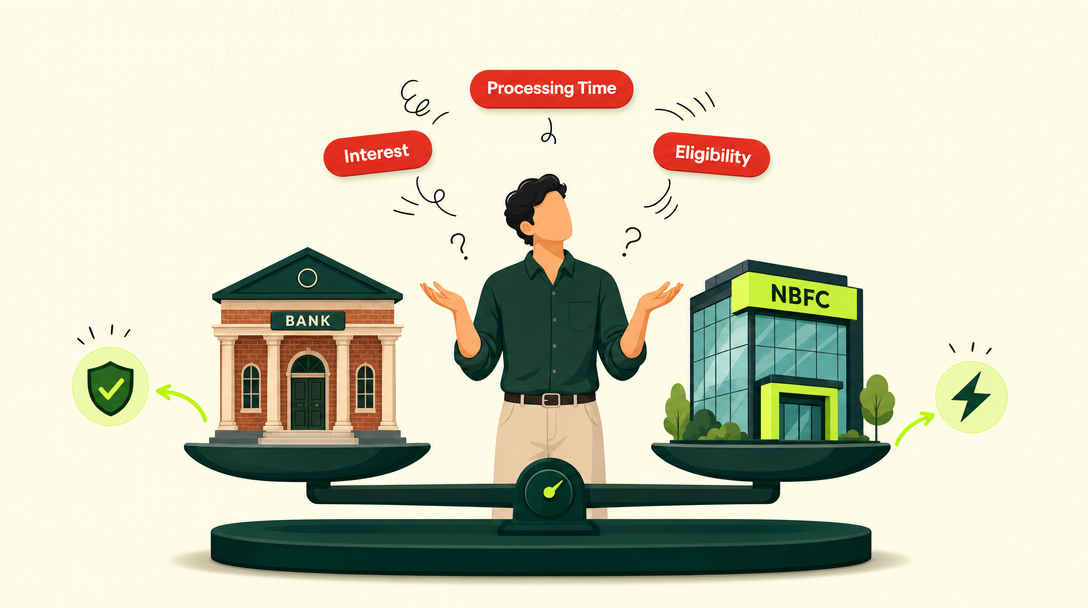
In 2026 India, the line between bank and NBFC for retail lending has blurred. NBFCs are now regulated by RBI under stricter rules than ever, and several have become as trusted as banks. Banks have responded with faster digital processes. The choice between them is no longer about safety — it is about fit. This guide compares banks and NBFCs across every parameter that matters and gives you a decision matrix to choose the right channel for your specific profile.
Bank vs NBFC: The Legal and Practical Difference
Bank:
- Licensed under the Banking Regulation Act, 1949.
- Can accept demand deposits (savings, current).
- Issues debit/credit cards, runs payment systems.
- CASA (current and savings) deposits fund their lending.
- Higher regulatory oversight: capital adequacy, statutory liquidity, daily reporting.
NBFC (Non-Banking Financial Company):
- Registered with RBI under Section 45-IA of the RBI Act.
- Cannot accept demand deposits (so no savings accounts).
- Funded by market borrowings, debentures, and term deposits.
- Lending-focused; some specialise in personal loans, others in commercial.
- Lighter regulatory framework than banks, but tightening rapidly post-2021.
In practical terms: a bank is a full-service financial institution; an NBFC is a specialised lender. For personal loans, both deliver the same product. The differences show up in rate, speed, and eligibility.
Real 2026 Interest Rate Comparison
| Lender Type | Best Rate (Prime Borrower) | Worst Rate (Sub-prime) | Typical Range |
|---|---|---|---|
| Public sector banks (SBI, BOB, PNB) | 10.5% | 13.5% | Tight band |
| Private banks (HDFC, ICICI, Axis) | 10.75% | 16% | Wider |
| Top NBFCs (Bajaj Finance, Poonawalla, Tata Capital) | 11% | 20% | Wide |
| App-based NBFCs (KreditBee, MoneyView, Fibe) | 16% | 29% | Highest band |
Notice: top NBFCs are competitive with banks at the prime end. The gap shows up at the sub-prime end — NBFCs price aggressively for borrowers, while banks reject.
Approval Speed: Where NBFCs Genuinely Win
| Process Stage | Bank Average | NBFC Average |
|---|---|---|
| Application to in-principle approval | 1–3 days | 10 minutes |
| Document verification | 2–4 days | Same day |
| Final approval | 3–7 days | Same day |
| Disbursal | 5–10 days | Same day to 2 days |
If you need money in 48 hours, NBFCs are usually your only realistic option. Banks are catching up with digital-only processes (Kotak 811, ICICI iPaL, HDFC Insta-Loan), but for borrowers without a pre-approved offer, NBFC is faster.
Eligibility Flexibility: Where NBFCs Win
Banks have rigid eligibility criteria. NBFCs have judgmental underwriting. This matters when:
- Your CIBIL is 650–699: Banks usually reject. NBFCs consider.
- You’re self-employed or a freelancer: Banks want 3 years of ITR. NBFCs accept 1–2 years or even UPI-based income data.
- Your employer isn’t on the bank’s approved list: NBFCs are usually employer-agnostic.
- You’ve had a past default that’s now resolved: Banks see the historic flag and reject. NBFCs review case-by-case.
- You’re 55+: Banks tighten; NBFCs flexible on age caps.
This flexibility is priced in. NBFCs charge 2–6% higher rates to compensate for higher-risk borrowers.
Hidden Costs in NBFC Loans
NBFCs are not bad lenders, but they monetise differently than banks. Watch for:
- Higher processing fees: Often 2–3.5% vs 1–2% at banks.
- Loan insurance bundling: More aggressive at NBFCs; often opt-in by default.
- Bounce charges higher: NBFCs charge ₹750–1,500 per bounce vs ₹500–800 at banks.
- Foreclosure penalties: Most NBFC personal loans (being fixed-rate) carry a 2–5% foreclosure charge.
- Variable rate language: Some NBFCs reserve the right to increase your rate if market rates rise. Banks rarely do this for personal loans.
Always read the sanction letter. Compare effective annualised cost, not just the headline rate.
How to Verify If an NBFC is RBI-Registered
In 2026, the regulatory landscape has tightened. Only borrow from RBI-registered NBFCs. Verification steps:
- Step 1: Go to rbi.org.in → Database of NBFCs.
- Step 2: Search by NBFC name.
- Step 3: Confirm the certificate of registration is active (not cancelled).
- Step 4: Check the type of NBFC (NBFC-MFI, NBFC-ICC, NBFC-IFC, etc.).
- Step 5: For loan apps, verify the parent NBFC is listed on the Play Store description and that it matches the RBI database.
If an app doesn’t disclose its parent NBFC clearly, do not borrow.
Top 10 RBI-Approved NBFCs for Personal Loans
| Rank | NBFC | Best For |
|---|---|---|
| 1 | Bajaj Finance | Salaried; large ticket sizes |
| 2 | Tata Capital | Salaried + self-employed; competitive rates |
| 3 | Poonawalla Fincorp | Salaried; sub-700 CIBIL |
| 4 | Aditya Birla Capital | Mid-income borrowers |
| 5 | L&T Finance | Salaried; stable employment |
| 6 | IIFL Finance | Small-ticket; faster process |
| 7 | Muthoot Finance | Gold loan + personal loan; trusted brand |
| 8 | Mahindra Finance | Semi-urban + rural; vehicle + personal |
| 9 | Cholamandalam Finance | Self-employed; SME owners |
| 10 | Hero FinCorp | Two-wheeler + personal loan combo |
Decision Matrix: When to Choose Which
| Borrower Profile | Choose |
|---|---|
| Salaried, CIBIL 750+, time not urgent | Bank (lowest rate) |
| Salaried, CIBIL 680–740, need money in 2 days | NBFC or digital bank |
| Self-employed, 2+ years ITR | Top NBFC (Bajaj, Tata Capital) > selective banks (HDFC, ICICI) |
| Self-employed, less than 2 years ITR | NBFC only |
| CIBIL 600–680 | NBFC (Poonawalla, Tata Capital, Aditya Birla) |
| CIBIL below 600 | App-based NBFC for small ticket, or focus on improving CIBIL first |
| Need ₹25L+ loan | Bank (better rates at this ticket size) |
| Need ₹1L or less, immediate | App-based NBFC (KreditBee, MoneyView, Fibe) |
| Existing customer of the bank with a pre-approved offer | That bank (lowest friction + rate) |
Frequently Asked Questions
Yes, if the NBFC is RBI-registered. The top 10 NBFCs are as safe as banks for borrowing. Avoid unverified apps and entities not on the RBI database.
Yes, all RBI-registered NBFCs are required to report to credit bureaus. Timely NBFC repayment helps your CIBIL the same way bank loan repayment does.
NBFCs borrow funds from the market at a higher cost than banks (which have low-cost deposits). They also take on borrowers banks reject, which adds a risk premium.
Yes. If your CIBIL improves over the loan tenure, you can balance transfer from NBFC to a bank at a lower rate.
Sometimes. Most NBFCs charge 2–4% foreclosure on fixed-rate personal loans. Some banks waive foreclosure on personal loans entirely after 12 EMIs.
Bottom Line
In 2026, the right question is not “bank or NBFC” but “which specific lender fits my profile, my speed need, and my rate sensitivity.” Top NBFCs are as legitimate as banks. App-based lenders fill a different niche — small-ticket, fast — at the cost of higher rates.
TapTap Loans compares both banks and RBI-registered NBFCs in one place. You don’t need to pick the channel — just pick the best rate for your profile.