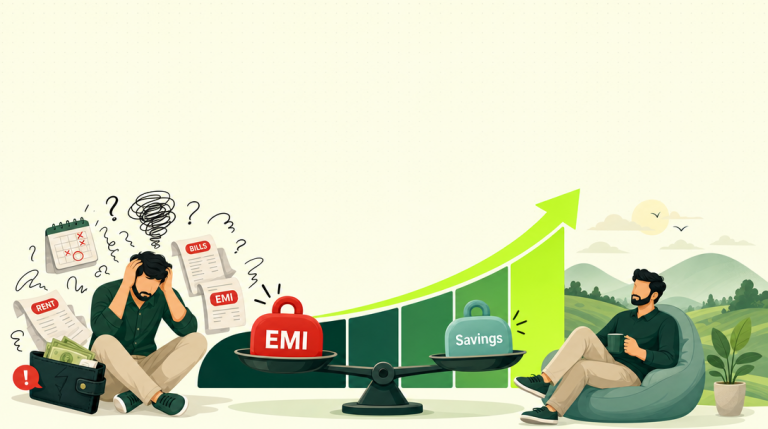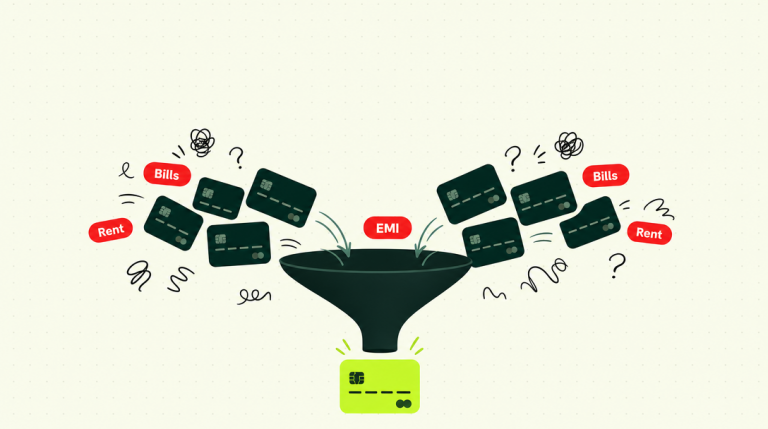







Debt consolidation India solutions are becoming increasingly popular in 2026 as borrowers look for ways to reduce multiple EMIs and lower interest costs. By replacing expensive credit card debt and high-interest loans with a single lower-rate EMI, debt consolidation can improve cash flow and simplify repayment management.
This guide explains exactly when consolidation makes financial sense, which lenders offer competitive consolidation products in 2026, how to calculate your actual savings, and the mistakes that cause consolidation to backfire.
What Debt Consolidation Actually Does
Debt consolidation is the process of taking one new personal loan and using the proceeds to pay off multiple existing debts — credit card balances, other personal loans, consumer EMIs, or any combination of these. The result is a single monthly EMI replacing multiple obligations.
The financial logic is straightforward: if your existing debts carry a weighted average interest rate of 25% and you can secure a consolidation loan at 13%, you save 12% per annum on the outstanding principal. On Rs. 5 lakh of debt, that is Rs. 60,000 per year in interest savings — or Rs. 2.5–3 lakh over a 5-year tenure.
What consolidation does not do: it does not reduce your principal. It does not eliminate your debt. It restructures the cost and timeline of repayment. If the underlying behaviour that created multiple debts does not change, consolidation provides temporary relief without long-term resolution.
When Consolidation Makes Financial Sense
The arithmetic of consolidation works in your favour only under specific conditions:
- Your weighted average interest rate on existing debts exceeds the consolidation loan rate by at least 5–7 percentage points. Below this threshold, processing fees and the time cost of applying may eliminate the savings.
- Your CIBIL score is above 700. Below this threshold, you will not access the low rates that make consolidation economical.
- Your total debt does not exceed 40–50% of your annual gross income. Above this level, repayment capacity becomes the binding constraint regardless of rate.
- You will not need additional credit (home loan, car loan) for the next 12–18 months. Consolidation uses up some of your debt capacity and may affect future loan eligibility.
- You are committed to not re-accumulating the credit card debt you are paying off with the consolidation proceeds.
How to Calculate Your Weighted Average Interest Rate
Before approaching any lender, calculate your current blended cost of debt:
- List each outstanding balance with its current interest rate
- Multiply each balance by its rate: Rs. 2,00,000 at 36% = 72,000; Rs. 3,00,000 at 18% = 54,000; Rs. 1,00,000 at 22% = 22,000
- Sum the products: 72,000 + 54,000 + 22,000 = 1,48,000
- Divide by the total outstanding principal: 1,48,000 / 6,00,000 = 24.7%
If you can secure a consolidation loan at 13%, you save 11.7% annually on Rs. 6 lakh — approximately Rs. 70,200 per year in interest before accounting for tenure effects. This calculation should always precede any lender conversation.
Best Lenders for Debt Consolidation in India 2026
Most banks and NBFCs offer personal loans that can be used for debt consolidation, though not all market them explicitly under this label. The most competitive options in 2026:
- IDFC FIRST Bank: Rates from 9.99% p.a. with no foreclosure penalty — critical for borrowers who plan to prepay once their financial situation improves. Approval process is strong for salaried borrowers with 750+ CIBIL.
- Poonawalla Fincorp: Competitive for both salaried and self-employed borrowers. Particularly useful for applicants with CIBIL in the 680–720 range who want to consolidate away from NBFC debt.
- Bajaj Finserv Flexi Loan: Allows borrowers to withdraw against an approved limit and pay interest only on the amount used. Useful for borrowers who want flexibility in drawdown timing.
- SBI Xpress Credit: Best rate option for government employees with existing SBI accounts. Requires an SBI salary account and is limited to government sector borrowers.
- HDFC Bank: Strong approval process for corporate sector employees. Personal loan rates from 10.50% p.a. for premium salary account holders.
A Real Savings Calculation
Consider a borrower with the following debt:
- Credit card balance: Rs. 2,00,000 at 36% p.a.
- Personal loan (NBFC): Rs. 3,50,000 at 22% p.a., 30 months remaining
- Consumer durable: Rs. 50,000 at 24% p.a., 6 months remaining
Total outstanding: Rs. 6,00,000. Weighted average rate: approximately 26% p.a. Combined monthly EMI: approximately Rs. 23,500.
Post-consolidation at 13% p.a. for 60 months: New EMI = approximately Rs. 13,600 per month. Monthly cash flow improvement: Rs. 9,900. Total interest cost under consolidation over 60 months: approximately Rs. 2,16,000. Estimated total interest under existing debts over comparable periods: approximately Rs. 4,80,000. Net saving: approximately Rs. 2,64,000.
This calculation assumes no prepayment and no additional debt. The actual savings will vary based on foreclosure charges on existing NBFC loans, which should always be calculated before proceeding.
When Consolidation Can Make Things Worse
- Extending tenure too aggressively: A 96-month consolidation loan may reduce your EMI dramatically but increase total interest paid over the full period. Run the numbers for both the shorter tenure (higher EMI, lower total cost) and the longer tenure (lower EMI, higher total cost).
- Not closing existing credit accounts: The most common post-consolidation mistake. Paying off a credit card and keeping it open — then spending on it again — doubles your debt within 6–12 months.
- Ignoring foreclosure charges on existing loans: NBFC personal loans often carry foreclosure penalties of 2–4% of outstanding principal. On a Rs. 3 lakh balance, that is Rs. 6,000–12,000 in exit costs that must be factored into your savings calculation.
- Using consolidation to buy time without addressing cash flow: If your monthly income genuinely cannot support your obligations, consolidation stretches the problem rather than solving it. Income augmentation or debt settlement may be more appropriate in severe cases.
The Process: From Application to Closing Existing Accounts
The consolidation process through TapTap Loans follows this sequence:
- Profile submission: Share your outstanding balances, interest rates, and income details. TapTap runs a soft enquiry to assess your credit profile.
- Lender matching: TapTap identifies the lender within its 20+ bank and NBFC network most likely to offer the lowest consolidation rate for your specific profile.
- Application and approval: A single targeted application is submitted. Approval typically takes 2–6 hours for salaried applicants with complete documentation.
- Disbursal and account closure: Consolidation funds are transferred to your bank account. You use these funds to close existing accounts — ideally with written confirmation of closure from each lender.
- New EMI begins: A single monthly payment replaces all previous obligations from the following month.
Key Takeaways
- Debt consolidation saves money only when the new rate is meaningfully lower than your existing weighted average rate — calculate this before applying.
- CIBIL score above 700 is necessary to access rates competitive enough for consolidation to be worthwhile.
- Always factor foreclosure charges on existing loans into your savings calculation.
- Closing consolidated credit card accounts is as important as the consolidation itself.
- TapTap’s EMI reduction advisory matches your profile to the right consolidation lender without triggering multiple hard enquiries.
Frequently Asked Questions
Short term: a single hard enquiry for the new loan may reduce your score by 5–10 points. Medium term: maintaining one account in good standing and closing multiple high-utilisation accounts typically improves scores within 6–9 months.
Yes. A consolidation personal loan can be used to pay off any combination of existing credit card balances, personal loans, consumer EMIs, or other unsecured obligations.
Most banks require 700 or above. Several NBFCs accept 680. Below 680, the rates offered may not be low enough for consolidation to produce meaningful savings.
Yes. Consolidation combines multiple debts into a single loan, often reducing the total monthly EMI burden.
Debt consolidation can be a smart option if the new loan offers a significantly lower interest rate than your current debts and helps simplify repayments.
Conclusion
Debt consolidation is one of the more underused tools in Indian personal finance — in part because borrowers struggle to identify lenders whose consolidation rates are actually competitive for their profile. A 36% credit card balance is genuinely expensive, and the Rs. 2–3 lakh in savings available to many consolidation candidates is real money that is currently being left on the table.
The calculation is worth doing. If the numbers work, the process is faster and simpler than most borrowers expect. TapTap Loans’ advisory service is specifically built to identify which lender will offer the lowest consolidation rate for your specific debt structure and credit profile — so the first application you make is the right one.