





Loan against mutual funds was once a private banking product, available only to ultra-high-net-worth customers with relationship managers. In the last three years, app-based lenders like Volt, Mirae’s MF Bachat, and Bajaj Finserv have made it accessible to anyone with a mutual fund portfolio worth ₹50,000+. Rates are 9–11% substantially below personal loans and approval is nearly instant.
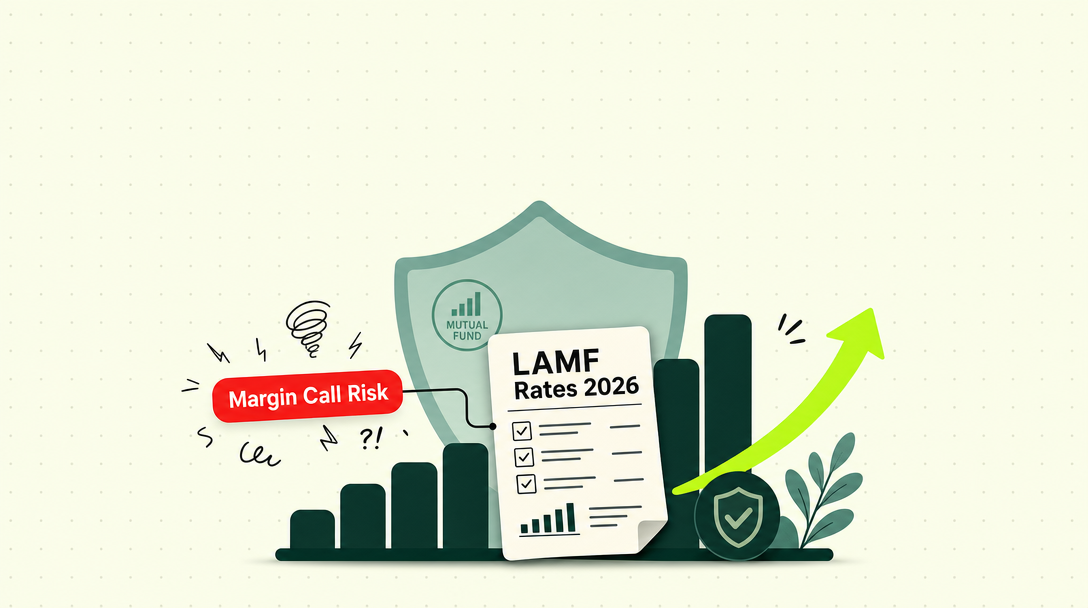
But there is a risk competitors quietly avoid mentioning: the margin call. If your mutual fund portfolio’s value drops in a market correction, the lender can demand additional collateral or sell your units to maintain the loan-to-value ratio. This blog explains exactly how LAMF works in 2026, which platforms are worth using, when LAMF beats a personal loan, and the margin call mechanics you need to understand before signing up.
What is LAMF and How It Became Mainstream
Loan against mutual funds (LAMF) is a secured loan where your mutual fund holdings are pledged to a lender. The mutual fund units stay in your demat account, continue to earn returns and dividends, but you cannot redeem them until the loan is repaid.
The mechanism became consumer-friendly when SEBI and AMFI standardised the digital pledge process in 2022–23. Now:
- You can pledge units online through the CAMS or KFin platform.
- Disbursal happens in 30 minutes to 2 hours.
- No physical documentation.
- Lenders include banks (HDFC, SBI, ICICI), NBFCs (Bajaj Finance, Mirae Asset), and fintech (Volt Money).
Equity vs Debt MF: How Much You Can Borrow
The loan-to-value (LTV) ratio depends on the mutual fund type:
| Mutual Fund Type | Typical LTV | Reason |
|---|---|---|
| Liquid / Debt funds | 75–85% | Low volatility, predictable value |
| Hybrid / Balanced funds | 60–70% | Moderate volatility |
| Large-cap equity funds | 50–60% | Higher volatility |
| Mid-cap / Small-cap equity | 40–50% | High volatility, market risk |
| ELSS (tax-saver) | 50%, with lock-in restrictions | 3-year lock-in concern |
| Sectoral/thematic | 30–40% | Concentrated risk |
Translation: if you have ₹5L in a large-cap equity fund, you can borrow approximately ₹2.5–3L. If the same amount is in a liquid debt fund, you can borrow ₹3.75–4.25L.
Best LAMF Providers in 2026
| Provider | Interest Rate | Min Portfolio | Max Loan | Processing |
|---|---|---|---|---|
| Volt Money | 10.5–11.5% | ₹50K | ₹1Cr | Fastest; app-based |
| Mirae Asset MF Bachat | 10.25–11.5% | ₹25K | ₹5Cr | Mirae fund holders preferred |
| Bajaj Finance LAMF | 10.5–11.75% | ₹1L | ₹10Cr | Standard NBFC process |
| HDFC Bank LAMF | 9.5–10.5% | ₹5L | ₹20Cr | Branch + online |
| ICICI Bank LAMF | 9.75–11% | ₹5L | ₹20Cr | Branch + online |
| SBI LAMF | 9–10.5% | ₹5L | ₹5Cr | Branch-driven |
Banks offer the lowest rates but require larger minimum portfolios. App-based lenders like Volt democratised the product for smaller portfolios.
LAMF vs Personal Loan: Cost Comparison
For a ₹3L loan over 24 months, with a ₹6L mutual fund portfolio:
| Parameter | LAMF | Personal Loan |
|---|---|---|
| Interest rate | 10.5% | 13% |
| EMI | ₹13,896 | ₹14,277 |
| Total interest paid | ₹33,504 | ₹42,648 |
| Processing fee | 0–1% | 2–3% |
| MF portfolio still earns a return | Yes | Not applicable |
| Total savings over 24 months | ₹10,000–15,000+ | — |
The Margin Call Risk Explained
This is the part LAMF marketing doesn’t emphasise. When the market falls, and your pledged equity MF portfolio drops in value, the lender’s LTV is violated.
Example:
- You pledge ₹6L of a mid-cap equity fund. LTV = 50%. Loan = ₹3L.
- Market falls 25%. Your portfolio is now worth ₹4.5L.
- New LTV: ₹3L loan / ₹4.5L portfolio = 66.7% above the 50% limit.
- Lender issues a margin call: pledge additional collateral, repay part of the loan, or the lender will sell units to restore LTV.
Margin calls can happen on a 24-hour or 72-hour notice. If you cannot meet the call, the lender sells your mutual fund units at the depressed market price locking in your losses.
How to manage margin call risk:
- Borrow less than the maximum LTV. If max is 50%, take 30–35% LTV. Leaves a cushion for market drops.
- Prefer debt funds or hybrid funds for pledging; lower volatility means smaller margin call risk.
- Maintain backup liquidity (separate FD or savings) to meet a sudden margin call.
- Track the market regularly during volatile periods.
Step-by-Step LAMF Process
- 1. Sign up on the lender’s platform (Volt, Mirae, bank app).
- 2. Link your CAMS / KFin / NSDL / CDSL holdings.
- 3. Select the mutual fund units you want to pledge.
- 4. The lender calculates the eligible loan amount based on LTV and fund type.
- 5. Sign the digital pledge through Aadhaar OTP.
- 6. Loan disbursal: 30 minutes to 2 hours.
- 7. Mutual fund units are lien-marked but stay in your account, earning returns.
- 8. EMI auto-debit from registered bank account.
- 9. On loan closure, the pledge is automatically released.
When LAMF is the Wrong Choice
LAMF doesn’t suit every situation:
- Your MF portfolio is concentrated in volatile small-caps: Margin call risk is high.
- Your loan need is small (under ₹1L): Personal loan or credit card EMI may be more convenient.
- You are likely to redeem the MF in the next 6 months for another purpose: The pledge will be in the way.
- Your equity MF has unbooked long-term gains: Forced sale during a margin call can trigger LTCG tax.
Tax Treatment
Interest paid on LAMF is generally NOT tax-deductible for individuals unless the loan proceeds are used for a clear business purpose. If you take LAMF for personal use (medical, marriage, travel), no tax benefit.
Capital gains on the underlying mutual fund: continue normally, taxed when you eventually redeem. The pledge doesn’t trigger a tax event by itself
Frequently Asked Questions
From a cost perspective, yes. From a market-risk perspective, LAMF carries margin call risk that personal loans don’t. Net: safer if you manage the LTV cushion.
Yes. Most platforms allow you to add additional units to maintain an LTV cushion or increase borrowing capacity.
App-based lenders accept portfolios as small as ₹25,000–50,000. Banks usually require ₹5L+.
Only the unpledged portion. Pledged units are frozen until loan closure.
You must repay in cash, not by selling units (unless you choose to sell). If you cannot repay, the lender sells units at the prevailing market price.
Conclusion
LAMF is one of the most efficient borrowing tools available in 2026 for investors with mutual fund portfolios. Done correctly, it costs 9–11% vs 13–18% for personal loans, while letting your investments continue to grow. The discipline required is to borrow well below the maximum LTV and to maintain backup liquidity for margin calls.
Not sure if LAMF or an unsecured personal loan suits you better? Compare both with TapTap Loans.