





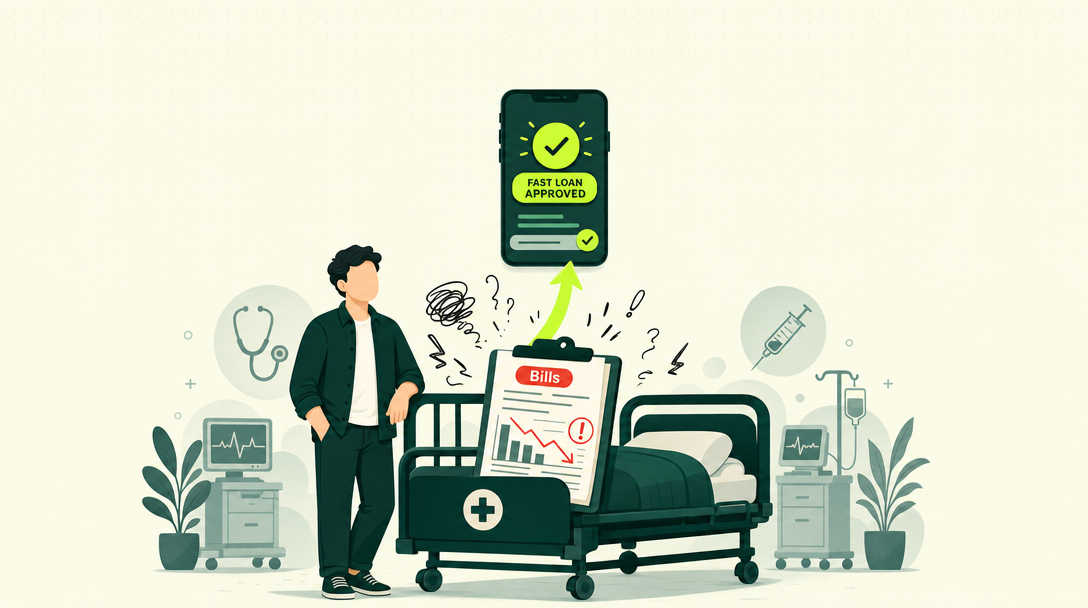
A personal loan for a medical emergency can help borrowers access urgent funds for hospital bills, surgeries and treatment costs without delaying care. In India, several banks and NBFCs now offer fast digital approvals, but choosing the right financing option during an emergency is critical in 2026.
This guide is designed to help you access funds as fast as is genuinely possible from a legitimate lender — while avoiding the rate and fee traps that are disproportionately deployed in emergency lending contexts.
How Fast Can You Actually Get a Personal Loan in a Medical Emergency?
For a salaried borrower with a CIBIL score above 700 and complete documentation, the fastest legitimate loan disbursals in India take:
- Best case: 4–6 hours from application to bank account credit (pre-approved customers of major banks)
- Typical case: 12–24 hours from a complete application submission
- Self-employed or thin-file applicants: 24–72 hours, depending on the lender and income verification approach
The 4–6 hour timeline requires one specific condition: you must already be a verified customer of the lending bank with a pre-approved offer outstanding. Many bank app users have this without realising it — check your bank’s app, net banking portal, or the registered mobile number for any pre-approved personal loan offer before approaching a new lender.
Documents Required for Fast Medical Loan Approval
The fastest way to slow down an emergency loan is to submit incomplete documents. Have these ready before initiating any application:
- Aadhaar card (for identity and address verification — enables instant Aadhaar OTP-based KYC)
- PAN card (linked to your Aadhaar for credit bureau pull)
- Last 3 months’ salary slips (or last 12 months’ bank statements for self-employed)
- Last 3 months’ bank statements showing salary credits
- Registered mobile number linked to Aadhaar (for OTP-based digital KYC)
Many lenders now complete the entire process digitally using Aadhaar OTP verification and account aggregator-based bank statement analysis — eliminating any need to upload or scan documents. If your Aadhaar is not linked to your mobile number, visit your nearest Aadhaar service centre before the emergency arises.
Which Lenders Disburse Fastest in India
Disbursal speed varies significantly by lender. Based on industry timelines for digital-first processing in 2026:
- HDFC Bank: Fastest for existing customers with pre-approved offers. Pre-approved amounts are disbursed in 3–6 hours. New customer applications: 24 hours.
- IDFC FIRST Bank: 4–8 hours for salaried applicants with complete documentation. Fully digital process with video KYC.
- Bajaj Finserv: Pre-approved Flexi loan customers can withdraw funds in under 4 hours. New applicants: 24–48 hours.
- KreditBee (NBFC): Disburses Rs. 50,000 to Rs. 4 lakh within 4–8 hours for eligible profiles. Useful for moderate amounts when bank approval is slower.
- TapTap Loans partner network: For amounts above Rs. 2 lakh, TapTap’s advisory model identifies the fastest-approving lender for your specific profile — ensuring you are not waiting 48 hours with a lender who requires extended verification when a 12-hour approval is available elsewhere.
Alternatives to Personal Loans for Medical Emergencies
In an acute emergency, a personal loan should be considered alongside other options — some of which are faster or cheaper:
Health Insurance Cashless Treatment
If you have health insurance with a cashless facility and the hospital is in the insurer’s network, you may not need a loan at all. Contact your insurer’s emergency helpline immediately after admission — most process cashless authorisations within 30–60 minutes for planned procedures and 1–2 hours for emergencies.
Medical Loan from the Hospital
Many large private hospitals (Apollo, Fortis, Manipal, Max) offer instalment payment plans through embedded NBFC partnerships. These are often interest-free for 3–6 months for qualifying procedures. Ask the hospital’s billing department about this before seeking an external loan.
Loan Against Fixed Deposit
If you have an FD, you can borrow up to 90% of its value at 1–2% above the FD interest rate. This is the cheapest credit available in a medical emergency and processes in 1–2 hours at most banks. No CIBIL check required.
Gold Loan
Gold loans are disbursed in 15–45 minutes at Muthoot, Manappuram, or any bank branch. No credit score requirement. If you have gold jewellery, this is often the fastest fund access option.
Hospital Payment Plans and Instalment Facilities
The hospital’s billing department is an underutilised resource in medical financial emergencies. Major private hospitals have financial counsellors whose specific role is to structure payment plans that allow treatment to proceed while the patient arranges funds. These plans typically include:
- Partial payment at admission, followed by balance on discharge
- EMI facilities through partnered NBFCs (often interest-free for 3 months)
- Credit card no-cost EMI arrangements for treatment costs above Rs. 25,000
Asking for this conversation is not a sign of financial weakness — it is standard practice at every major private hospital in India.
The Mistakes to Avoid in Emergency Borrowing
- Accepting the first loan offer without checking if you have a pre-approved offer elsewhere: A 30-second check of your bank app can save you 2–3% in annual interest.
- Using an unverified lending app: Emergency conditions are exactly when predatory lenders are most aggressive in their marketing. Verify any lending platform’s NBFC registration before proceeding.
- Borrowing more than you need: Emergency context creates a tendency to request a buffer amount ‘just in case.’ Borrowing exactly what you need costs less and keeps your FOIR healthier.
- Not clarifying end-use restrictions: Some lenders have exclusions on what personal loan funds can be used for. Medical expenses are universally accepted, but clarify if the loan documentation asks about end-use.
What If Your CIBIL Score Is Low?
A medical emergency does not pause for credit score improvement. If your CIBIL is below 680 and a personal loan is unavailable, the prioritised alternatives are:
- Gold loan: No CIBIL requirement, disbursal in under an hour.
- Loan against FD: No CIBIL requirement, processes the same day.
- NBFC personal loan with alternative underwriting: Poonawalla Fincorp and certain co-operative NBFCs consider bank statement income even below 680 CIBIL.
- Hospital’s own payment plan: Often the most practical solution before sourcing external credit.
Key Takeaways
- Check your existing bank app for a pre-approved personal loan offer before approaching any new lender — it is the fastest and often cheapest route.
- Loan against FD and gold loans disburse faster than any personal loan and require no CIBIL assessment.
- Most large private hospitals offer instalment payment plans or instalment NBFC tie-ups — ask before taking an external loan.
- Aadhaar must be linked to your mobile number for digital KYC to work. This is worth checking before any emergency arises.
- TapTap Loans can identify the fastest-approving lender for your profile within its network — reducing the risk of wasting time with a lender who takes 72 hours when 12 hours is available elsewhere.
Frequently Asked Questions
Yes. Banks and NBFCs offer fast personal loans for medical emergencies based on income, CIBIL score and repayment capacity.
Pre-approved personal loans, gold loans and loan-against-FD products are usually the fastest financing options.
Yes, if you have a pre-approved offer from your existing bank. HDFC, ICICI, and Bajaj Finserv all offer same-day disbursal for pre-approved customers. For new applicants, 24 hours is the realistic target with complete documentation.
A personal loan taken for medical treatment does not directly qualify for tax deduction under Section 80D (which covers health insurance premiums). However, if the medical expenses meet the criteria under Section 80DDB (treatment of specified diseases), the medical expenditure itself — not the interest — may be deductible. Consult a tax advisor for your specific situation.
Most banks offer personal loans up to Rs. 25–40 lakh for salaried borrowers. The actual amount is limited by your income, CIBIL score, and FOIR. For large-scale medical procedures requiring more than Rs. 20 lakh, hospital payment plans and health insurance are likely to be relevant alongside personal credit.
Conclusion
Medical emergencies require fast decisions — but fast does not have to mean expensive or unprotected. The framework in this guide reduces the time to identify the right funding source from hours to minutes: check pre-approved offers first, use secured alternatives if available, apply to the fastest lender matched to your profile, and avoid emergency-focused predatory marketing.
TapTap Loans supports borrowers in exactly this situation — providing rapid profile assessment and lender matching without the trial-and-error of applying to multiple banks in sequence.