





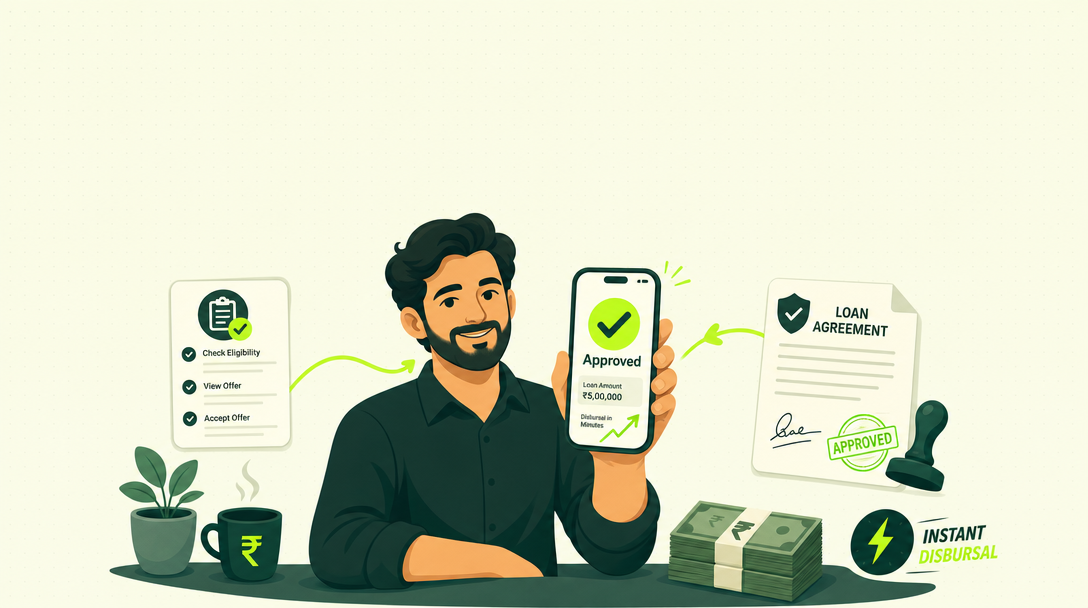
“Congratulations! You have a pre-approved personal loan of ₹5,40,000 at 12.5% interest. Click here to disburse in 30 seconds.”
You have seen this SMS. Maybe from HDFC, SBI YONO, ICICI iMobile, Bajaj Finance, or your salary account bank. The instinct is to either dismiss it as marketing noise or accept it because it sounds easy. Both reactions cost you money.
A pre-approved personal loan is real — but it is also a starting offer, not the final one. Banks send pre-approved offers to filter customers they have already underwritten internally based on salary history, banking behaviour, and existing CIBIL. This guide explains what “pre-approved” really means in 2026 India, where to check your eligibility across major lenders, how to negotiate the rate down, and the hidden fees that turn a 12.5% headline into a 16% effective cost.
What “Pre-Approved” Actually Means
A pre-approved personal loan is an offer extended by your bank or NBFC to a customer who has already cleared the lender’s internal credit screen. The bank has access to your salary credit history, account behaviour, existing loan repayment, and credit bureau score. Based on this, it estimates the maximum loan amount it is willing to give you, the interest rate, and the tenure.
It is not the same as “guaranteed approval.” A pre-approved offer can still be declined at the final stage if:
- Your CIBIL has dropped between the offer date and the application date.
- You have taken a new loan in the interim that raised your FOIR above the lender’s cap.
- Your salary credit was missed or reduced.
- Your KYC has changed (address, mobile), and the new details fail verification.
In practice, around 92–95% of pre-approved offers convert to actual disbursal if the borrower applies within the validity window (usually 30–60 days).
Pre-Approved vs Fresh Application: The Real Difference
| Parameter | Pre-Approved Loan | Fresh Application |
|---|---|---|
| Documents needed | Minimal (sometimes zero) | Full KYC + income + bank statements |
| Processing time | A few minutes to few hours | 1–7 working days |
| Interest rate | Pre-calculated; often 0.25–1% lower than card rate | Card rate; variable based on profile |
| Approval probability | 92–95% if applied within validity | 60–80% depending on profile |
| Negotiability | Often negotiable (most borrowers don’t know this) | Very limited |
| Hard inquiry impact | Soft pull initially; hard pull only at disbursal | Hard pull on every application |
The hidden advantage: a pre-approved offer is a soft credit pull. If you do not accept it, your CIBIL is untouched. A fresh application triggers a hard pull immediately, which costs 5–10 CIBIL points.
Where to Check Your Pre-Approved Offer
Every major Indian lender has a checking mechanism, but the path differs:
- HDFC Bank: Net banking → “Offers” tab; or HDFC Mobile Banking → “My Offers.”
- SBI: SBI YONO → “My Offers” or send PAPL <space> account number to 567676.
- ICICI: iMobile → “Personal Loan” → “Check Pre-approved Offer.”
- Axis Bank: Axis Mobile → “Loans” → “Instant Personal Loan.”
- Bajaj Finance: Bajaj Finserv app → “Pre-approved offers” dashboard.
- Kotak: Net banking → “Kotak 811” → “Check offers.”
If you have a salary account with a particular bank, that bank usually has the strongest pre-approved offer for you because they see your monthly income directly.
Hidden Fees in Pre-Approved Offers
The headline interest rate is rarely the full cost. Watch for:
- Processing fee: Usually 1–3% of the loan amount, deducted upfront. A ₹5L loan at 2% fee means you receive ₹4.9L but pay EMI on ₹5L.
- GST on processing fee: 18% on the processing fee, so ₹1% becomes effectively ₹1.18%.
- Insurance add-on: Lenders often bundle a credit life insurance, adding 1–3% to the loan amount. You usually can opt out, but they will not tell you that voluntarily.
- Stamp duty: State-dependent, usually negligible, but adds ₹100–500.
- Foreclosure/prepayment charges: Many pre-approved loans carry a 2–4% foreclosure penalty, even though RBI has banned this for floating-rate loans. Most pre-approved personal loans are fixed-rate, so the penalty is legal.
When you add it all up, a 12.5% headline rate can translate to 14.5–16% effective annual cost. This is why a fresh application from a competitor sometimes beats a pre-approved offer — because the competitor offers similar fees but a cleaner sticker rate.
5 Ways to Negotiate Your Pre-Approved Offer
Most borrowers do not know that pre-approved offers can be negotiated. Here is what actually works, in order of leverage:
1. Quote a competing offer
If another lender (Tata Capital, Bajaj Finance, IDFC First) has given you a better rate, share the offer letter with your primary bank. They have the authority to match up to a certain extent, especially for salary account customers. Banks lose ₹5–10L of lifetime value when you switch, so they will protect the relationship.
2. Ask for a processing fee waiver
The processing fee is the most negotiable component. Banks have monthly disbursal targets, and at month-end, relationship managers can waive 50–100% of processing fees. The headline rate stays the same, but your effective cost drops by 1–1.5%.
3. Decline the insurance bundle
Credit life insurance bundled with personal loans is rarely a good purchase. Decline it. If the lender claims it is mandatory, it is not —the RBI prohibits making credit linked to forced insurance sales.
4. Negotiate tenure flexibility
Banks earn more on longer tenures. Asking for a shorter tenure without a rate change reduces your total interest. Equally, asking for a 0–1% rate reduction in exchange for a longer tenure sometimes works for borrowers who need lower EMI.
5. Time your application
Banks have quarterly and annual disbursal targets. The last 10 days of March, June, September, and December are the most flexible. Bring up your pre-approved offer in this window for the best results.
When to Accept, When to Wait
Accept your pre-approved offer when:
- Your immediate need is urgent (medical, family emergency).
- The rate is at or below the average market rate for your CIBIL band.
- The processing fee is under 1.5% or has been waived.
- Tenure fits your repayment capacity (FOIR under 50%).
Wait or compare further when:
- Your need is 30+ days away.
- The rate seems higher than what a quick comparison shows for your profile.
- You haven’t checked your CIBIL recently — you may qualify for a cheaper loan from a different lender.
- You already have multiple EMIs, and consolidation might be a better answer than a new loan.
Frequently Asked Questions
Not always. About 92–95% of pre-approved offers convert to disbursal if applied within the validity window. The rest are declined due to fresh CIBIL drops, new loans taken, KYC mismatches, or salary changes.
Yes, especially if you have a competing offer or are a long-standing customer. The processing fee is the most negotiable component, often waivable entirely at month-end.
Checking the offer is a soft pull and does not affect CIBIL. Only the final disbursal application triggers a hard pull. If you decline the offer, your CIBIL stays unaffected.
Typically, 30–60 days from the offer date. Some lenders extend up to 90 days. Check the offer letter for the specific validity — it is usually mentioned in the fine print.
Yes. If you have salary accounts and credit cards with multiple banks, you may see pre-approved offers from each. Comparing them is the smart move.
Bottom Line
A pre-approved offer is the bank saying, “We trust you enough to lend without a full application.” Treat it as a starting point in a negotiation, not the final price.
Before accepting any pre-approved offer, compare it against current market rates from banks and NBFCs. Sometimes a fresh application from a competitor beats a pre-approved offer by 1–2 percentage points.