





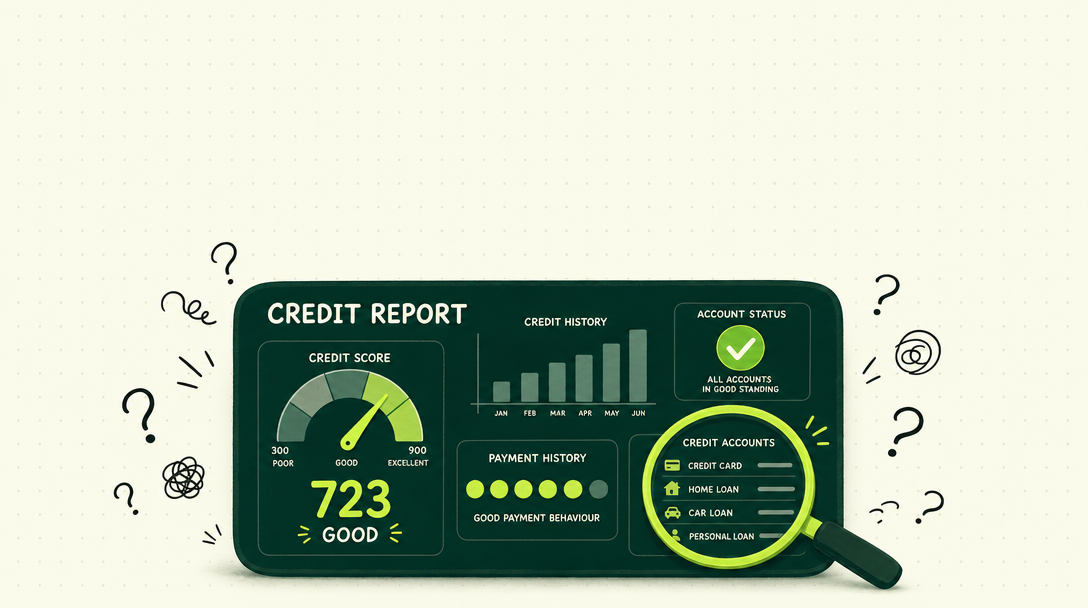
A credit report is the detailed document behind your credit score, showing every loan and card you’ve held, your payment history, and any inquiries made against your profile. This guide explains exactly what’s in it, section by section.
Credit Report vs Credit Score: The Difference
Your score is a single number, summarizing your creditworthiness. Your report is the full, detailed record that number gets calculated from. Think of the score as a headline, and the report as the full article behind it.
Section 1: Personal Information
Your name, date of birth, PAN, address, and contact details, as reported by lenders you’ve dealt with. Check this section for accuracy first, since errors here can sometimes indicate a mixed-up file with someone else’s data.
Section 2: Account Summary
A list of every credit account under your name, loans, credit cards, and similar facilities. Each entry shows the lender, account type, sanctioned amount, and current status: active, closed, or overdue.
Section 3: Payment History
A month-by-month record of whether you paid on time for every account listed. This is the section that most directly drives your score, since payment history carries the heaviest weight in most scoring models.
Section 4: Credit Utilization
For revolving credit, mainly cards, this shows your current balance against your approved limit for each account. Lenders and scoring models watch this closely, since high utilization is a significant negative factor.
Section 5: Enquiries
Every time a lender checks your credit, whether you applied for something or they did a promotional check, it can show up here. Hard inquiries, from actual applications, differ from soft inquiries, which don’t affect your score.
Section 6: Remarks
Any special notations, settlements, write-offs, disputes, or restructuring appear here. This section carries significant weight with any lender reviewing your file closely.
A Quick Reference Table
| Section | What It Shows | Why It Matters |
|---|---|---|
| Personal info | Your identity details | Confirms the report is genuinely yours |
| Account summary | Every credit account you hold | Full picture of your borrowing |
| Payment history | Monthly on-time or late record | Biggest factor in your score |
| Utilization | Balance vs limit on revolving credit | Second biggest factor |
| Enquiries | Who has checked your credit, and when | Signals recent credit-seeking activity |
| Remarks | Settlements, disputes, restructuring | Flags for closer lender review |
How Often Should You Check Your Report?
At least once or twice a year, and always before a major loan application. Checking your own report is a soft inquiry, with zero impact on your score, so there’s no downside to checking regularly.
What to Look for When Reviewing Your Report
Confirm every account listed actually belongs to you. Check that payment history reflects accurately; no on-time payment shown incorrectly as late. Review your utilization figures for accuracy. And check that any old, resolved issues are properly marked as closed or settled, not still showing as active or unresolved.
What to Do If You Find an Error
Raise a formal dispute directly with the credit bureau, or through the specific lender who reported the incorrect information. Include supporting documentation wherever possible, such as payment receipts and closure letters, to speed up resolution.
How Long Does Information Stay on Your Report?
Most information stays visible for several years, though its actual impact on your score generally fades well before it’s removed entirely, particularly with consistent good behavior on other accounts in the meantime.
Why Your Report Matters Beyond Just Your Score
Lenders reviewing a major loan application, a home loan especially, often look at your full report, not just the summary score. A clean, well-organized report, with no unexplained gaps or errors, supports your application beyond what the score alone conveys.
Can Your Report Differ Between Bureaus?
Yes. Different bureaus- CIBIL, Equifax, Experian, CRIF High Mark- may hold slightly different data or weigh it differently, leading to variations in both the report details and the calculated score. This is normal, not a sign of an error.
Frequently Asked Questions
Your score is a single summary number. Your report is the detailed record, showing every account, payment, and inquiry that the score is calculated from
You’re entitled to one free report annually directly through the bureau’s official website, and many bank or fintech apps offer regular free access too.
Raise the dispute directly with the credit bureau, or through the lender who reported the incorrect information, with supporting documentation.
No. This is a soft inquiry, with zero impact on your score, regardless of how often you check.
Checking it once or twice a year is a good habit. Review it more carefully before applying for a major loan to catch errors early.
Conclusion
Your credit report is the detailed record lenders use to understand your borrowing and repayment behaviour, not just a number. Reviewing it regularly can help you catch incorrect accounts, payment errors, high utilization, or outdated remarks before they affect a future loan application. Check your report at least once or twice a year and dispute any inaccurate information promptly.
Want to see how your full credit profile affects your loan options? Check with TapTap across 20+ lenders, with zero impact on your score.