






If your take-home pay is ₹50,000 a month, most online answers will tell you that you can borrow “up to ₹10 lakh” or “20 times your salary”. Both can be right, and both can be badly wrong for you, because the answer depends less on your salary than on what you already pay out every month.
This guide shows exactly how lenders calculate the maximum, with tables for different existing EMIs, rates, and tenures, and the practical steps that move the number up.
The short answer
With a net salary of ₹50,000 and no existing EMIs, most lenders will consider a personal loan of roughly ₹7.5 lakh to ₹11 lakh for a 3- to 5-year tenure at around 12%. Each ₹5,000 of existing EMIs reduces that by about ₹2.25 lakh for a 5-year loan.
The final figure is set by your lender’s FOIR limit, the rate you are offered, the tenure you choose, and your credit profile.
How lenders calculate your maximum loan
Lenders work backwards from the EMI you can afford.
- Net monthly income. Your in-hand salary after deductions: ₹50,000.
- FOIR limit. Fixed obligations to income ratio: the share of income that can go to all EMIs combined. For a ₹50,000 salary, most lenders allow 40% to 55%. We use 50%.
- Available EMI. ₹50,000 × 50% = ₹25,000, minus existing EMIs.
- Loan amount. The principal that ₹25,000 a month can repay at the offered rate and tenure.
Credit card dues count too. Many lenders treat 5% of your outstanding card balance as a monthly obligation. Our FOIR guide explains how different obligations are counted.
Maximum loan by existing EMIs and tenure
Net salary ₹50,000, FOIR 50%, rate 12% p.a. Figures are approximate.
| Existing EMIs | Available EMI | 3 years | 5 years | 6 years |
|---|---|---|---|---|
| None | ₹25,000 | ₹7.5 lakh | ₹11.2 lakh | ₹12.8 lakh |
| ₹5,000 | ₹20,000 | ₹6.0 lakh | ₹9.0 lakh | ₹10.2 lakh |
| ₹10,000 | ₹15,000 | ₹4.5 lakh | ₹6.7 lakh | ₹7.7 lakh |
| ₹15,000 | ₹10,000 | ₹3.0 lakh | ₹4.5 lakh | ₹5.1 lakh |
Two things stand out. Existing EMIs have a large effect: ₹10,000 of current EMIs cuts a 5-year eligibility from about ₹11.2 lakh to ₹6.7 lakh. And tenure matters: moving from 3 to 5 years raises the ceiling by about 50%.
How the interest rate changes your limit
The same ₹25,000 EMI supports a different loan at different rates. Over 5 years, with no existing EMIs:
| Rate offered | Maximum loan |
|---|---|
| 11% | about ₹11.5 lakh |
| 12% | about ₹11.2 lakh |
| 14% | about ₹10.7 lakh |
| 18% | about ₹9.9 lakh |
A stronger credit score gets you a lower rate, which in turn raises the amount you can borrow on the same salary.
The salary-multiplier cap
Some lenders also apply a ceiling expressed as a multiple of net monthly salary, commonly between 10 and 25 times depending on employer category and credit score. On ₹50,000, that is ₹5 lakh to ₹12.5 lakh.
Your sanctioned amount is the lower of the FOIR-based figure and the multiplier cap. That is why two lenders can quote very different maximums for the same person.
Other factors that change the amount
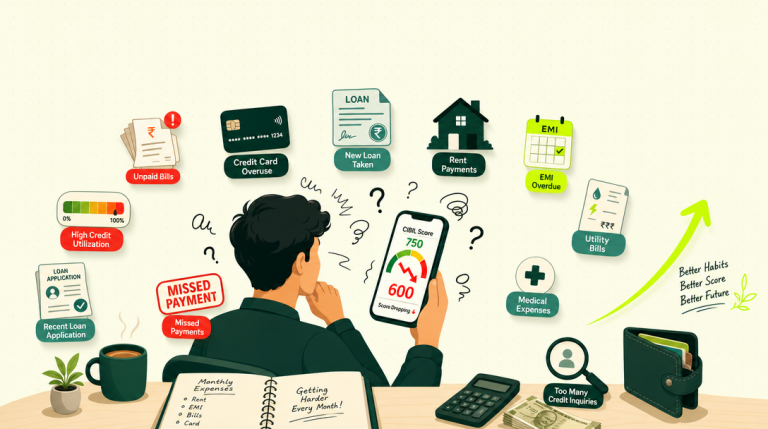
- Credit score. Scores above 750 unlock higher FOIR limits and lower rates; scores below 700 may cut the amount or lead to rejection.
- Employer category. Employees of listed companies, MNCs, and government bodies often get higher FOIR and multipliers. See company category in personal loans.
- Job stability. Frequent job changes or less than six months with the current employer can lower the limit.
- City. Some lenders apply different minimum salaries and limits in metro and non-metro locations.
- Recent enquiries. Several hard enquiries in a short period signal credit hunger and can reduce the offer.
How to increase your eligible amount
Clear or consolidate small EMIs first
Closing a ₹5,000 EMI adds about ₹2.25 lakh of 5-year eligibility. Paying off a two-wheeler loan with a few months left, or clearing a small app loan, often gives the biggest boost for the least money.
Pay down credit card balances.
A ₹1 lakh card balance can be treated as a ₹5,000 monthly obligation. Clearing it before applying frees up the same eligibility.
Choose a longer tenure.
A 5- or 6-year tenure lowers the EMI per lakh borrowed. You can prepay later if your income rises. See personal loan part payment.
Add a co-applicant
An earning spouse or parent as a co-applicant adds their income to the FOIR calculation.
Show all income
Regular variable pay, rental income, or incentives, if documented in bank statements or ITR, can be counted by some lenders.
Apply to lenders that suit your profile.e
FOIR limits and multipliers differ widely. Applying to the right lender first avoids rejections that add hard enquiries to your report.
Use cases
No existing EMIs, IT services employee. At 12% over 5 years, eligible for about ₹11 lakh. Needs ₹6 lakh. At the same rate over 4 years, the EMI would be about ₹15,800, a comfortable FOIR of 32%.
Two existing EMIs totalling ₹12,000. Eligibility over 5 years drops to about ₹5.8 lakh. Consolidating the two loans into the new loan often produces a higher usable amount and one lower combined EMI.
Key takeaways
- On ₹50,000 net with no EMIs, expect roughly ₹7.5 lakh (3 years) to ₹11 lakh (5 years) at around 12%.
- Each ₹5,000 of existing EMIs cuts 5-year eligibility by about ₹2.25 lakh.
- Lenders use the lower of the FOIR-based amount and a salary-multiplier cap.
- Credit score, employer category, and card balances can move the number significantly.
- Clearing small EMIs, choosing a longer tenure, or adding a co-applicant are the fastest ways to raise it.
Frequently Asked Questions
Typically ₹7.5 lakh to ₹11 lakh with no existing EMIs, depending on tenure, rate, and the lender’s FOIR limit. Existing EMIs reduce this.
Lenders usually allow total EMIs of ₹20,000 to ₹27,500 on ₹50,000 net (40% to 55% FOIR). For your own comfort, keeping total EMIs near ₹20,000 leaves room for savings.
Yes, if you have no or very small existing EMIs, a good credit score, and choose a 5-year tenure. At 12%, the EMI would be about ₹22,244.
Most lenders use net (in-hand) salary as credited to your bank account.
Yes. A higher score typically brings a lower rate and a higher FOIR limit, both of which raise the maximum loan.
Conclusion
Your salary sets the ceiling; your existing EMIs, credit score, and choice of lender decide how close you get to it. On ₹50,000 a month, the difference between a well-prepared and an unprepared application can be several lakh rupees.
TapTap Loans calculates your eligibility across 20+ banks and NBFCs with a soft check that does not affect your credit score, and shows you which lender will offer the highest amount at the lowest rate.