





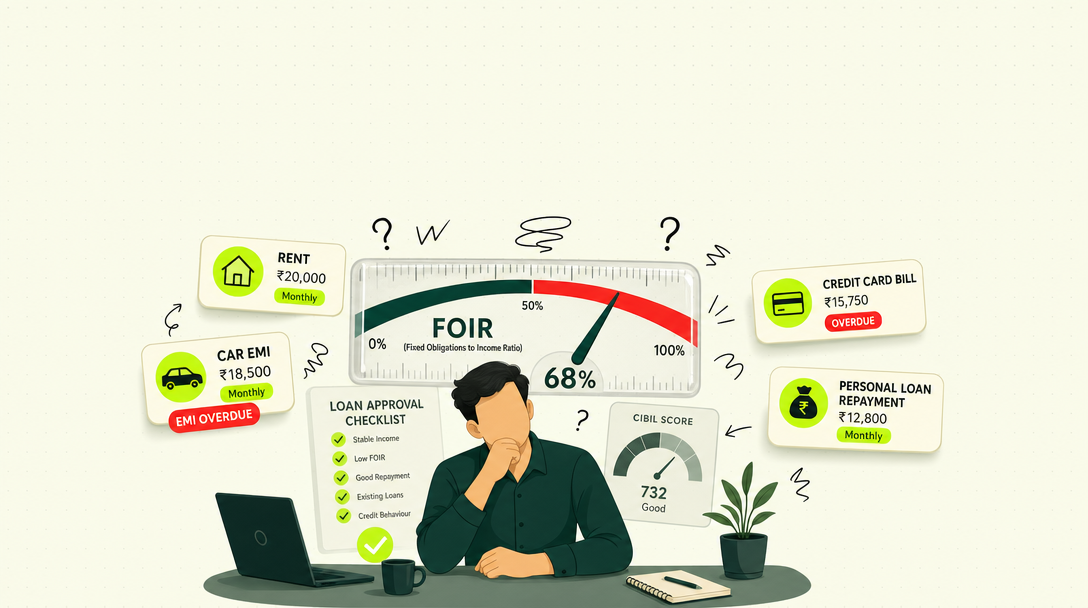
Thousands of personal loan applicants with CIBIL scores above 720 are rejected every month in India — not because of their credit history, but because of a ratio most of them have never heard of. The Fixed Obligation to Income Ratio (FOIR) is the calculation banks use to determine whether you can afford the proposed loan EMI alongside your existing obligations. When this ratio exceeds the lender’s threshold, the application fails regardless of creditworthiness.
Understanding FOIR — and knowing how to position it before applying — is the most underutilised lever in personal loan applications.
What FOIR Means and Why It Matters
FOIR stands for Fixed Obligation to Income Ratio. It measures the percentage of your net monthly income that is already committed to fixed financial obligations — existing loan EMIs, credit card minimum payments, and any other fixed repayment commitments.
The ratio matters because a lender extending new credit to you is effectively betting that you can service the additional EMI. If 55% of your income is already committed to existing obligations, adding another EMI may push you into financial stress. FOIR is the formal expression of this repayment capacity assessment.
What Is FOIR and How Is It Calculated?
The formula is straightforward:
FOIR = (Total Fixed Monthly Obligations / Net Monthly Income) x 100
Example: A borrower earning Rs. 70,000 per month net (take-home salary) with existing EMIs of Rs. 25,000:
Base FOIR = 25,000 / 70,000 = 35.7%
If the borrower applies for a personal loan with an EMI of Rs. 12,000, the lender calculates:
Post-loan FOIR = (25,000 + 12,000) / 70,000 = 52.9%
At most banks, 52.9% falls within the acceptable range (up to 55%). At a stricter lender with a 50% ceiling, this application would be declined even though the borrower earns Rs. 70,000 per month and has a strong CIBIL score.
What Counts as a Fixed Obligation
Lenders include the following in the fixed obligation calculation:
- All active EMIs: Home loan, car loan, education loan, personal loan, gold loan — any loan with a fixed monthly repayment.
- Credit card minimum payments: Typically, 5% of the outstanding balance. Some lenders use the full balance outstanding divided by 12.
- Rent obligations (in some cases): Certain lenders for specific borrower profiles include declared rental obligations.
What is typically not included:
- Voluntary investments (SIP, PPF contributions)
- Insurance premiums (unless EMI-based)
- Utility bills or discretionary expenses
FOIR Thresholds by Lender Type
- Private sector banks (HDFC, ICICI, Axis): Maximum FOIR of 50% in most cases; some allow 55% for high-income borrowers (above Rs. 1 lakh per month).
- PSU banks (SBI, Bank of Baroda): Maximum FOIR of 50–60%, typically more flexible for government employees.
- NBFCs: Range from 55% to 65% — more flexible than banks, which is why NBFCs serve higher-debt borrowers who have been rejected by banks.
- For high-income borrowers (above Rs. 1.5 lakh per month net): Some lenders apply FOIR up to 65–70%, recognising that the absolute residual income remains substantial even at higher ratios.
How FOIR Affects Your Loan Amount Eligibility
FOIR is also used to calculate the maximum EMI the lender will permit, which in turn limits your loan amount. The calculation works backwards from the FOIR ceiling:
Maximum permissible EMI = (FOIR limit x Net monthly income) minus existing obligations
Example: Borrower earning Rs. 80,000 per month with existing EMIs of Rs. 22,000, applying to a bank with a 50% FOIR limit:
Maximum permissible EMI = (0.50 x 80,000) minus 22,000 = Rs. 40,000 minus Rs. 22,000 = Rs. 18,000
The bank will approve a loan whose EMI does not exceed Rs. 18,000. At 13% p.a. over 60 months, an EMI of Rs. 18,000 corresponds to a loan amount of approximately Rs. 7.9 lakh. The borrower requesting Rs. 10 lakh — which would generate an EMI of approximately Rs. 22,700 — will be declined or offered a reduced amount.
How to Reduce FOIR Before Applying
FOIR reduction is one of the most impactful pre-application actions a borrower can take. The options:
- Foreclose small high-EMI loans: If you have a consumer durable or personal loan with a small outstanding balance, clearing it before applying eliminates that EMI from the FOIR calculation. An Rs. 1,500 per month EMI freed up increases your maximum permissible new EMI by Rs. 1,500.
- Pay down credit card debt: Reducing the minimum payment on credit cards reduces the obligation factored into FOIR. A credit card balance of Rs. 40,000 may add Rs. 2,000 per month to your obligation tally (5% minimum payment rule).
- Apply jointly with a higher-earning co-applicant: Adding a co-applicant (spouse or parent) increases the income denominator in the FOIR calculation. A household’s combined income of Rs. 1.5 lakh provides significantly more FOIR headroom than a single income of Rs. 80,000.
- Apply for a smaller loan amount that falls within FOIR limits: If the desired loan generates an EMI above the FOIR threshold, consider whether a slightly smaller loan meets your actual need.
FOIR vs. CIBIL: Which One Matters More?
Both matter, but they serve different functions in the underwriting process. CIBIL determines whether you will be considered at all (a gate-keeping function). FOIR determines how much you can borrow and whether the proposed loan fits within your repayment capacity.
A borrower with a 760 CIBIL score and a 60% FOIR will be declined by most private banks — the CIBIL passes the gate, but the FOIR fails the capacity test. Conversely, a borrower with a 690 CIBIL score and a 35% FOIR may be approved by an NBFC that places high weight on repayment capacity.
Most lenders assess both sequentially: CIBIL first (does this borrower have a history of repaying?), then FOIR (can they afford this specific loan?).
Key Takeaways
- FOIR is the percentage of your net income committed to existing fixed obligations plus the proposed new EMI.
- Most banks permit a maximum FOIR of 50%; NBFCs allow up to 65% in some cases.
- A high CIBIL score does not protect against FOIR-related rejection — both are assessed independently.
- Foreclosing small loans before applying can materially reduce your FOIR and increase your loan amount eligibility.
- TapTap’s advisory process includes a FOIR assessment during soft profile review — identifying the maximum loan amount your income profile supports across different lenders.
Frequently Asked Questions
In most cases, no. FOIR is calculated based on the applicant’s (or co-applicants’) income and obligations. A spouse’s separate obligations would only be included if the spouse is a co-applicant on the loan.
Yes. FOIR is used across all loan categories — personal loans, home loans, car loans, and business loans. Home loan lenders typically allow FOIR up to 55–65% because the loan is secured against property, and default is less likely due to emotional attachment to the asset.
Yes. Each lender sets its own FOIR ceiling, and some exclude certain obligations (like informal rent) that others include. This is why the same loan application may be approved at one lender and declined at another.
Most banks prefer FOIR below 50%, while some NBFCs may allow up to 65% for higher-income borrowers.
Reducing existing EMIs, paying down credit card debt and applying jointly with a co-applicant can lower FOIR.
Conclusion
FOIR is not a mysterious or arbitrary concept — it is a straightforward repayment capacity calculation that determines whether your income can support the proposed loan. The reason it catches borrowers by surprise is that it is rarely explained clearly before an application is submitted.
Knowing your FOIR — and knowing how to manage it — before you apply is one of the most direct ways to improve approval probability. TapTap Loans’ advisory model incorporates FOIR assessment as a standard step in profile evaluation, ensuring that the loan amount recommended is one your income can support within the FOIR thresholds of the matched lender.