





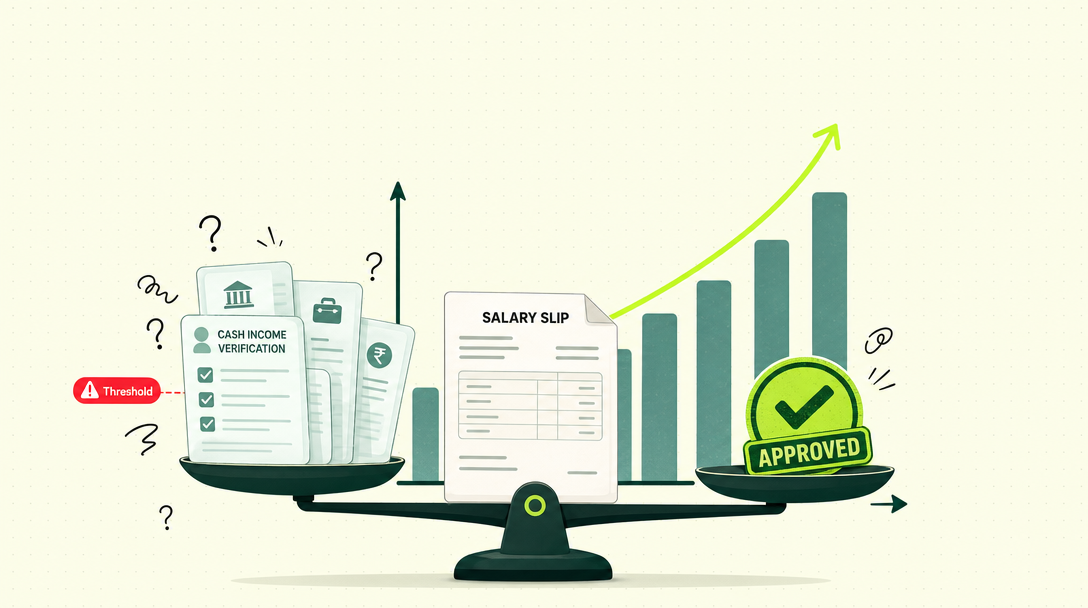
A cash salary loan is a personal loan for someone whose employer pays wages in cash. Most banks and NBFCs hesitate because they cannot verify cash income. Your chances improve with a salary certificate, employer verification, EPF records, and, above all, three to six months of salary deposited regularly into a bank account.
Millions of salaried Indians are paid in cash: shop and showroom staff, drivers, security and housekeeping teams, workers in small factories and family-run offices. They have a job and a monthly income, yet a loan application asks for salary slips, Form 16, and bank statements showing salary credits that they do not have.
A cash salary loan is not impossible, but it works differently from a standard salaried loan. The lender’s problem is evidence, not your character, and evidence can be built.
Why a cash salary loan is hard to get
A lender approving an unsecured loan wants to answer three questions: how much do you earn, how stable is it, and how much of it is already committed. For an employee paid by bank transfer, the bank statement answers all three. For an employee paid in cash, it answers none.
The RBI’s Digital Lending Directions require lenders to capture each borrower’s age, occupation and income before lending and keep that record for audit (RBI, Digital Lending Directions, 8 May 2025, para 7(i)). A lender cannot record income it has no way to check.
Cash salaries usually come with other gaps too:
- No salary slips, or slips without a company registration or signatory.
- No Form 16, because income is below the taxable threshold or tax was not deducted.
- No EPF or ESIC deduction, so no government record of employment.
- No credit history, because the person has never held a loan or card.
Each gap makes a cash salary loan riskier for the lender. The good news is that most can be closed within months.
Check whether your profile fits any of 20+ lenders, with no credit-score impact.
What lenders can verify instead of bank salary credits
Lenders that consider a loan on cash salary rely on documents that tie you to an employer and to a pattern of income. None of these alone is sufficient, but together they build a case.
Evidence that supports a cash salary loan application
| Evidence | What it proves | How to get it |
|---|---|---|
| Salary certificate on company letterhead | Employer, designation, monthly pay | Ask HR or the owner; signed and stamped |
| Appointment letter | Date of joining and terms | Ask the employer; see the note below |
| Employer verification call or visit | That the job exists | The lender contacts the employer directly |
| EPFO passbook or UAN | Contributions in your name | EPFO member portal, if PF is deducted |
| Regular cash deposits into your account | A monthly income pattern | Deposit salary on the same date each month |
| ITR or Form 26AS | Declared income | File a return even if income is below the tax limit |
On appointment letters, the four Labour Codes took effect on 21 November 2025, and the government has said every employee will be given an appointment letter in the prescribed format (PIB, 4 Dec 2025). [compliance review: state rules under the Labour Codes were still being notified; confirm the appointment-letter requirement applies to the reader’s establishment before relying on it]
If you have income but no standard documents for other reasons, our guide on what lenders accept when you have no standard income proof covers bank statements, tax statements, and co-applicants in more depth.
How much a cash salary loan can be
Lenders size a loan using FOIR, the fixed obligations to income ratio: the share of monthly income that may go to EMIs. Read how lenders calculate FOIR for the full method. For cash income, lenders typically apply a more cautious ratio than for bank-credited salary, and they count only income they can verify.
The table assumes no existing EMIs and an illustrative rate assumed for the calculation, not a lender quote: 16% a year.
Loan a cash salary can support at two FOIR levels (illustrative 16% a year)
| Monthly cash salary | FOIR | EMI room | Loan over 36 months | Loan over 48 months |
|---|---|---|---|---|
| ₹30,000 | 35% | ₹10,500 | ₹2,98,660 | ₹3,70,497 |
| ₹30,000 | 50% | ₹15,000 | ₹4,26,657 | ₹5,29,282 |
| ₹40,000 | 35% | ₹14,000 | ₹3,98,213 | ₹4,93,997 |
| ₹40,000 | 50% | ₹20,000 | ₹5,68,876 | ₹7,05,709 |
| ₹50,000 | 35% | ₹17,500 | ₹4,97,767 | ₹6,17,496 |
| ₹50,000 | 50% | ₹25,000 | ₹7,11,095 | ₹8,82,137 |
The catch is verification. If you earn ₹30,000 but deposit only ₹20,000 a month, a lender will usually assess ₹20,000. At 35% FOIR, that supports about ₹1,99,107 over 36 months.
That matters because personal loans arranged through TapTap Loans start at ₹2 lakh. A ₹2 lakh loan at 16% over 36 months needs an EMI of ₹7,031, so at a 35% FOIR you would need about ₹20,090 a month of verifiable income; over 48 months, the EMI falls to ₹5,668 and the threshold to about ₹16,194. If you are on a modest salary.
A 3–6 month plan to become bankable
Most cash-salaried applicants are closer to eligibility than they think. The aim is to create the records a lender would otherwise see in a salary account.
- Ask your employer to pay by bank transfer. Even a partial transfer creates a salary credit that lenders recognise. If the employer will not, move to step 2.
- Deposit your salary on the same date each month. Use one account, deposit the full amount where possible, and avoid withdrawing it all the same day. Three months is a minimum; six is better.
- Collect a salary certificate and an appointment letter, signed and stamped, with the employer’s address and contact number.
- Check whether PF is deducted. If your employer is covered and deducts PF, activate your UAN and download the passbook. If PF should apply but is not deducted, raise it with HR.
- File an income tax return, even if your income is below the taxable limit. A filed return is a dated record of declared income.
- Build a credit history. A secured credit card issued against a small fixed deposit, used lightly and paid in full each month, creates a repayment record within a few billing cycles.
After three months, a cash salary loan application has a deposit pattern to point to. After six, with a card history and documents in hand, you look much closer to a standard salaried applicant.
Safer alternatives to a cash salary loan
If you need money before your records are ready, secured or employer-based options carry less risk and usually cost less.
- Gold loan: lenders assess the gold, not your income. Under the RBI’s Lending Against Gold and Silver Collateral Directions, 2025, lenders may lend up to 85% of the gold’s value on loans below ₹2.5 lakh, with compliance required by 1 April 2026 (PTI, 6 Jun 2025). [compliance review: confirm LTV tiers against the final Directions and RBI’s 28 Nov 2025 consolidation]
- Loan against a fixed deposit: if you have savings in an FD, it needs no income proof and keeps the deposit earning interest.
- Employer salary advance: many small employers will advance one or two months’ pay, recovered from future wages, with no interest. Ask for the terms in writing.
- Staging the purchase: if the need is not urgent, saving for two or three months while you build records often costs less than any loan.
Checking your options before you apply
Lenders differ widely on whether they offer a cash salary loan at all. Some decline cash salaries outright; others consider them with strong employer verification and deposit history. Applying to several in turn means several hard enquiries, which can hurt a thin credit file.
Check fit before you apply. TapTap Loans, a loan advisory platform that matches borrowers with 20+ banks and NBFCs, assesses your profile with a soft credit check that does not affect your score, and tells you whether any lender in its network fits it and what documents would strengthen the case. The advisory service is free; lender fees apply.
Red flags: lenders offering a loan on cash salary with no checks
Applicants turned away by banks are the main target of predatory apps. On 7 August 2026, the Indian Cyber Crime Coordination Centre (I4C) flagged six loan apps that posed as legitimate lenders, charged exorbitant interest and harvested users’ Aadhaar, contacts and photos (Outlook Business, 12 Aug 2026).
- “No verification” offers: a regulated lender must assess income, so an offer with no questions is a warning sign.
- Upfront fees: never pay a “file charge” or “insurance” before you receive a sanction letter and Key Fact Statement from a named bank or NBFC.
- Excessive app permissions: refuse access to contacts, gallery, and location.
- Unknown lender names: check the RBI’s list of digital lending apps deployed by regulated entities, published under Citizen’s Corner on rbi.org.in (RBI press release, 8 May 2025), and unregistered entities on the RBI’s Sachet portal.
Learn how to recognise a fake loan app and report fraud on the National Cybercrime Helpline 1930 or cybercrime.gov.in.
Three borrower scenarios
Scenario 1: Showroom sales executive, Surat. ₹32,000 cash salary, no EMIs, no credit history. She deposits her full salary each month for four months, gets a salary certificate and a secured card, then applies for a ₹2 lakh cash salary loan over 48 months with an EMI near ₹5,668.
Scenario 2: Driver for a family business, Delhi. ₹28,000 in cash, but deposits only ₹15,000 a month. On verifiable income, a ₹2 lakh loan on cash salary is out of reach for now, so he takes a small gold loan for the immediate need and starts depositing his full salary.
Scenario 3: Supervisor at a small factory, Coimbatore. ₹48,000, half by bank transfer and half in cash, with PF deducted. His EPFO passbook and partial salary credits make him close to a standard applicant; a lender counts the transferred portion plus verified deposits.
How TapTap helps
Offer: a free eligibility check across 20+ lenders, with no credit-score impact.
- What happens after you submit: TapTap runs a soft credit check and reviews your income evidence, then matches you with banks and NBFCs in its network that fit your profile, if any do. You are told which documents to share; TapTap submits the application to the lender you choose and follows up with that lender until disbursal.
- What to have ready: PAN, Aadhaar, six months of bank statements showing salary deposits, a salary certificate, an appointment letter and, if available, your UAN.
- Cost: nothing for TapTap’s advisory service; lender charges such as the processing fee still apply.
- Credit score: the assessment uses a soft check with no score impact; a hard enquiry happens only after you choose to proceed with a specific lender.
- Contact: documents are shared digitally, with no branch visit; you get a callback after your enquiry and can chat on WhatsApp.
TapTap Loans is a loan advisory platform. Loans are offered and approved by RBI-regulated banks and NBFCs at their discretion; rates, fees, and tenures vary by lender and borrower profile.
Key takeaways
- A cash salary loan is difficult because lenders must verify income, and cash leaves no bank record.
- A salary certificate, appointment letter, employer verification, EPF records, and a filed ITR help, but regular bank deposits matter most.
- Lenders count only verifiable income; at 35% FOIR and 16% illustrative interest, ₹2 lakh over 36 months needs about ₹20,090 a month.
- Three to six months of consistent deposits plus a secured credit card can make you bankable.
- Gold loans, loans against FDs, and employer advances are safer short-term options; “no verification” lenders are a red flag.
F
Frequently asked questions
Yes, but fewer lenders offer one,ne and they need evidence. A salary certificate, employer verification, and several months of regular salary deposits into your bank account are the usual minimum. Secured options such as a gold loan need far less income evidence.
If a lender verifies the full ₹30,000 and applies a 35% FOIR, that supports about ₹2.99 lakh over 36 months at an illustrative 16%. If you deposit only part of your salary, the amount falls in proportion.
Yes. Many lenders accept salary credited to any savings account. What matters is regular, traceable credit. For cash salaries, consistent monthly deposits are the closest substitute.
It is the most useful single step. Deposit the full salary on the same date every month for at least three months, and avoid withdrawing it all at once. Questions about your documents? Message a TapTap adviser on WhatsApp.
Conclusion
A cash salary loan is a records problem more than an income problem. Lenders cannot lend against money they cannot see, but they can lend against a salary certificate, a verified employer, and months of consistent deposits. Building those takes three to six months, and safer secured options can bridge the gap in the meantime.
Once your records are in place, the next step is to find out which lenders accept your profile before using up hard enquiries.
Check your eligibility for free, with no credit-score impact.