





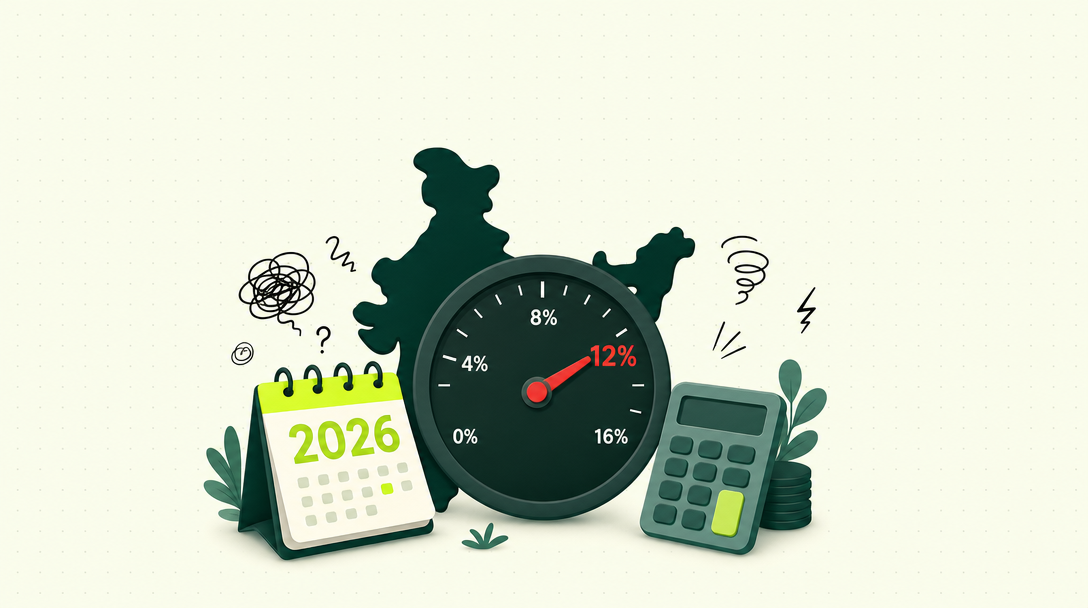
Personal loan interest rates at major Indian banks currently start at about 9.99%–10.40% a year and run up to 15%–38% depending on the lender, based on official rate pages accessed on 12 Nov 2026. Your own rate depends on your credit score, employer, income, and FOIR, and the APR after fees matters more than the floor.
Advertised floors are what most borrowers compare, and they are the number fewest borrowers get. Lenders that publish their averages show the gap: HDFC Bank reports an average offered rate of 10.89% for April–June 2026 against a 9.97% minimum, and Axis Bank a mean of 12.79% for July–September 2026.
This guide shows each lender’s current personal loan interest rate range with dates, how lenders price you within that range, and how to compare offers on APR rather than the headline rate.
Before you apply, have these three numbers ready: 1. Your net monthly salary. 2. Your current EMIs and credit card balances. 3. The amount and tenure you are considering.
TapTap Loans offers a free check across 20+ banks and NBFCs with a soft credit check, so your score is not affected, and there is no fee for TapTap’s service.
Personal loan interest rate by lender, November 2026
Figures below come only from each lender’s official page, accessed on 12 Nov 2026. They are published ranges, not offers. [legal review]
| Lender | Published rate range (p.a.) | Period or date shown | Processing fee (published) |
|---|---|---|---|
| SBI | 10.00%–15.00% (2-year MCLR 8.75% + 1.25%–6.25%) | w.e.f. 15 Dec 2025; mean 11.54% in Q1 FY27 | Xpress Credit: 1.50%, min ₹1,000, max ₹15,000, + GST |
| HDFC Bank | 9.99%–24.00% (salaried) | Offered Apr–Jun 2026: 9.97%–24.06%, average 10.89% | Up to ₹6,500 + GST |
| ICICI Bank | 10.25%–16.50% | Jul–Sep 2026 | Up to 2% + taxes |
| Axis Bank | 9.99%–22% | Offered Jul–Sep 2026: 8.75%–21.55%, mean 12.79% | Up to 2% + GST |
| Bank of Baroda | 10.40%–17.75% floating, by employer category | No date shown on page | 1%–2% + GST (min ₹1,000, max ₹10,000); nil for govt employees with BoB salary account |
| IDFC FIRST Bank | 9.99%–38% | November 2026 | Zero processing fee |
| Bajaj Finance (NBFC) | 10%–30.5% | October 2026 | Up to 4.13% incl. taxes |
Published ranges change, and some pages carry inconsistent dates; always check the lender’s current page and your Key Fact Statement. Kotak Mahindra Bank was left out because its page showed conflicting starting rates on the day we checked.
The table shows two things. Bank floors cluster around 10%, but ceilings range from 15% to 38%, a sign of how differently lenders price risk. And where lenders disclose averages, typical borrowers pay about one to three points above the published floor.
Where will your rate land? A self-check
Lenders do not publish their pricing grids, but the factors are consistent across rate pages and policies. Use this as a general guide, not a quote.
| Factor | Likely nearer the floor | Likely mid-range | Likely upper end |
|---|---|---|---|
| Credit score and history | Strong score, no recent delays | Fair score or thin history | Recent missed payments |
| Employer | Government, PS, U, or large listed company | Mid-size private company | Small firm or unlisted employer |
| FOIR after the new EMI | Under 35% | 35%–50% | Above 50% |
| Relationship | Salary account with the lender | Savings account only | No relationship |
| Credit card use | Low utilisation | Moderate | Cards near the limit |
Indicative EMI room at 50% FOIR with no other EMIs, five years, illustrative rates:
| Net monthly salary | EMI room | Indicative loan at 11% | Indicative loan at 16% |
|---|---|---|---|
| ₹30,000 | ₹15,000 | ₹6,89,896 | ₹6,16,826 |
| ₹50,000 | ₹25,000 | ₹11,49,826 | ₹10,28,043 |
| ₹75,000 | ₹37,500 | ₹17,24,739 | ₹15,42,064 |
| ₹1,00,000 | ₹50,000 | ₹22,99,652 | ₹20,56,085 |
Indicative figures; rates are illustrative assumptions, not lender quotes. Your actual personal loan interest rate also changes how much you can borrow.
How a personal loan interest rate is set
A personal loan interest rate has three layers.
- Benchmark. Banks price off an internal benchmark such as MCLR. SBI states its personal loan rate as the 2-year MCLR of 8.75% plus a spread of 1.25%–6.25% (SBI, w.e.f. 15 Dec 2025). NBFCs price off their own cost of borrowing.
- Policy environment. RBI raised the repo rate 25 basis points to 5.50% in October 2026 and moved to a “calibrated tightening” stance (RBI, MPC minutes, 21 Oct 2026). Transmission is partial: RBI’s October 2026 Bulletin found that the weighted average lending rate (WALR) on fresh rupee loans fell 93 basis points against 125 basis points of repo cuts between Feb 2025 and Mar 2026 (RBI, 23 Oct 2026).
- Your risk spread. This is the part you control: credit score, employer category, FO, IR, and relationship decide where you land within the spread.
For context, the WALR on all fresh rupee loans by banks was 8.61% in August 2026 (RBI, 30 Sep 2026). Unsecured personal loans are priced above that average because they carry no collateral. NBFCs often take on profiles that banks decline, which is why their ceilings are higher.
Most personal loans are fixed-rate, so a repo change affects new quotes rather than your existing EMI; our note explains when that differs.
APR vs headline rate: a worked example
Two offers for ₹5 lakh over three years:
| Offer A | Offer B | |
|---|---|---|
| Headline rate | 10.99% | 11.75% |
| Processing fee | 2% + 18% GST = ₹11,800 | Nil |
| Amount credited | ₹4,88,200 | ₹5,00,000 |
| EMI | ₹16,367 | ₹16,548 |
| APR | about 12.65% | 11.75% |
| Total cost over credit received | ₹1,01,012 | ₹95,711 |
Offer A has the lower headline rate but costs about ₹5,300 more. RBI requires the Key Fact Statement to state the APR, which includes interest and all other charges, including third-party charges such as insurance (RBI, KFS circular, 15 Apr 2024). [compliance review: confirm current Master Direction reference after RBI’s 28 Nov 2025 consolidation] Also confirm the rate is on a reducing balance. A flat rate looks lower but costs far more.
What a higher personal loan interest rate costs you
On ₹5 lakh over five years:
| Rate | EMI | Total interest |
|---|---|---|
| 10% | ₹10,624 | ₹1,37,411 |
| 12% | ₹11,122 | ₹1,67,333 |
| 14% | ₹11,634 | ₹1,98,048 |
| 18% | ₹12,697 | ₹2,61,803 |
| 22% | ₹13,809 | ₹3,28,567 |
Every two points add roughly ₹30,000–₹35,000 of interest at this size. Moving from a mid-range 14% to 12% saves about ₹30,700, more than most fee negotiations.
How to get quoted nearer the lower end
- Check your report first. Correct errors and pay down card balances; utilisation and recent delays weigh heavily. See the CIBIL score lenders look for
- Lower your FOIR. Closing a small loan before applying can move you into a better band.
- Use your relationships. Bank of Baroda’s floors are 50 basis points lower when your salary is credited with it.
- Target lenders that rate your employer well. Employer lists differ by lender.
- Avoid scattering applications. Several hard enquiries in a short span can push your rate up or lead to declines.
- Compare on APR. Ask for the KFS from each shortlisted lender.
Questions people ask before comparing personal loan interest rates
Does checking rates lower my CIBIL score? No. The check TapTap runs is a soft enquiry, which your score does not register. A hard enquiry is made only when you choose a lender and proceed.
What does TapTap charge? Nothing; its advisory service is free for borrowers. Lender fees such as processing fees apply and appear in the KFS.
Is my data safe? Documents are shared digitally, and loans come only from RBI-regulated banks and NBFCs. Under the DPDP Act, 2023 and the DPDP Rules notified on 14 Nov 2025, you must be told why data is collected and can withdraw consent (PIB, Nov 2025). [compliance review: confirm DPDP consent wording and which phased obligations currently apply to TapTap]
Why not just ask my bank for its rate? Do ask; your bank may give the right offer. But ranges differ widely, and one quote cannot tell you whether it is competitive for your profile. Comparing 20+ lenders can.
What if I’m rejected? The soft check leaves your score untouched, and you learn whether credit history, FOI, R, or amount is the issue before a formal application.
Three borrower scenarios
Illustrative scenarios, not real customers.
- Ankit, 30, Noida, listed IT firm, ₹70,000 net, no EMIs. He compares a 10.99% offer with a 2% fee and an 11.75% no-fee offer on ₹5 lakh for three years and takes the second, saving about ₹5,300.
- Farah, 37, Kochi, private school, ₹45,000 net, cards at 80% of limit. She pays her card balances down before applying, aiming for a mid-range quote rather than the upper end.
- Deepak, 42, Nagpur, state PSU, ₹85,000 net, salary with a public sector bank. He gets a quote from his salary bank first, then compares it with offers across lenders before accepting.
How TapTap helps
TapTap Loans, a loan advisory platform that matches borrowers with 20+ banks and NBFCs, offers one thing here: a free eligibility check that shows which lenders fit your profile, with no impact on your credit score.
What happens after you submit
- TapTap runs a soft credit check, which leaves your CIBIL score as it is.
- An advisor assesses your income, EMIs, credit profile, le and employer.
- Lenders from the 20+ bank and NBFC network whose pricing suits your profile are shortlisted.
- You receive the exact document list for the lender you choose and share it digitally.
- TapTap submits the application to your chosen lender and follows it up until disbursal; a callback follows your enquiry, and the team is also on WhatsApp.
What you need ready: net salary, current EMIs, amount and tenure, PAN.
Cost: TapTap’s service is free to you; each lender’s own fees are listed in its KFS.
TapTap Loans is a loan advisory platform. Loans are offered and approved by RBI-regulated banks and NBFCs at their discretion; rates, fees, and tenures vary by lender and borrower profile.
Key takeaways
- Published bank floors cluster around 9.99%–10.40%, but ceilings run from 15% to 38% (official pages, 12 Nov 2026).
- Disclosed averages (HDFC 10.89%, Axis 12.79%, SBI 11.54%) show typical borrowers pay above the floor.
- Your rate is benchmark plus a risk spread set by credit score, employer, FOIR, and relationship.
- Compare offers on APR: a lower headline rate with a 2% fee costs about ₹5,300 more in our example.
- Two points of rate on ₹5 lakh over five years cost roughly ₹30,000–₹35,000.
Frequently asked questions
On official pages accessed 12 Nov 2026, published ranges include SBI 10.00%–15.00%, HDFC Bank 9.99%–24.00% for salaried borrowers, ICICI Bank 10.25%–16.50%, Axis Bank 9.99%–22%, and IDFC FIRST Bank 9.99%–38%. Your rate depends on your profile.
Banks start from a benchmark such as MCLR and add a spread for your risk. The spread depends on your credit score, employer category, FOIR, and relationship with the lender. Fees then raise the effective cost, shown as APR in the KFS.
Floors are similar, but NBFC ceilings are often higher because they lend to a wider range of profiles. Bajaj Finance publishes 10%–30.5%, while SBI publishes 10.00%–15.00%. Compare APR, not lender type.
Advertised rates are floors for the strongest profiles. Lenders that disclose averages show most borrowers pay more: HDFC Bank’s average offered rate was 10.89% in April–June 202,6 against a 9.97% minimum.
Conclusion
The personal loan interest rate you are offered is not a market number; it is a judgement on your profile, layered on a benchmark that RBI policy moves slowly. That makes the floor a poor guide and APR the only fair comparison.
Improve what you can control before applying, shortlist lenders that rate your employer well, and compare APRs from several offers without spending hard enquiries to get them.