





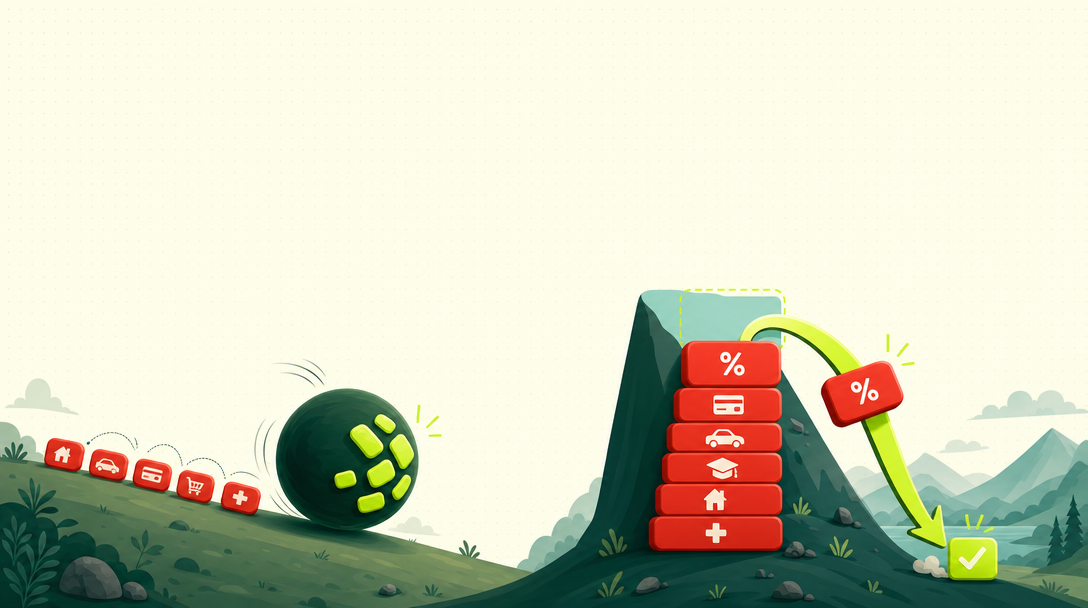
In debt snowball vs avalanche, the snowball method pays off your smallest debt first, for quick motivational wins. The avalanche method pays off your highest-interest debt first, saving the most money. This guide compares both, with a real example.
What Is the Debt Snowball Method?
List all your debts from smallest balance to largest, regardless of interest rate. Pay the minimum on everything except the smallest debt, and put every extra rupee toward that one. Once it’s paid off, roll that payment amount into the next-smallest debt, building momentum as each one closes.
The core idea is psychological. Quick wins, seeing a debt fully disappear, keep you motivated to continue, even if it’s not the mathematically optimal approach.
What Is the Debt Avalanche Method?
List all your debts from highest interest rate to lowest, regardless of balance size. Pay the minimum on everything except the highest-rate debt, and put every extra rupee toward that one. Once it’s paid off, move to the next-highest rate debt.
This approach is mathematically optimal; it minimizes the total interest you’ll pay across all your debts combined, since you’re always attacking the most expensive debt first.
A Side-by-Side Comparison
| Factor | Debt Snowball | Debt Avalanche |
|---|---|---|
| Order of attack | Smallest balance first | Highest interest rate first |
| Best for | Motivation, quick wins | Minimizing total interest cost |
| Total interest paid | Usually more | Usually less |
| Psychological impact | Strong, visible progress early | Slower visible progress, especially if the highest-rate debt is large |
A Worked Example: Comparing Both Methods
Consider three debts. A ₹40,000 credit card at 36%. A ₹1,50,000 personal loan at 15%. A ₹80,000 consumer durable loan at 20%.
Snowball order: Card (₹40,000) first, since it’s smallest, then the durable loan (₹80,000), then the personal loan (₹1,50,000) last.
Avalanche order: Card (₹40,000) first, since it has the highest rate at 36%, then the durable loan (₹80,000) at 20%, then the personal loan (₹1,50,000) at 15% last.
In this particular case, both methods happen to produce the same order, since the smallest balance also carries the highest rate. This isn’t always true, and when it isn’t, the two methods genuinely diverge in both order and total cost.
When the Two Methods Actually Differ
Consider a different mix. A ₹1,00,000 personal loan at 22%. A ₹30,000 consumer durable loan at 14%.
Snowball would attack the ₹30,000 loan first, since it’s smaller, even though it carries the lower rate. Avalanche would attack the ₹1,00,000 loan first, since it carries the higher rate, even though it’s the larger balance.
In this scenario, avalanche saves more money overall, since the higher-rate debt accrues interest faster the longer it’s left unaddressed. Snowball, however, delivers a faster initial “win,” closing the smaller debt first.
Which Method Should You Actually Choose?
If you’re confident in your discipline and primarily want to minimize total cost, avalanche is the mathematically better choice. If you’ve struggled with sticking to a debt repayment plan in the past, and need the motivational boost of an early win to stay committed, snowball’s psychological benefit may outweigh its slightly higher cost.
Neither answer is universally “correct”; the right choice depends on which approach you’ll actually stick with consistently.
A Third Option: Consolidation
Both snowball and avalanche assume you’re managing multiple separate debts individually. There’s a third approach worth considering: consolidating your debts into a single loan, at one blended rate, eliminating the need to choose an attack order at all.
This works particularly well if your existing debts carry high, varied interest rates, since consolidation can immediately reduce your blended rate, achieving much of what avalanche aims for, but through a single structural change rather than an ongoing repayment strategy.
Combining Consolidation With a Repayment Method
These approaches aren’t mutually exclusive. You might consolidate your highest-rate, most expensive debts into one loan, while continuing a snowball or avalanche approach on any remaining, smaller debts that don’t make sense to fold into the consolidation. This hybrid approach captures the immediate rate benefit of consolidation, alongside the structured discipline of a chosen repayment method for what’s left.
Common Mistakes With Either Method
Not accounting for minimum payments correctly. Both methods require you to keep paying at least the minimum on every debt except the one you’re actively attacking; missing this creates its own problems.
Switching methods mid-way, repeatedly. Consistency matters more than which method you pick. Frequently switching between snowball and avalanche can leave you making less progress on either.
Ignoring new debt accumulation. Neither method works if you’re adding new debt while trying to pay down existing debt. Both require pausing new borrowing during the repayment period for the plan to actually work.
How to Get Started With Either Method Today
List every debt you currently have, with its balance and interest rate. Choose your method, snowball for motivation, avalanche for savings, based on your own history with sticking to financial plans. Calculate how much extra you can realistically put toward your target debt each month, beyond the minimums on everything else. And track your progress visibly, whether through a simple spreadsheet or an app, to maintain momentum.
Frequently Asked Questions
Avalanche generally saves more total interest, since it always targets the highest-rate debt first, regardless of balance size.
Snowball is often considered easier to maintain, since paying off a smaller debt quickly provides an early, motivating sense of progress.
Yes. Consolidating your highest-rate debts into one loan can reduce your overall interest cost immediately, while you continue snowball or avalanche on any remaining debts.
Not really; both methods are specifically designed for managing multiple debts simultaneously. With a single debt, focus simply on paying it down as fast as your budget comfortably allows.
If a loan has a very low interest rate and carries prepayment charges, it may not be the best candidate for early repayment. Prioritize high-interest debts first while continuing the required minimum payments on lower-cost loans.
Conclusion
Both the debt snowball and debt avalanche methods can help you become debt-free—the best choice is the one you can follow consistently. If staying motivated is your biggest challenge, the snowball method offers quick wins. If reducing interest costs is your priority, the avalanche method is the smarter financial choice. Whichever strategy you choose, avoid taking on new debt during repayment and make consistent extra payments whenever possible.
Managing multiple high-interest debts? See how consolidation could simplify your repayment strategy.