





What Is Loan Consolidation?
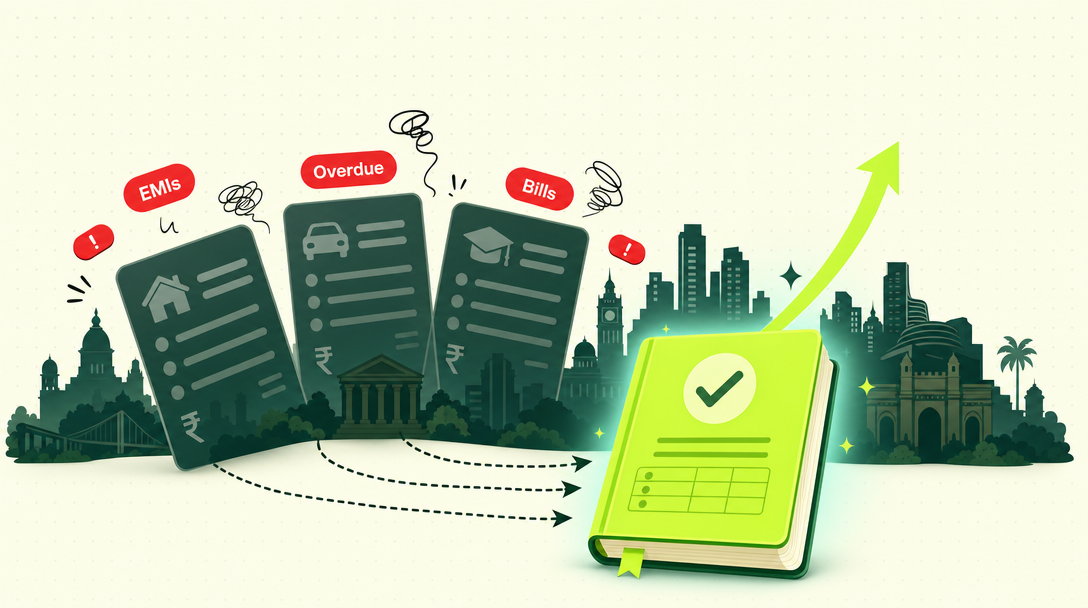
Loan consolidation in India is the process of combining multiple debts personal loans, credit card dues, or both into a single new loan with one EMI, one due date, and usually a lower blended interest rate. Instead of tracking four due dates and four interest rates every month, you make one payment to one lender.
For Indian borrowers juggling a personal loan, two credit cards, and maybe a consumer durable EMI, loan consolidation isn’t just a convenience; it’s often the single fastest way to cut monthly outflow. Credit cards in India routinely charge 30–42% annual interest when a balance is carried past the due date. A well-structured consolidation loan can bring that same debt down to 10.5–18% p.a., depending on your credit profile.
This guide breaks down exactly how loan consolidation works in India, who should (and shouldn’t) use it, what it costs, and how to avoid the mistakes that turn a smart move into a bigger debt trap.
How Loan Consolidation Works in India?
The mechanics are straightforward:
- You list every debt — personal loans, credit card outstanding, gold loan, consumer durable loan, along with the outstanding amount, interest rate, and remaining tenure on each.
- A lender (bank or NBFC) assesses your profile — income, CIBIL score, existing EMI obligations (your FOIR), and employment stability- for bank vs NBFC personal loans.
- You’re offered a new consolidation loan sized to cover your total outstanding debt, typically at a lower weighted interest rate than what you’re currently paying across accounts.
- The new loan disburses, and the funds are used to close your existing debts either paid directly to the old lenders or credited to you to pay them off within a defined window.
- You’re left with one EMI, on one date, at one fixed rate, for a fixed tenure.
The savings come from two places: a lower blended interest rate, and the discipline of a fixed repayment schedule instead of revolving credit card debt that can balloon indefinitely if only minimum payments are made.
Who Should Consider Loan Consolidation?
Consolidation isn’t for everyone. It tends to make financial sense when:
- You’re carrying credit card debt at 30%+ interest alongside a personal loan at a lower rate; consolidating the card debt specifically can produce large savings.
- You have three or more active EMIs/dues and are finding it hard to track due dates, leading to occasional late payments or bounced auto-debits.
- Your credit score is stable enough (generally 650+) to qualify for a meaningfully lower rate than your current average.
- You have steady income that supports a new fixed EMI without stretching your budget further.
- You’re committed to not re-accumulating debt on the credit cards or loans you just paid off.
It makes less sense if your existing debts are already at a low blended rate, if you can’t qualify for a materially better rate than what you’re paying now, or if you’re likely to run up new credit card balances immediately after consolidating;g in that case, you end up with the new EMI and fresh card debt, which is worse than where you started.
Loan Consolidation vs Managing Multiple EMIs Separately
| Factor | Multiple Separate Debts | Consolidated Loan |
|---|---|---|
| Number of payments/month | 3–5 different due dates | 1 fixed due date |
| Interest rate | Often 24–42% blended (if cards involved) | Typically 10.5–18% p.a. |
| Risk of missed payment | Higher — easy to lose track | Lower — single reminder to manage |
| Credit score impact | Volatile — utilization + missed payments hurt | Improves with consistent on-time payment |
| Total interest paid | Usually higher over time | Usually lower, if rate is genuinely better |
The clearest win is on interest cost. A borrower carrying ₹2 lakh on a credit card at 36%, a ₹3 lakh personal loan at 18%, and a ₹1 lakh gold loan at 12% has a weighted average interest rate above 24%. A consolidation loan at 12–13% on the same ₹6 lakh outstanding can save well over ₹50,000 a year in interest alone money that goes toward the principal instead of vanishing into interest charges.
What Types of Debt Can You Consolidate?
Not every debt in India is treated the same way when it comes to consolidation. Here’s how the common categories stack up:
- Credit card debt is the classic candidate: the high interest (30–42% p.a.), revolving balances, and multiple due dates make it the single most expensive debt most Indians carry. This is almost always the first thing to fold into a consolidation loan.
- Existing personal loans can be consolidated too, particularly if you took two or three smaller personal loans over time at progressively worse rates as your credit profile changed.
- Consumer durable loans (phone, laptop, appliance EMIs) are often small individually but add up in due-date complexity, worth including if you’re already consolidating other debt.
- Gold loans usually carry lower interest already (10–14%), so they’re often better left alone unless your consolidated rate genuinely beats it.
- Buy-now-pay-later (BNPL) dues are increasingly common among younger borrowers and, while usually interest-free if paid on time, can carry steep late fees once mis. These are worth including if they’ve slipped into overdue territory.
A good rule of thumb: consolidate the expensive, revolving, or hard-to-track debt. Leave cheap, already-fixed-rate debt where it is unless the math clearly favors moving it too.
A Worked Example
Consider a salaried borrower in Bengaluru with the following outstanding debt:
- Credit card A: ₹1.5 lakh at 38% p.a.
- Credit card B: ₹1 lakh at 34% p.a.
- Personal loan: ₹2.5 lakh at 16% p.a.
Total outstanding: ₹5 lakh. Weighted average interest rate: roughly 27% p.a. Monthly minimum payments and EMIs combined were running close to ₹18,500, with two separate credit card due dates and one loan EMI date to track, and a missed credit card payment earlier in the year had already dented the CIBIL score.
By consolidating all three into a single personal loan at 12% p.a. over 60 months, the new EMI dropped to roughly ₹11,10,0 a monthly saving of over ₹7,000, and total interest saved over the life of the loan running into several lakh rupees compared to continuing to service the credit cards at their existing rates. Just as importantly, the borrower now has one due date instead of three, cutting the risk of a future missed payment dramatically.
Documents and Eligibility for Loan Consolidation
Most banks and NBFCs in India ask for a fairly standard set of documents:
- KYC: PAN card, Aadhaar card, recent photograph
- Income proof (salaried): Last 3 months’ salary slips, Form 16, 6 months’ bank statement showing salary credit
- Income proof (self-employed): 2–3 years’ ITR, GST returns (if applicable), 6–12 months’ bank statement
- Existing loan statements: Latest statement or foreclosure letter for each debt you want to consolidate
- Credit report: Most lenders pull this themselves via a soft or hard inquiry
Eligibility generally hinges on three things: your CIBIL score (700+ gets the best rates; 650–700 is workable but at a higher rate; below 650 gets difficult), your FOIR (Fixed Obligation to Income Ratio most lenders cap total EMI obligations, including the new consolidated EMI, at 50–55% of monthly income), and employment stability (a consistent job/business history matters more than the absolute income number).
Interest Rates You Can Expect on a Consolidation Loan
As of 2026, consolidation loan interest rates in India generally range from 9.75% to 18% per annum, depending heavily on:
- Your CIBIL score (a 750+ score can unlock rates near the bottom of the range)
- Whether you’re salaried or self-employed
- The lender: NBFCs are often faster to approve but charge 2–4 percentage points more than banks for the same profile.ile
- Loan amount and tenure
The number that actually matters isn’t the advertised “starting from” rate — it’s the rate you qualify for. This is exactly where a loan advisory platform like TapTap adds value: rather than applying to one bank and hoping, TapTap assesses your profile against 20+ banks and NBFCs simultaneously (with a soft credit check that doesn’t hurt your score) and matches you to the lender most likely to offer both approval and the best available rate for your specific profile.
Step-by-Step: How to Consolidate Your Loans With TapTap
- Tell us what you’re carrying — every credit card, personal loan, or EMI you want folded into one payment.
- We assess your eligibility across our network of 20+ banks and NBFCs, without a hard credit inquiry at this stage.
- We match you to the lender most likely to approve you at the lowest available rate no guesswork, no multiple rejected applications hurting your score.
- We handle the paperwork — you’re told exactly which documents to share, nothing more.
- Funds are disbursed within 24–48 hours of final approval, and your old debts are closed out.
Risks and Mistakes to Avoid
Loan consolidation solves a math problem, not necessarily a spending problem. The most common way it goes wrong:
- Closing old debts but not closing the habit. If you pay off your credit cards through consolidation and then run the balances back up, you now have the new EMI plus fresh card debt a strictly worse position.
- Choosing a longer tenure purely to shrink the EMI. A smaller EMI over a much longer tenure can mean paying more total interest, even at a lower rate. Always compare total interest paid, not just the monthly number.
- Ignore processing fees and foreclosure charges on the loans you’re closing, since these eat into your savings and should be factored into the decision, not discovered afterward.
- Consolidating debt that was already cheap. If one of your existing loans already carries a low rate, folding it into the new consolidation loan may not help; sometimes it’s better to consolidate only the expensive debt (credit cards) and leave a genuinely cheap loan untouched.
Used with discipline, loan consolidation is one of the most effective tools available to an Indian borrower juggling multiple EMIs; it replaces financial chaos with a single, predictable, lower-cost payment. Used carelessly, it’s just deck-chair rearrangement. The difference is whether you treat it as a one-time fix or the start of a genuinely lower-debt lifestyle.
Frequently Asked Questions
In the short term, applying for a new loan triggers a hard inquiry that can cause a small, temporary dip in your CIBIL score. In the medium-to-long term, consolidation typically improves your score;e it lowers your credit utilization ratio (especially if credit card balances are paid off) and replaces multiple payment obligations with one consistent, on-time payment history.
There’s no fixed cap, but most lenders in India comfortably consolidate 3–5 debts into a single new loan. The real constraint is your total outstanding amount relative to your income and FOIR eligibility, not the number of accounts.
Yes, in both directions. The initial credit inquiry causes a minor, temporary dip. Ongoing, consistent on-time payments on the new consolidated loan combined with lower credit utilization from cleared credit cards generally push your score up over 6–12 months.
This varies by lender, but most banks and NBFCs in India will consider consolidation loans starting from around ₹50,000–₹1,00,000 in total outstanding debt. Very small amounts may not be worth the processing fees involved.
Yes. Self-employed borrowers can access consolidation loans, though the documentation differs; lenders typically ask for 2–3 years of ITR, GST returns where applicable, and bank statements in place of salary slips. Rates for self-employed profiles are sometimes marginally higher due to perceived income variability, but approval is very much possible through NBFCs that specialize in self-employed lending.