





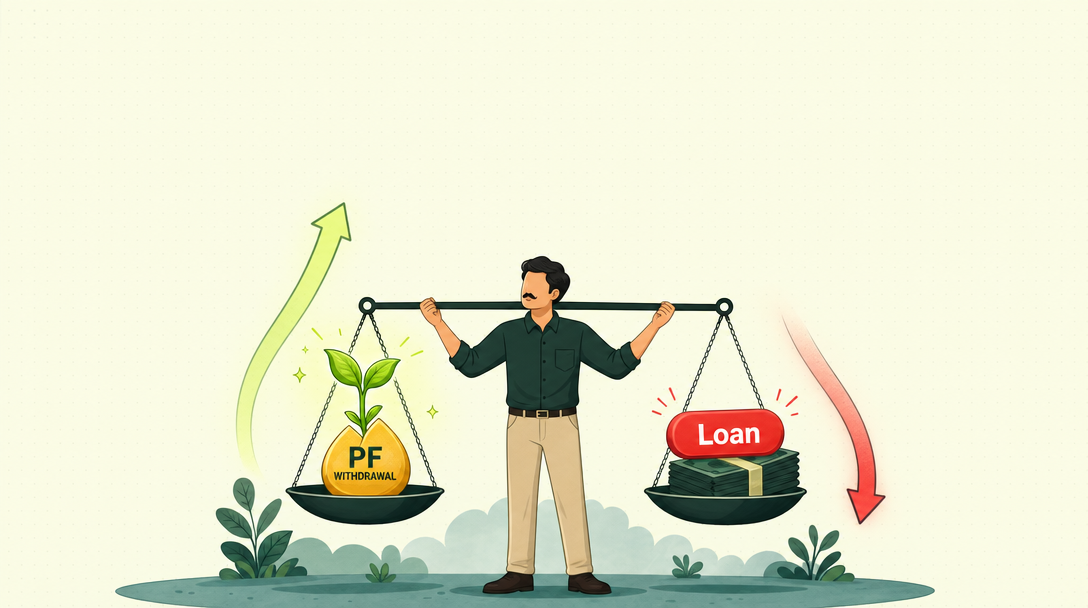
When a large expense lands, two sources of money look obvious to a salaried employee: the provident fund that has quietly built up for years, and a personal loan that can be in the bank by tomorrow. One feels free. The other has an interest rate printed on it.
The real comparison is not that simple. EPF money is not free, because it stops compounding the day it leaves. A personal loan is not automatically worse, because it keeps your retirement savings intact. This guide sets out the 2026 EPF withdrawal rules, runs the numbers both ways, and gives you a clear way to decide.
EPF partial withdrawal rules in 2026
EPFO simplified partial withdrawals in October 2025, and the Employees’ Provident Fund Scheme, 2026 brought new provisions into force on 29 June 2026. The key rules now are:
- 12 months of service is the uniform minimum for partial withdrawals.
- Three broad categories replace the earlier 13: essential needs (illness, education, marriage), housing needs, and special circumstances, where no reason is required.
- A 25% minimum balance must stay in the account. The remaining 75%, including the employer’s share and interest, is the “eligible balance” you can draw on.
- Faster settlement. Many partial claims are now settled automatically without documentary proof.
- Pension money is separate. The EPS portion cannot be withdrawn for these purposes.
Partial withdrawals are not taxed. The EPF interest rate for 2025-26 is 8.25%, ratified by the government in June 2026.
The hidden cost of a PF withdrawal
Every rupee withdrawn from EPF stops earning 8.25% a year, compounding and largely tax-free, until retirement. Over long horizons, that adds up to far more than the amount withdrawn.
| Withdrawn | Years to retirement | Value at 8.25% if left in EPF |
|---|---|---|
| ₹3,00,000 | 25 | ₹21.8 lakh |
| ₹3,00,000 | 28 | ₹27.6 lakh |
| ₹3,00,000 | 30 | ₹32.4 lakh |
A 30-year-old who withdraws ₹3 lakh and never puts it back gives up about ₹27.6 lakh at 58. That is the real price of “free” money.
The cost of a personal loan
A personal loan costs only what you pay in interest and fees, and your EPF keeps compounding untouched.
| Loan | Rate | Tenure | EMI | Total interest |
|---|---|---|---|---|
| ₹3,00,000 | 11% | 24 months | ₹13,982 | ₹35,576 |
| ₹3,00,000 | 13% | 36 months | ₹10,108 | ₹63,895 |
On these numbers, a loan at 13% costs about ₹64,000 in interest. Compared with ₹27.6 lakh in lost retirement savings, the loan looks cheap. But that comparison is not fair either.
The comparison most articles get wrong
The ₹27.6 lakh figure assumes the withdrawn money is never replaced. The ₹64,000 figure ignores that you spend ₹10,108 a month for three years on EMIs. A fair test gives both options the same monthly cash outflow.
Suppose you withdraw ₹3 lakh from EPF, then commit the same ₹10,108 a month for 36 months to your Voluntary Provident Fund (VPF), which earns the EPF rate.
| Path | Your monthly outflow | EPF-linked savings after 3 years |
|---|---|---|
| Take the loan, leave EPF untouched | ₹10,108 EMI | About ₹3.8 lakh (the original ₹3 lakh grown) |
| Withdraw from EPF, repay yourself through VPF | ₹10,108 to VPF | About ₹4.1 lakh |
With the same discipline, withdrawing and repaying yourself leaves you about ₹30,000 better off, because you are effectively borrowing at 8.25% instead of 13%.
The catch is the word discipline. Most people who withdraw from PF never rebuild it, and there is no lender sending a reminder when the VPF contribution quietly stops.
When to use PF and when to borrow
A PF withdrawal makes more sense when
- The need is a genuine emergency, such as medical treatment, and speed and certainty matter most
- Your credit profile would only get you a loan above 16% to 18%, or none at all
- You will set up a VPF contribution immediately to rebuild the amount
- The withdrawal is small relative to your total corpus
A personal loan makes more sense when
- You have a strong CIBIL score and can borrow at 10.5% to 12%
- You are early in your career, and your PF corpus is small and needs every year of compounding
- The expense is planned and repayable within two to three years
- You know you are unlikely to rebuild your PF on your own
- The 25% floor or the 12-month service rule leaves you short of what you need
Situations where neither is ideal
If the expense is discretionary, such as a vacation or a gadget upgrade, neither raiding retirement savings nor taking a loan is a good idea. If you already carry several EMIs, adding a new loan worsens your FOIR, and consolidating existing debt may free more cash than either option.
For short-term needs, compare a loan against FD too, which is often priced just 1 to 2 percentage points above the FD rate.
Use cases
Amit, 29, needs ₹3 lakh for his sister’s wedding. His EPF balance is ₹6 lakh and his CIBIL score is 785. He qualifies for a personal loan at 11% for two years, with an EMI of ₹13,982. Withdrawing would take half his retirement savings at an age when compounding matters most, so he borrows.
Rekha, 41, faces a ₹2.5 lakh hospital bill. Her credit profile is thin, and loan offers come in above 18%. Her EPF balance is ₹14 lakh. She makes an essential-needs withdrawal, which settles within days, and sets up a VPF contribution of ₹8,000 a month to rebuild it.
Key takeaways
- Under the 2026 EPF rules, you can withdraw up to 75% of your balance after 12 months of service; 25% must stay in the account.
- PF money is not free: ₹3 lakh withdrawn at 30 can mean about ₹27.6 lakh less at retirement if it is never replaced.
- A personal loan at 13% on ₹3 lakh costs about ₹64,000 in interest over three years.
- Withdrawing and repaying yourself through VPF beats a 13% loan, but only if you actually rebuild.
- Strong credit, early career and planned expenses favour a loan; emergencies and expensive credit favour PF.
Frequently Asked Questions
After 12 months of service, up to 100% of your eligible balance, which is 75% of your total accumulated balance. At least 25% must remain in the account.
No. Partial withdrawals under EPF rules are not taxed. Tax issues arise mainly on certain final withdrawals made before five years of continuous service.
If you have good credit and are early in your career, a personal loan usually protects more long-term wealth. If loans are expensive for you, a PF withdrawal followed by VPF contributions can cost less.
No. EPF is not credit and is not reported to bureaus. A personal loan does appear on your report and builds history if paid on time.
Not as a direct repayment, but you can increase your Voluntary Provident Fund contribution through your employer, which earns the EPF rate.
Conclusion
The right choice depends less on the interest rate and more on what you will do afterwards. Borrowing from your PF is cheaper only if you pay yourself back. A personal loan costs more in interest but protects decades of compounding by default. Choose the option whose discipline you can rely on.
If you decide to borrow, compare personal loan offers from multiple lenders on TapTap Loans and get the lowest rate your profile qualifies for.