






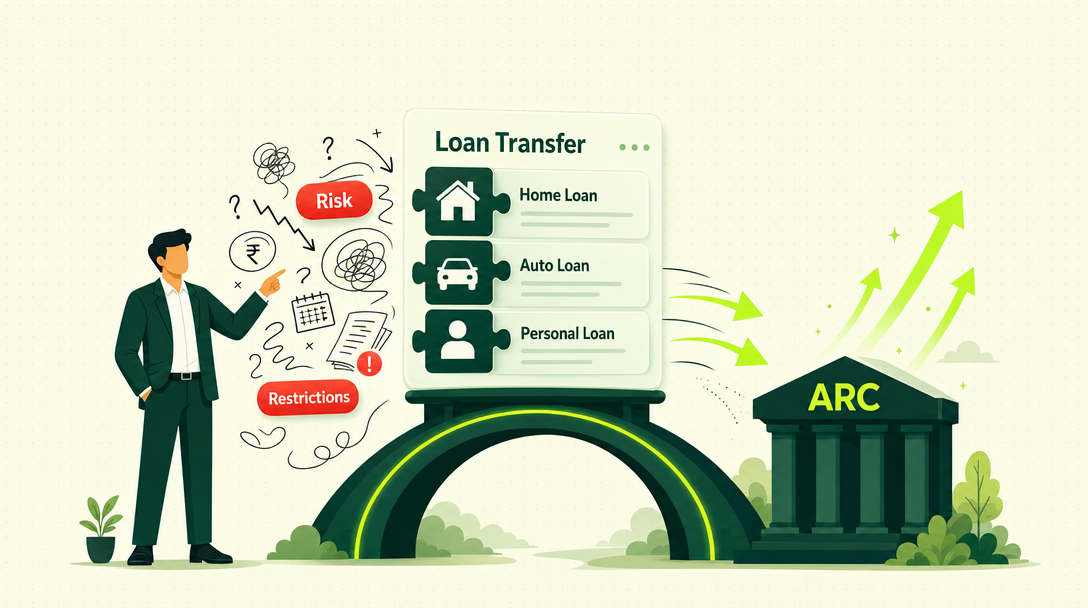
A letter arrives from a company you have never heard of, saying it now owns your loan. For many borrowers, that is the first sign that a long-overdue account has been sold by the bank to an asset reconstruction company (ARC). The usual reactions are confusion, and sometimes the mistaken belief that the debt has gone away.
It has not. The ARC now holds the same rights the bank had. But the change does open options, particularly around settlement, that were harder to reach while the loan sat with the original lender. This guide explains what an ARC is, what it can and cannot do, and how to respond.
What an asset reconstruction company is
An ARC is a specialised financial institution registered with, and regulated by, the Reserve Bank of India under the SARFAESI Act, 2002. Its business is buying stressed loans from banks and NBFCs and recovering what it can.
ARCs typically buy portfolios of non-performing assets (NPAs) at a discount to the amount outstanding, paying partly in cash and partly in security receipts. Their returns come from recovering more than they paid.
Why lenders sell loans to ARCs
Once a loan has been an NPA for some time, the lender has already set aside provisions for it and spent effort on collection. Selling it clears the account from the books, frees management time, and converts an uncertain recovery into cash today.
From the borrower’s side, a sale usually means the account had been overdue for many months, had been classified as an NPA after 90 days past due, and may already have been written off in the lender’s books. Our guides on NPA meaning and SMA status explain how an account reaches that stage.
What changes for you, and what does not
| Changes | Does not change |
|---|---|
| Who you owe and pay | The fact that the debt is owed |
| Who contacts you about recovery | Your original loan terms, including the interest rate and charges allowed by the contract |
| The account number and the entity on your credit report | Your liability as borrower, co-borrower or guarantor |
| Willingness to negotiate a settlement | Your legal rights and protections as a borrower |
An assignment transfers the lender’s rights and obligations to the ARC. The ARC steps into the lender’s position. It cannot add charges or raise the rate beyond what your original agreement permits.
What an ARC can do: secured vs unsecured loans
Secured loans: home loans, loans against property, vehicle loans
For secured loans, an ARC can use the SARFAESI Act just as a bank could. That means a demand notice under Section 13(2) giving you 60 days to repay, followed,d if unpaid, by steps under Section 13(4) to take possession of the secured asset, and ultimately its sale.
You can respond to the 13(2) notice with a written representation, which the ARC must consider and reply to. You can also approach the Debt Recovery Tribunal if you believe the action is unlawful.
Unsecured loans: personal loans and credit cards
There is no asset to enforce against. The ARC’s options are negotiation, a civil suit, recovery proceedings before the DRT where the amount crosses the tribunal’s threshold, or arbitration if your agreement provides for it.
In practice, most unsecured accounts bought by ARCs are resolved through settlements, because litigation for small amounts is expensive relative to the recovery.
Your rights when dealing with an ARC
- The right to be informed. You should receive notice of the assignment. Ask for a letter from the original lender confirming the sale, or the ARC’s registration details.
- The right to verify. Check the ARC’s name against RBI’s list of registered ARCs before paying anything.
- The right to a statement of dues. Ask for a break-up of principal, interest, est, and charges, and compare it with your last statement from the original lender.
- The right to fair recovery conduct. ARCs and their agents must follow RBI’s fair practices and recovery conduct rules. Threats, abuse, calls at odd hours, or contacting your family and colleagues are not allowed. Our guide to RBI rules on loan recovery agents sets out the limits.
- The right to complain. ARCs are RBI-regulated. If a written complaint to the ARC goes unresolved, you can escalate to RBI.
Settling with an ARC: how it works.
Because an ARC bought your loan at a discount, it can often accept less than the full outstanding amount and still make a return. ARCs settle under board-approved policies, and settlement terms are usually more flexible than those of the original bank.
What to negotiate
- A lump-sum amount you can actually pay, or a short instalment plan
- Waiver of penal interest and charges added after the account became an NPA
- A written settlement letter on the ARC’s letterhead before you pay, stating the amount, the dates, and that the account will be closed on payment
- A No Dues Certificate after the final payment
What settlement does to your CIBIL report
A settled account is reported as “settled”, not “closed”. Lenders read that as a loss on a previous loan, and it weighs on approvals for years. Your report may also show the original account as written off or transferred, alongside the ARC’s account.
If you can afford to pay the full outstanding amount, or a restructured plan that ends in full repayment, the long-term credit outcome is better. Compare the two honestly using our guide to one-time settlement.
How to respond to an ARC letter, step by step
- Do not ignore it. Silence on a secured loan can lead to enforcement within months.
- Verify the ARC against RBI’s register and confirm the assignment with the original lender.
- Request a full statement of dues and check it against your own records.
- Decide your route: full repayment, a restructured plan, or a settlement.
- Negotiate in writing, and keep copies of every letter and email.
- Pay only to the ARC’s official bank account, never to an individual or a UPI handle given over a call.
- Collect the closure or settlement letter and No Dues Certificate, then check your credit report a month later and dispute any error.
Use cases
Manoj stopped paying a ₹4.5 lakh personal loan during a period of unemployment. Two years later, an ARC wrote to say it had acquired the loan. He verified the ARC, asked for a statement, and found ₹1.1 lakh in penal charges. He negotiated a lump-sum settlement well below the claimed total, got the terms in writin,g and paid from savings. He accepts that “settled” will sit on his report and is now rebuilding with on-time payments on a secured card.
Lata’s home loan was sold to an ARC after a family medical crisis. She received a Section 13(2) notice. She replied within the 60 days with a proposal, paid part of the overdue amount, andagreed too a revised schedule. The account remains with the ARC, but enforcement stopped.
Key takeaways
- When a loan is sold to an ARC, the debt remains; only the creditor changes.
- The ARC holds the original lender’s rights but cannot exceed the original contract’s terms.
- Secured loans can face SARFAESI action; unsecured loans are usually settled or pursued through courts or the DRT.
- Verify the ARC with RBI, insist on a statement of dues, and get every settlement in writing before paying.
- A settlement closes the dispute but leaves a “settled” status that affects future credit.
Frequently Asked Questions
No. The debt is transferred, not cancelled. The ARC can recover it with the same rights the original lender had.
No. The ARC is bound by the terms of your original loan agreement and cannot raise the rate or add charges the contract does not allow.
Check its name against RBI’s list of registered asset reconstruction companies and ask the original lender to confirm the assignment in writing.
Often, yes. ARCs buy loans at a discount and frequently accept settlements. Get the agreed amount and closure terms in writing before you pay.
The account stops accumulating overdue days, which helps. But it is reported as settled, which continues to weigh on applications for several years.
Conclusion
A loan sold to an ARC is a late-stage problem, but not a hopeless one. The ARC usually wants a resolution more than a lawsuit, and that gives a well-prepared borrower room to negotiate. Verify first, get everything in writing, and choose the outcome that protects your finances and your credit together.
If you are still current on your loans but feel this path approaching, act now. Talk to TapTap Loans about reducing your EMI burden before an account slips into NPA.