





For most Indian borrowers juggling three or more debts, loan consolidation in India is cheaper and simpler because it locks in a fixed rate and EMI for the entire repayment period. Balance transfer works out cheaper only in one specific scenario: a single credit card balance, small enough, that you’re confident you can pay off entirely within the introductory low/0% interest window typically 3 to 12 months. Outside that narrow window, balance transfer’s post-promotional rate often jumps back above where you started, erasing the benefit.
What Is Loan Consolidation?
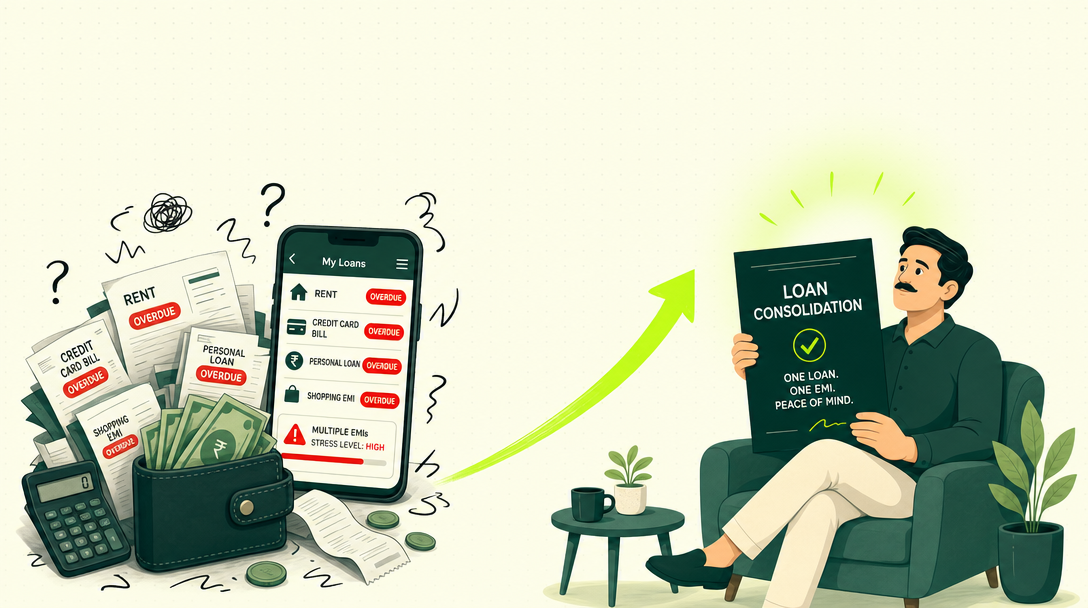
Loan consolidation combines multiple debts credit cards, personal loans, or both into a single loan with a fixed interest rate and tenure. You make one EMI, on one date, and the rate doesn’t change midway through unless you have a floating-rate loan.
What Is Balance Transfer?
Balance transfer moves an existing debt balance- a loan in India, most commonly a credit card balance, sometimes a personal loan to a new lender offering a lower rate, often a promotional 0% rate for a limited period. After that window closes, the interest rate typically reverts to a standard (and sometimes higher) rate.
Side-by-Side Comparison
| Factor | Loan Consolidation | Balance Transfer |
|---|---|---|
| Best suited for | Multiple debts, larger combined balance | Single card, smaller balance, short payoff timeline |
| Interest rate | Fixed, 9.75–18% p.a. for the full tenure | 0% or low promotional rate, reverts after 3–12 months |
| Repayment structure | Fixed EMI, fixed tenure | Flexible during promo period; risk of rate spike after |
| Number of debts handled | Multiple at once | Typically one at a time |
| Fees | Processing fee (1–2%), possible foreclosure charge on old loans vs prepayment | Transfer fee (1–3% of balance) |
| Risk if not managed | Overextending tenure to lower EMI | Missing the payoff deadline before rate reverts |
Real Example: ₹5,00,000 Debt Compared
Say you owe ₹5,00,000 across credit cards at a blended 22% p.a.
Balance Transfer route: You move the debt to a card offering 0% interest for 12 months, paying a 3% transfer fee (₹15,000) upfront. If you clear the full ₹5,00,000 within the 12 months, your total cost is exactly ₹5,15,000 no interest at all, just the fee. This is the best-case outcome for balance transfer, and it requires disciplined, aggressive repayment within a tight window.
Consolidation route: You take a 3-year consolidation loan at 10% p.a. Your EMI is lower and more manageable month to month, but because the tenure is longer, total repayment comes to roughly ₹5,80,000 more than the balance transfer’s best case, but spread comfortably over 36 months instead of demanding full repayment in 12.
The verdict flips depending on your cash flow: if you can genuinely clear ₹5 lakh within a year, balance transfer wins on total cost. If you need the payment spread out to stay affordable, consolidation wins on sustainability, and if you can’t clear the balance transfer within its window, its true cost jumps well past the consolidation loan’s, because post-promotional card rates routinely exceed 30%.
When to Choose Loan Consolidation
- You have three or more separate debts and want to consolidate multiple personal loans.
- Your income supports a fixed EMI comfortably, and you’d rather have certainty over the full tenure than a countdown clock.
- You’re not confident you can pay off the full balance within a typical 6–12 month promotional window.
- You want the psychological simplicity of one due date instead of tracking multiple cards and their differing promotional end dates.
When to Choose Balance Transfer
- You have one clearly defined card balance, not multiple debts spread across accounts.
- You have a realistic, disciplined plan to clear the full balance before the promotional rate expires.
- Your balance is small to moderate relative to your income, making an aggressive 6–12 month payoff genuinely achievable.
- You have a good enough credit score to qualify for the best promotional balance transfer offers, which tend to go to stronger profiles.
Many borrowers actually benefit from combining both strategies over time — using a balance transfer to buy breathing room on one card while separately consolidating other higher, harder-to-clear debts into a fixed loan. The right call depends less on which product is “better” in the abstract and more on your specific mix of debts, income stability, and repayment discipline.
A Middle-Ground Strategy: Sequential Use
Many financially savvy borrowers don’t pick one option exclusively; they sequence them. A common pattern: use a balance transfer aggressively on the single largest, highest-interest card balance first, since that’s where the 0% promotional window delivers the biggest bang for the buck. Simultaneously, consolidate the remaining smaller debts (other cards, an existing personal loan) into a single fixed-rate loan, since those are harder to pay off within a tight promotional window anyway. This hybrid approach captures the best of both: maximum interest-free savings on the debt you can genuinely clear fast, and payment stability on everything else.
What Lenders Actually Look At for Each Option
For a balance transfer, the receiving card issuer is primarily interested in your credit score and existing relationship with them (many of the best promotional offers go to customers the issuer is trying to win over from competitors); approval tends to be faster and less document-heavy than a full loan application.
For consolidation, the lender is underwriting a full personal loan, which means a more thorough look at your income, FOIR, employment stability, and overall debt profile. This is more paperwork upfront, but it also means the lender has effectively “signed off” on your ability to repay the full amount over the full tenure, re reducing the risk of a nasty surprise partway through, unlike a balance transfer where your situation could change before the promotional period ends.
A Second Worked Example: Smaller Balance, Shorter Timeline
Not every case involves ₹5 lakh. Consider a smaller, more common scenario: ₹1,50,000 on a single credit card at 32% p.a., with a borrower confident they can repay ₹15,000 a month.
Balance Transfer route: Moving the full ₹1,50,000 to a card with a 6-month 0% offer, at a 2% transfer fee (₹3,000). At ₹15,000/month, the balance clears in exactly 10 months, meaning 4 months fall outside the promotional window. Once the promo expires (after month 6), the remaining balance (roughly ₹60,000 at that point) starts accruing interest at the new card’s standard rate, which could be 30%+ adding a meaningful, if smaller, interest cost on top of the transfer fee.
Consolidation route: The same ₹1,50,000 consolidated into a 12-month personal loan at 13% p.a. produces an EMI of roughly ₹13,400 comfortably within the same monthly budget, fully clearing in exactly 12 months with total interest of around ₹10,800, all known upfront with no risk of a rate spike partway through.
In this case, consolidation turns out both cheaper and safer, precisely because the balance transfer’s promotional window (6 months) didn’t match the borrower’s realistic repayment pace (10 months). This is the core lesson: balance transfer’s advantage evaporates and can even reverse the moment your actual repayment timeline overshoots the promotional period, which is a more common outcome than borrowers often expect once real-world cash flow variability is factored in.
Frequently Asked Questions
It depends entirely on your ability to repay within the balance transfer’s promotional window. If you can genuinely clear the full balance before the low-rate period ends typically 6 to 12 months balance transfer is usually cheaper, since you pay only a one-time fee and little to no interest. If you need longer to repay, consolidation’s fixed rate for the full tenure is usually cheaper, since post-promotional balance transfer rates can exceed 30%, often higher than what a consolidation loan would have charged from the start.
Yes, and it’s a genuinely sound strategy for borrowers with multiple debts of different sizes. Use a balance transfer for the one balance you’re confident of clearing quickly, and consolidate the rest into a fixed-rate loan. Just make sure you’re tracking both repayment timelines carefully, since managing two different structures simultaneously requires more discipline than either alone.
Consolidation loans are often more accessible for lower credit scores (in the 650–700 range), since a wider range of NBFCs specifically cater to this risk band, albeit at a somewhat higher interest rate than what a top-tier score would command. The best balance transfer promotional offers genuinely 0% for 12 months tend to be reserved for stronger credit profiles (generally 700+), meaning borrowers with weaker scores may find consolidation both more accessible and, once fees are factored in, comparably priced.
Both trigger a credit inquiry when you apply, causing a similar small, temporary dip. The bigger score impact difference tends to show up later in the process: consolidation’s fixed EMI is generally easier to pay consistently on time since the amount never changes, while a missed payment deadline on a balance transfer failing to clear the balance before the promo period ends can simultaneously spike your interest cost and your credit utilization ratio, compounding the negative effect on your score.
This is exactly the kind of decision where a loan advisory platform adds the most value. Rather than manually modeling both scenarios against your specific balance, rate, and timeline, a platform like TapTap can run both comparisons against your actual numbers and recommend the option that genuinely costs less for your situation, not just the one with the more attractive headline rate.
Not sure which option fits your specific debts? Talk to TapTap; we assess your full profile across 20+ lenders and recommend the option that actually saves you the most, not just the one with the flashiest advertised rate.