





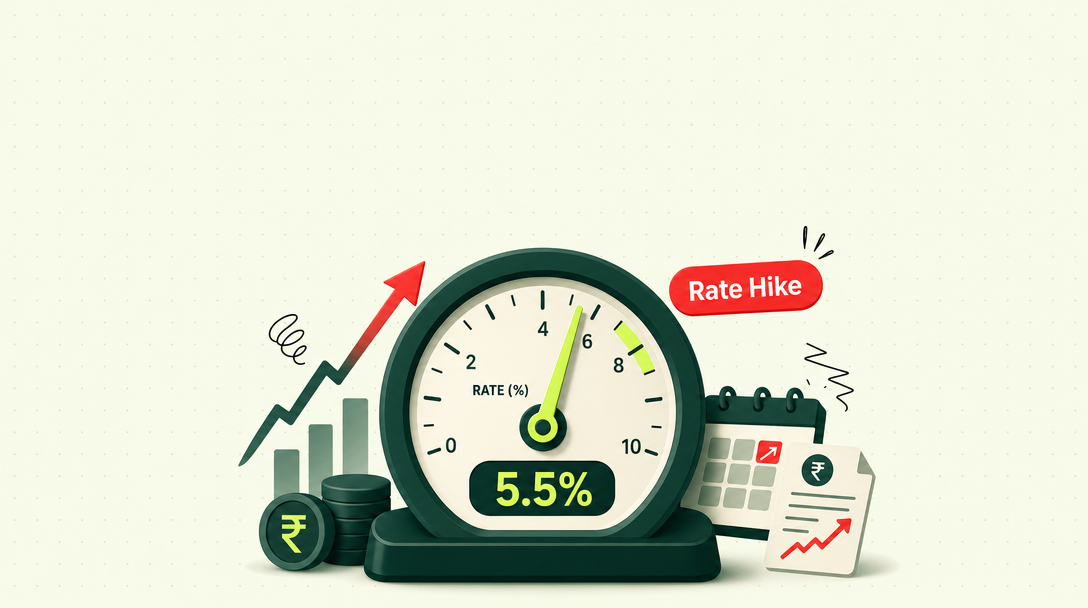
On 7 October 2026, the Reserve Bank of India raised the policy repo rate by 25 basis points to 5.50%. It is the first increase since February 2023, and the Monetary Policy Committee also changed its stance from neutral to calibrated tightening, which signals that rate cuts are off the table for now.
For borrowers, the headline number matters less than the plumbing. Whether your EMI moves next month, next year, or not at all depends on how your loan is priced. This guide explains exactly how a repo rate hike travels to your loan, what it costs in rupees, and the decisions worth making in the next 90 days.
What RBI decided on 7 October 2026
The MPC voted unanimously at its 63rd meeting, held 5 to 7 October, to lift the repo rate from 5.25% to 5.50%. Retail inflation had climbed to 4.82% in August 2026, above the 4% target, with pressure from elevated crude prices, West Asia-related risks and a weaker rupee.
The stance change is the more important signal. “Calibrated tightening” means the next move is either another hike or a pause. Several economists, including SBI Research and Nomura, had expected a second 25 bps increase in December, which would take the repo rate to 5.75%. The MPC minutes are due on 21 October 2026.
How a repo rate hike reaches your loan
The repo rate is what RBI charges banks for short-term funds. It does not appear in your loan agreement directly, but one of three pricing structures links your interest rate to it.
External benchmark loans (EBLR or RLLR)
Since 1 October 2019, RBI has required banks to link new floating-rate retail loans, including home and personal loans, to an external benchmark. Most banks chose the repo rate.
Your rate is the benchmark plus a spread fixed at sanction. When the repo rate rises 25 bps, your rate rises 25 bps at the next reset. RBI requires the rate to be reset at least once every three months, so most EBLR borrowers see the change within one quarter.
MCLR-linked loans
Loans sanctioned between April 2016 and September 2019 are usually linked to the bank’s Marginal Cost of Funds-based Lending Rate. MCLR is an internal benchmark that moves with the bank’s own cost of deposits and borrowings.
Transmission is slower and less complete. Your rate changes only on your reset date, which is often once a year, and only by however much the bank has revised its MCLR by then.
Fixed-rate loans
Most personal loans in India are fixed-rate. If yours is, the repo hike does not change your EMI at all. The rate in your sanction letter holds for the full tenure.
What changes is the price of your next loan. Lenders reprice new disbursals quickly after a hike, so a personal loan quoted at 12% in September may be quoted at 12.25% or higher in November.
What happens to your EMI: worked examples.
The examples below use the standard reducing-balance EMI formula. Interest rates are illustrative; the arithmetic is exact for the rates shown.
| Loan | Before hike | After 25 bps | EMI change | Extra cost over remaining tenure |
|---|---|---|---|---|
| ₹50 lakh home loan, 20 years, EBLR | 7.90%: ₹41,511 | 8.15%: ₹42,290 | +₹779 a month | ₹1.87 lakh |
| ₹30 lakh home loan, 15 years left, EBLR | 8.40%: ₹29,367 | 8.65%: ₹29,807 | +₹440 a month | ₹79,000 |
| ₹5 lakh new personal loan, 3 years | 12.00%: ₹16,607 | 12.25%: ₹16,667 | +₹60 a month | ₹2,160 |
If RBI hikes again in December, the ₹50 lakh borrower’s EMI rises to ₹43,075, which is ₹1,564 a month more than before October.
Two points stand out. First, the absolute impact of a single 25 bps hike is modest. Second, the impact scales with loan size and remaining tenure, so large, young home loans carry most of the risk.
Raise the EMI or extend the tenure?
When a floating rate resets upward, most banks default to extending the tenure so your EMI stays the same. That default is convenient and expensive.
Take the ₹50 lakh loan above. If the EMI stays at ₹41,511 after the rate rises to 8.15%, the tenure stretches by about 11.7 months. Those extra instalments cost roughly ₹4.88 lakh, against ₹1.87 lakh if you simply accept the ₹779 increase in EMI.
RBI’s 2023 framework on resetting floating rates on EMI-based personal loans gives you the right to choose. At each reset, the lender must offer you the option to increase the EMI, extend the tenure, or combine both, and to switch to a fixed rate where the lender offers one. You can also prepay in part at any time.
If your cash flow allows it, ask for the EMI increase in writing. It is the cheaper path in almost every case.
What to do now, by loan type: If you have an EBLR home loan
- Check your spread. The repo rate is the same for everyone; the spread is where lenders differ. A borrower paying repo plus 3% is paying 50 to 75 bps more than many new borrowers.
- Ask your lender for a spread reduction. Many banks offer a conversion for a one-time fee.
- If they refuse, compare a home loan balance transfer. The break-even math is usually clear within a few minutes.
If you have an MCLR-linked loan
- Find your next reset date on your loan statement.
- Compare your current MCLR rate with your bank’s EBLR rate for new borrowers. If the EBLR rate is lower even after the hike, a switch can still save money.
If you have a fixed-rate personal loan
- Your EMI does not change. No action is required on the existing loan.
- If you were planning a personal loan balance transfer, move sooner. New-loan pricing will drift up through the tightening cycle.
If you plan to borrow in the next six months
- Get your CIBIL report in order now, because the rate you are offered depends more on your score than on the repo rate.
- Compare fixed and floating options honestly. In a tightening cycle, a fixed rate removes reset risk, but floating loans carry no prepayment charges for individual borrowers.
Use cases
Rahul, 34, has a ₹42 lakh EBLR home loan from 2023 at repo plus 2.9%. His new rate is 8.40%. A large private bank offers new borrowers with his profile repo plus 2.35%, or 7.85%. That 55 bps gap is worth more than this month’s hike, and fixing it is within his control.
Priya, 29, took a ₹4 lakh fixed-rate personal loan in June at 13.5%. Her EMI is unaffected. Her decision is simply not to take a second loan this quarter, and to clear one credit card balance so her score improves before she needs credit again.
Key takeaways
- RBI raised the repo rate to 5.50% on 7 October 2026 and moved to a calibrated tightening stance.
- EBLR loans reprice within three months; MCLR loans move on their reset date; fixed-rate personal loans do not move at all.
- On a ₹50 lakh, 20-year loan, 25 bps adds ₹779 to the EMI, or about 11.7 months to the tenure.
- Accepting a higher EMI usually costs far less than letting the tenure stretch.
- Your spread over the repo rate is the number you can negotiate, and it often matters more than the hike.
Frequently Asked Questions
Only if your personal loan is on a floating rate. Most personal loans in India are fixed-rate, so the EMI stays exactly as sanctioned. New personal loans are likely to be priced slightly higher.
For EBLR-linked loans, within the next reset cycle, which RBI caps at three months. For MCLR-linked loans, on your annual or half-yearly reset date.
Yes. RBI’s reset framework requires lenders to let you choose between a higher EMI, a longer tenure, or a mix, and to communicate the change clearly.
It can be, if another lender offers a lower spread over the same benchmark. A hike raises rates for everyone; the spread difference between lenders is what a transfer captures.
The MPC said future action will be either a hike or a pause. Several economists expect another 25 bps in December. Plan your budget for that possibility.
Conclusion
A 25 bps hike will not break a household budget, but it ends the easing cycle that began in 2025, and it exposes how much borrowers are paying above the benchmark. The repo rate is set in Mumbai. Your spread, your reset choice, and your credit score are set by you.
If your EMIs already feel heavy, now is the time to review them before a second hike lands.
Check how much you could save on your existing loans with TapTap Loans.