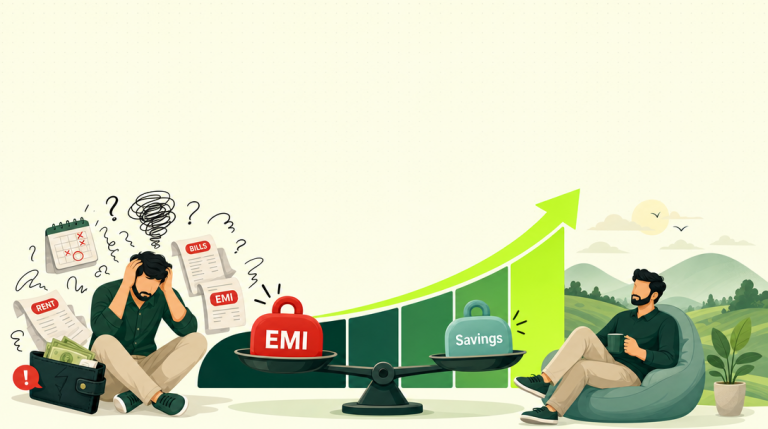






Your EMI is too high if it consumes more than 40–50% of your monthly take-home pay. Lenders use a metric called FOIR (Fixed Obligation to Income Ratio) to measure exactly this — and if you are above the threshold, you are not just financially stressed today, you are also ineligible for further credit tomorrow. This checklist will tell you exactly where you stand.
The Quick Answer: What FOIR Tells You
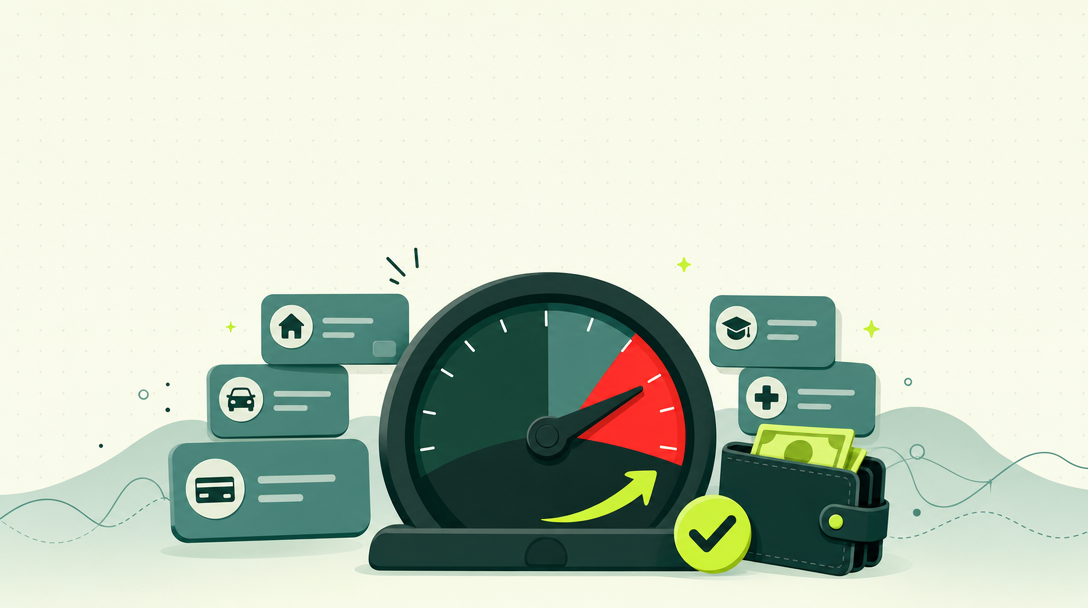
FOIR stands for Fixed Obligation to Income Ratio. It is the percentage of your monthly net income that goes toward all loan EMIs combined — personal loans, home loans, car loans, and credit card minimum dues. Banks and NBFCs calculate this before approving any new loan. If your FOIR is already above 50–55%, most lenders will either reject your application or offer a much higher interest rate.
Formula: FOIR = (Total Monthly EMIs ÷ Net Monthly Income) × 100
| FOIR Range | What It Means | Your Risk Level |
|---|---|---|
| Below 30% | Comfortable — you have room for additional credit | Low |
| 30–40% | Manageable — but monitor carefully | Moderate |
| 40–50% | Stretched — one income disruption away from default | High |
| Above 50% | Dangerous — most lenders will not extend fresh credit | Very High |
Three Real Borrower Scenarios
Scenario 1 — Ravi (Salaried, ₹55,000/month net)
Ravi has a personal loan EMI of ₹15,000, a car loan EMI of ₹8,000, and pays ₹2,500 as the minimum due on his credit card. Total obligations: ₹25,500. FOIR = (25,500 ÷ 55,000) × 100 = 46.4%. Ravi is in the danger zone. Any job disruption, emergency expense, or rate hike on his floating loans puts him at default risk. His EMI is too high — not catastrophically, but enough to act on immediately.
Scenario 2 — Priya (Self-Employed, ₹80,000/month net)
Priya runs a small business and shows a net income of ₹80,000 after taxes. She has two personal loans totalling ₹22,000 in EMI and a business loan EMI of ₹18,000. Total: ₹40,000. FOIR = 50%. For a salaried borrower at 50%, banks might still approve. For self-employed borrowers, most lenders apply a stricter cap of 40–45%, meaning Priya is already over their ceiling. Her EMI load is functionally too high for her borrower profile.
Scenario 3 — Karan (Salaried, ₹1,00,000/month net)
Karan earns ₹1 lakh net but has a home loan EMI of ₹28,000, a personal loan of ₹12,000, and no other obligations. FOIR = 40%. By numbers, he is within range. But Karan also has ₹60,000 in savings and zero emergency fund. The ratio alone does not capture full financial health. Even at 40%, if your savings rate is near zero, your EMI structure is more fragile than the number suggests.
The 5-Question EMI Diagnostic Checklist
- Calculate your FOIR right now. Add every loan EMI and credit card minimum due. Divide by your net monthly take-home. If it is above 40%, proceed to question 2.
- Have you missed or delayed any EMI in the past 12 months? Even one 30-day delay triggers a CIBIL flag that stays on your report for 7 years. If yes, your EMI is not just high — it is actively damaging your credit health.
- Do you have 3 months of EMI payments saved as a buffer? Most financial planners recommend maintaining a buffer equal to 3 months of total EMI obligations as an emergency reserve. If you do not, your EMI structure has zero tolerance for disruption.
- Is your EMI growing relative to your income? If you took a loan 2 years ago and your income has not grown proportionally, your effective FOIR has increased even without taking on new debt.
- Are you using credit cards to fund monthly living expenses? If yes, this is a critical warning sign. Credit cards charging 36–42% APR on revolving balances will compound your EMI burden faster than almost anything else.
What to Do If Your EMI Is Too High
There are three primary paths, and the right one depends on your specific profile:
- Balance Transfer: If you have a personal loan at 17–22% and a CIBIL score above 720, you may qualify for a lower rate — as low as 11–13% — by transferring your loan to a different lender. On a ₹10L loan with 24 months remaining, moving from 19% to 13% saves approximately ₹38,000 in interest. [See our Balance Transfer Guide for a complete calculation walkthrough]
- Partial Prepayment: If you have received a bonus or have idle savings, using ₹1–2 lakhs to prepay principal can meaningfully reduce your EMI without changing lenders. On a ₹10L loan at 14%, paying ₹1L extra after 12 months saves roughly ₹28,000 in total interest.
- Loan Consolidation: If you have 3 or more EMIs from different lenders, consolidating them into one personal loan at a lower rate simplifies cash flow and often reduces total monthly obligation. [See our Loan Consolidation Guide for eligibility criteria]
When Your EMI Problem Is Actually a Credit Score Problem
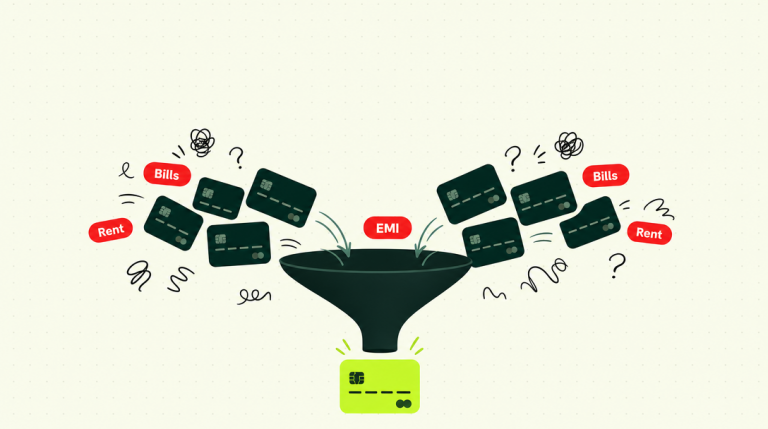
Many borrowers find that their EMI is high, not because they borrowed irresponsibly but because they were offered a high interest rate to begin with. A CIBIL score of 680 gets you 18–22% on a personal loan. The same borrower with a 750+ score gets 11–13%. If you have been paying EMIs consistently for 12–18 months and your CIBIL has improved, you may now qualify for a significantly lower rate through a balance transfer.
Check your CIBIL score for free on the official CIBIL website [External: www.cibil.com]. If your score has increased by 30–50 points since you took the loan, use that as leverage to either negotiate with your existing lender or transfer to a better-rate lender.
Decision Framework: When to Act vs When to Wait
| FOIR above 50%, CIBIL 720+ | Balance transfer immediately | High |
| FOIR 40–50%, CIBIL 700–720 | Partial prepayment or negotiate with the lender | Medium |
| FOIR 40–50%, CIBIL below 700 | Focus on CIBIL improvement first, then transfer in 6 months | Medium |
| FOIR below 40%, stable income | Monitor quarterly, no immediate action needed | Low |
| Missing EMIs already | Seek loan restructuring before default | Urgent |
If your FOIR is above 40%, check whether you qualify for a lower interest rate through a balance transfer. It takes 2 minutes to check your eligibility — and the savings can be substantial.
Frequently Asked Questions
A: Most lenders consider a FOIR of 40–50% acceptable for salaried borrowers. For self-employed individuals, the threshold is stricter — typically 35–45%. Keeping your total EMI burden below 40% of net income gives you financial headroom for emergencies and new credit needs.
A: It is difficult but not impossible. Some NBFCs extend credit at FOIR up to 60%, but at significantly higher interest rates. Most major banks and reputable NBFCs cap at 50–55%. If your FOIR is at 50%, your priority should be reducing it before applying for new credit.
A: Yes, but only the minimum due amount — not the total outstanding balance. However, lenders are increasingly factoring in total credit card exposure when assessing risk, even if technically only the minimum due enters the FOIR formula.
A: The fastest method is a combination of partial prepayment (reduces EMI on existing loans) and stopping new credit card usage. A balance transfer that reduces your interest rate also reduces your EMI, lowering your FOIR within 30–45 days of approval.
A: A single 30-day delayed payment creates a negative flag on your CIBIL report that stays for 7 years. It reduces your credit score by 50–100 points, depending on your profile. If you are close to missing an EMI, call your lender and request a one-month deferment rather than simply not paying.
Conclusion
An EMI that consumes 40–50% of your income is not just uncomfortable — it is a structural risk to your financial stability. The good news is that most borrowers in this situation have at least one viable path: a balance transfer to a lower rate, a partial prepayment to reduce principal, or a consolidation to simplify multiple obligations into one manageable EMI. The first step is knowing your FOIR. If you have calculated it and it is above 40%, check whether a lower rate is available to you today.