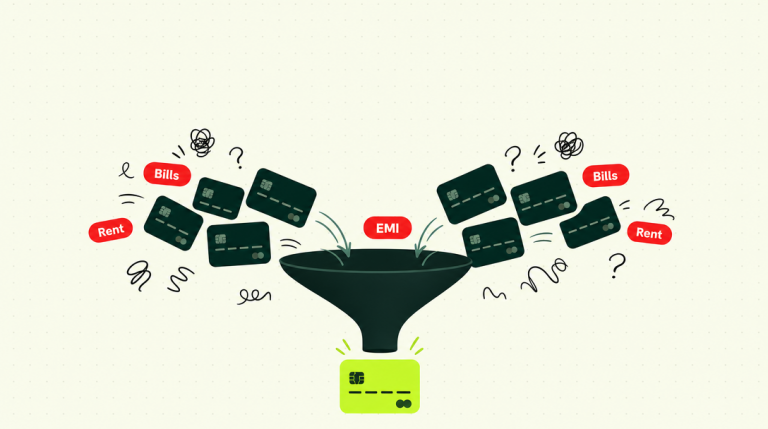






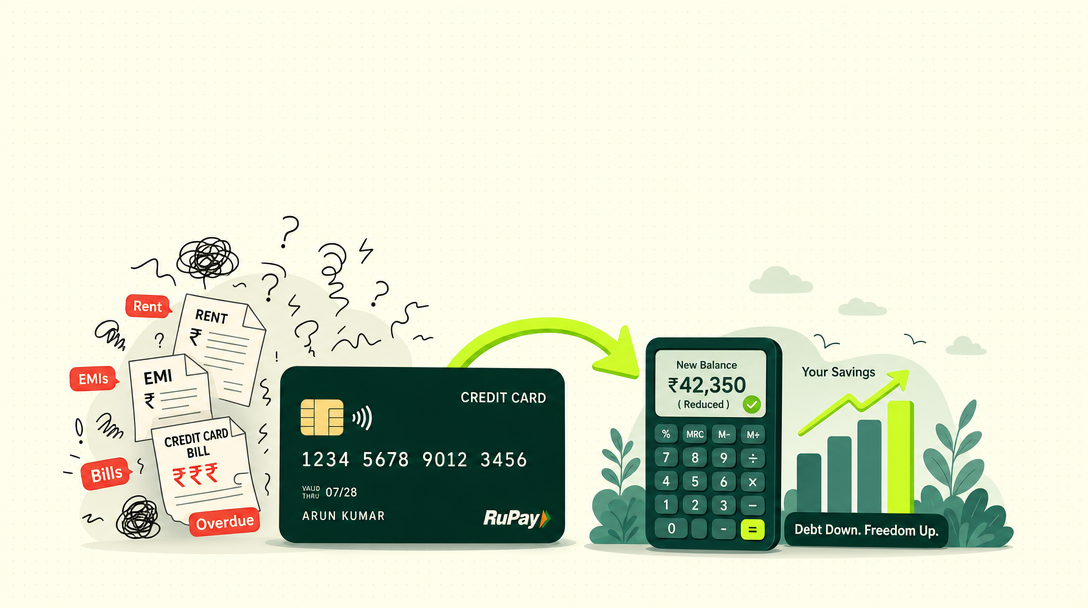
A credit card balance transfer sounds simple: move your credit card balance to a card (or lender) charging less interest. In practice, most borrowers don’t read the fine print closely enough — and the fine print is where the savings can disappear.
This guide explains how credit card balance transfers actually work in India in 2026, what the promotional rates mean (and don’t mean), and how to calculate whether the math works in your favour.
What is a Credit Card Balance Transfer?
A credit card balance transfer moves the outstanding balance from one credit card to another (or to a lender’s EMI plan) at a lower or zero interest rate for a specified promotional period. The intent is to reduce the interest cost on existing credit card debt.
In India, this facility is offered in two primary forms:
- Card-to-card transfer: Move balance from one credit card to another card at a promotional rate
- Balance transfer on EMI: Convert the outstanding balance into a fixed EMI plan offered by the card issuer at a lower rate (typically 12–18% p.a.)
Types of Credit Card Balance Transfers in India
Promotional Rate Transfer (0%–1.5% per month)
Some banks offer a credit card balance transfer at 0% or a very low monthly rate (e.g., 1–1.5%) for a promotional window of 3–6 months. After the promotional period ends, the standard rate (typically 3–3.5% per month = 36–42% p.a.) applies to any remaining balance.
This is only genuinely beneficial if you can clear the entire transferred balance within the promotional window.
Balance Transfer on EMI
This converts your outstanding balance into fixed monthly instalments at a flat interest rate, usually 12–18% per annum for 6–24 months. There is often a one-time processing charge of 1–2%. This is functionally similar to a personal loan, but initiated directly by your card issuer without a new credit application.
The Promotional Rate Trap
The most common misconception about credit card balance transfers: borrowers assume the promotional rate applies to new purchases on the new card as well. It typically doesn’t. New purchases continue to accrue interest at the standard rate, while payments are applied to clear the balance transfer amount first.
Additionally, some banks revert the full transferred balance to the standard rate if any payment is missed during the promotional period, even if one is missed. Read the terms carefully before initiating a credit card balance transfer.
How to Calculate Your Real Savings
Before executing a credit card balance transfer, calculate the total cost and savings:
Example: ₹1 lakh outstanding, promotional rate of 0% for 3 months, 1.5% balance transfer fee, standard rate of 40% applies after 3 months if the balance is not cleared.
The credit card balance transfer saves money only in Scenario 1. In Scenario 2, you pay the fee plus high interest on the residual, potentially worse than not transferring.
Eligibility and Approval Process
For a credit card balance transfer in India:
- You must have an existing credit card with the issuing bank, or apply for one that offers balance transfer facilities
- Your credit limit on the receiving card must be sufficient to accommodate the transferred balance
- CIBIL score influences approval, particularly for new card applications
- The balance must be from a card issued by a different bank (most issuers don’t accept own-card transfers)
Credit Card BT vs Personal Loan for Credit Card Debt
- A credit card balance transfer only saves money if you can clear the balance within the promotional period; otherwise, you pay the fee plus standard rates.
- Promotional rates in India range from 0% to 1.5% per month for 3–6 months; after that, standard rates (36–42% p.a.) apply to any remaining balance.
- New purchases on the receiving card typically do not benefit from the promotional rate.
- For balances you can’t clear in 3–6 months, a personal loan offers a more predictable, often cheaper solution.
- Missing even one payment during the promotional period can revert the entire balance to standard rates in many bank schemes.
Frequently Asked Questions
You transfer your outstanding balance from one credit card to another card (or to the issuer’s EMI plan) at a lower promotional rate. The receiving card pays off your existing balance, and you repay the new card at the lower rate for the promotional period.
Yes. Most banks charge a balance transfer fee of 1–3% of the transferred amount. This fee is typically charged upfront or added to the balance. Always factor this into the total cost calculation.
Some card issuers allow you to consolidate multiple credit card balance transfers onto one card, subject to the available credit limit. Alternatively, use a single personal loan to clear all card balances simultaneously — often a more efficient approach for large multi-card balances.
A balance transfer can work well if you can clear the debt within the promotional period. For longer repayment periods, a personal loan may offer more predictable costs.
Some issuers allow multiple transfers, subject to your available credit limit and eligibility.
Conclusion
A credit card balance transfer is a useful but conditional tool. The condition is simple: you must be confident you can fully repay the transferred amount within the promotional window. If that discipline is in place, the savings are real. If there’s uncertainty, a personal loan at a fixed rate for a defined tenure is the more reliable and often cheaper alternative. The decision comes down to how quickly you can clear the balance, not just which option sounds better.