





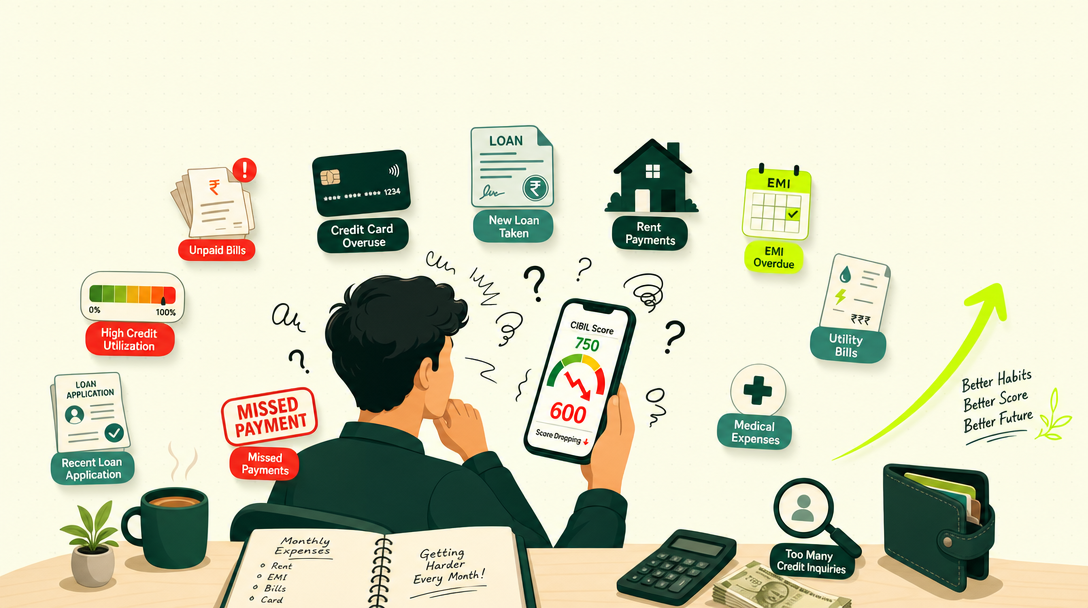
A CIBIL score that falls 40 points in a month feels arbitrary. It rarely is. The score is a summary of what your lenders have reported, so every drop has a cause somewhere in your credit report. The skill is knowing where to look.
This guide lists the 11 most common reasons a CIBIL score drops, shows you which section of the report reveals each one, and explains what to do about it. Some causes fix themselves within weeks. Others need a dispute, and a few need a change in how you manage debt.
First, rule out normal movement.
Scores move by a few points as balances change and accounts age. A drop of 5 to 10 points with no new event is usually noise.
Also check that you are comparing like with like. CIBIL, Experian, Equifax, and CRIF each compute their own score, and many free apps show Experian or CRIF rather than CIBIL. A “drop” between two different bureaus is not a drop.
A sustained fall of 20 points or more, or a sudden fall after a quiet period, deserves a closer look.
The 11 common causes of a score drop
1. A late or missed payment
This is the single largest driver. Even one EMI or card payment reported as days past due (DPD) can cause a sharp fall, and the impact grows with each 30-day bucket.
2. High credit card utilization
A large purchase reported before you paid it, or balances creeping up across cards, raises your utilization ratio. Our guide to credit utilization ratio explains how the reporting date catches people out.
3. Several loan applications in a short period
Each application to a lender creates a hard inquiry. Applying to multiple banks, NBFCs,s and loan apps within weeks signals credit hunger. Checking your own score is a soft inquiry and does not count, as explained in soft vs hard inquiry.
4. A new loan or card
A new account lowers the average age of your credit and adds to your total debt. The dip is usually modest and recovers as you pay on time.
5. Closing an old credit card
Closing a card removes its limit, which pushes up utilization, and over time can shorten your credit history.
6. A settlement or write-off being reported
If you settled a loan or card for less than the full amount, the account is reported as settled. If the lender wrote it off, the status shows as written off. Both are heavy negatives.
7. A reporting error
Wrong DPD entries, a closed loan still shown as active, a duplicate account,nt or a balance that does not match are more common than most people expect. These are fixable through a dispute.
8. A loan you guaranteed or co-borrowed
If you are a guarantor or co-applicant on someone else’s loan and they miss payments, it appears on your report and affects your score.
9. A forgotten small loan or BNPL dues
Small-ticket app loans and buy-now-pay-later balances of a few thousand rupees are reported like any other credit. A forgotten ₹1,500 can do real damage.
10. A lower credit limit
Issuers sometimes reduce limits on inactive cards or after reviewing risk. Your balance stays the same, but utilization jumps.
11. A loan opened in your name without your knowledge
Identity misuse, often through a leaked PAN or Aadhaar copy, can create accounts or inquiries you never applied for. These need a dispute and, if confirmed, a police complaint.
How to diagnose the drop in your report
Download your full CIBIL report, not just the score. Then work through it section by section.
| Cause | Where to look in the report | What you will see |
|---|---|---|
| Late payment | Account details, payment history grid | Days-past-due figures instead of “000” or “STD” |
| High utilization | Credit card accounts | Current balance close to the credit limit |
| Many applications | Enquiry section | Several enquiries from lenders in recent weeks |
| New account | Account details | An open date in the last 1 to 3 months |
| Closed card | Account details | Card marked closed, total limit lower |
| Settlement or write-off | Account status | “Settled”, “Written off” or post-write-off settled |
| Reporting error | Account details | Balances, dates,tes or status that do not match your records |
| Guarantor default | Account ownership | An account marked as guarantor or joint with DPD |
| Small loan or BNPL | Account details | A low-value account with DPD |
| Limit reduced | Credit card accounts | Lower sanctioned limit than before |
| Fraudulent account | Account details, enquiries | A lender or account you do not recognise |
Match the date of the drop with the reporting dates on each account. The account that changed around that time is almost always the cause.
Which drops fix themselves and which need action
Recover on their own, usually within one to three months:
- High utilization, once lower balances are reported
- A single hard inquiry
- A new account, as you build a payment record on it
Need action from you:
- Reporting errors and fraudulent accounts: raise a dispute through the bureau; our CIBIL dispute guide covers the steps
- Missed payments: bring the account current immediately; the record stays, but recent on-time payments reduce its weight over time
- Guarantor defaults: speak to the borrower and the lender; you are liable for the dues
Need a change in strategy:
- Repeated late payments or rising card balances usually mean too many EMIs for your income. Consolidating them into one manageable EMI stops the pattern that keeps pulling the score down.
Use cases
Vikram’s score fell from 768 to 731 in a month. His report showed no late payments, but four enquiries from different lenders in three weeks and a new credit card. He stopped applying, paid the new card in full before its statement date, and the score was back above 755 within two months.
Divya’s score fell 62 points. Her report showed 60 DPD on a ₹2,000 BNPL account she believed was closed. She paid it, raised a dispute about the late fee she had never been notified of, and asked the lender to confirm closure. The DPD record remains, but she stopped further damage and is rebuilding.
Key takeaways
- A meaningful drop almost always traces to a specific account or inquiry in your report.
- Missed payments and settlements cause the largest falls; utilization and inquiries cause smaller, temporary ones.
- Compare scores from the same bureau before concluding your score has dropped.
- Errors and unrecognised accounts should be disputed promptly.
- Repeated drops from late payments signal an EMI load problem, not a reporting problem.
Frequently Asked Questions
The usual causes are higher card utilization, recent loan applications, a new account, a closed card, or a reduced limit. Check the enquiry and credit card sections first.
No. Checking your own score is a soft inquiry and has no effect. Only lender inquiries made when you apply for credit count.
The record remains on your report for years, but its effect fades as you build a longer record of on-time payments after it.
Apps often show different bureaus. CIBIL, Experian, Equifax, and CRIF each use their own model and may receive data on slightly different dates.
Apps often show different bureaus. CIBIL, Experian, Equifax,x and CRIF each use their own model and may receive data on slightly different dates.
Conclusion
A falling CIBIL score is a message, not a mystery. Read the report, find the account that changed, and act on it: dispute what is wrong, wait out what is temporary, and fix what is structural. If the root cause is too many EMIs competing for one salary, solving that will do more for your score than any shortcut.
Find out whether consolidating your EMIs could stop the slide.