





Minimum Eligibility Checklist
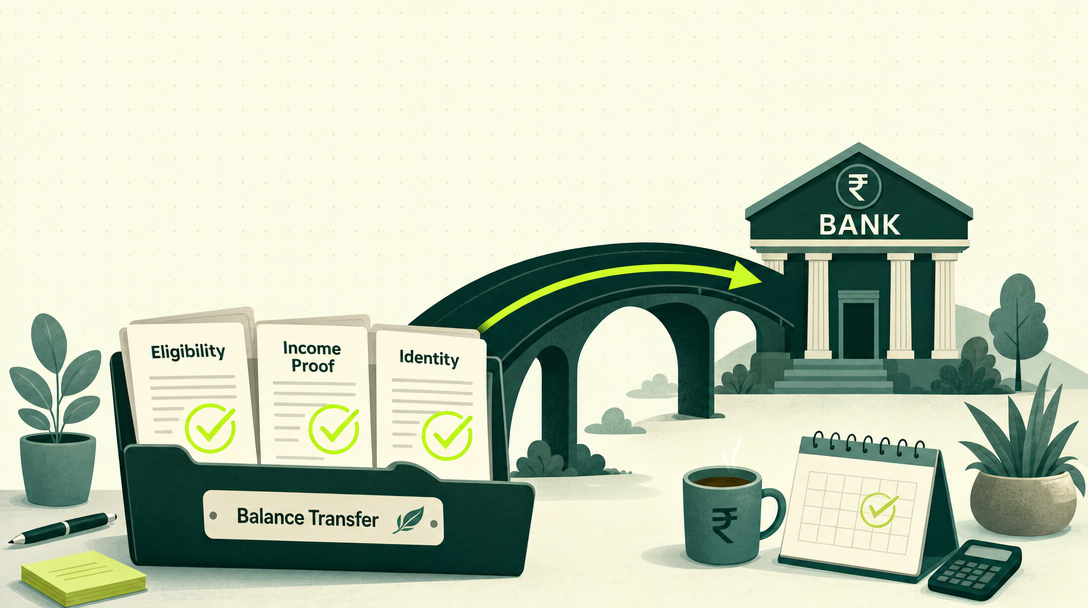
Before applying for a personal loan balance transfer in India, most lenders check for:
- CIBIL score of 700+ for the best rates (650–700 is workable but at a somewhat higher rate)
- A track record of on-time EMI payments on your existing loan; even one or two recent missed payments can hurt your application significantly.
- At least 12 months of remaining tenure, so the interest savings have time to outweigh transfer fees
- Stable income, whether salaried or self-employed, sufficient to support the new EMI within acceptable FOIR limits
- No major change in employment status since the original loan — job stability signals matter to the new lender.
CIBIL Score Required
Your credit score is the single biggest lever in a balance transfer decision, because it directly determines the rate you’re offered:
- 750+: Access to the lowest available rates, often near the bottom of the 9.75–14% range
- 700–749: Good access to competitive rates, typically 12–16%
- 650–699: Approval possible but at higher rates, typically 15–20%, and from a narrower set of lenders (mostly NBFCs)
- Below 650: Balance transfer becomes difficult; focus first on improving the score before reapplying
Minimum Tenure Remaining
Lenders generally prefer applicants with at least 12 months of tenure left on their existing loan. This isn’t an arbitrary rule; it reflects the math: transfer fees and processing charges need enough remaining interest payments to offset against. A loan with only 2–3 EMIs left rarely has enough remaining interest cost for a transfer to make financial sense, even if approved.
Income & Employment Criteria
Salaried applicants typically need a minimum monthly income of ₹20,000–₹25,000 (varies by lender and city), at least 6 months in current employment, and a total FOIR (including the new EMI) under 50–55% of income.
Self-employed applicants need 2–3 years of business continuity, ITR filings for the same period, and bank statements showing consistent business income. NBFCs are often more flexible with self-employed profiles than traditional banks.
Documents Checklist
- KYC: PAN card, Aadhaar card
- Existing loan statement or foreclosure letter from your current lender, showing outstanding balance and rate
- Income proof (salaried): last 3 months’ salary slips, 6 months’ bank statements showing salary credit, Form 16
- Income proof (self-employed): 2–3 years’ ITR, GST returns if applicable, 6–12 months’ bank statements
- Photograph and signature as required by the specific lender’s application form
How Lenders Verify Each Eligibility Factor
It’s useful to understand what actually happens behind the scenes once you apply. Your CIBIL score and repayment history are pulled directly from the credit bureau via either a soft inquiry (no score impact, used for pre-qualification) or a hard inquiry (small score impact, used for final underwriting). Income is cross-verified against submitted documents;s salary slips are checked against bank statement credits to confirm they match, and ITR filings for self-employed applicants are checked for consistency across the years submitted. FOIR is calculated automatically from your credit report’s list of active accounts and their reported EMI amounts, cross-checked against your declared income. Any mismatch between what you declare and what the documents or bureau show is one of the fastest ways an otherwise-eligible application gets delayed or declined, so accuracy in the initial application matters as much as meeting the underlying thresholds.
Salaried vs Self-Employed: Key Eligibility Differences
While the core criteria overlap, lenders weigh a few things differently across the two applicant types. Salaried applicants benefit from more predictable, easily verifiable income (salary slips and bank credits are straightforward to check), which often translates into faster approval and marginally better rates for equivalent credit scores. Self-employed applicants face closer scrutiny of income consistency across their ITR and bank statement history;ry a business with fluctuating revenue, even if overall healthy, may need to provide additional context or a longer document trail than a salaried applicant with a stable monthly credit. Neither category is automatically disadvantaged, but understanding which bucket you fall into helps set realistic expectations for both timeline and required documentation.
What Disqualifies an Application
- Recent missed or delayed EMI payments on the existing loan (within the last 6–12 months)
- CIBIL score below the lender’s minimum threshold — this varies but is commonly 650
- Insufficient remaining tenure — many lenders decline transfers with under 6–12 months left.
- FOIR breach — if the new EMI would push your total obligations beyond the lender’s acceptable ratio
- Recent job change or income instability that raises repayment-risk concerns
How to Improve Approval Chances
- Check and improve your CIBIL score first; if it’s below 700, even a few months of perfect payment history can move the needle meaningfully.
- Clear any other overdue payments (credit cards, other loans) before applying, since these show up in your credit report.
- Apply through a platform that runs a soft inquiry across multiple lenders, rather than applying to several banks individually;y each hard inquiry can itself lower your score and hurt your case.
- Time the application to when you have stable, recent income documentation right after a salary hike or a strong ITR filing, for instance.
Frequently Asked Questions
Most lenders want at least 650–700, with the best rates reserved for scores of 750 and above. Below 650, approval becomes difficult, and options narrow mostly to NBFCs at higher rates.
This varies by lender, but many set a practical minimum around ₹1,00,000–₹2,00,000 in outstanding balance, since smaller amounts often don’t generate enough interest savings to offset transfer fees.
Technically, some lenders may allow it, but it’s rarely worthwhile — with so little tenure and interest remaining, the processing fee on the new loan often exceeds any savings. Balance transfer works best with 12+ months of tenure remaining.
Yes, indirectly. Other active obligations count toward your FOIR calculation, meaning higher existing EMI commitments elsewhere can reduce how much of a new loan (including a balance transfer) you qualify for, even if the transfer itself doesn’t increase your total debt. Clearing or reducing other smaller debts before applying can improve your eligibility profile.
It’s possible but considerably harder. A recent missed payment is one of the most heavily weighted negative factors in a new lender’s assessment, since it directly signals repayment risk on the exact type of obligation they’re being asked to take on. Most applicants in this situation are better served waiting 6-12 months to rebuild a clean payment record before attempting a transfer.
Not sure if you qualify? Check your eligibility with TapTap in minutes with a soft credit check across 20+ lenders with zero impact on your score.