





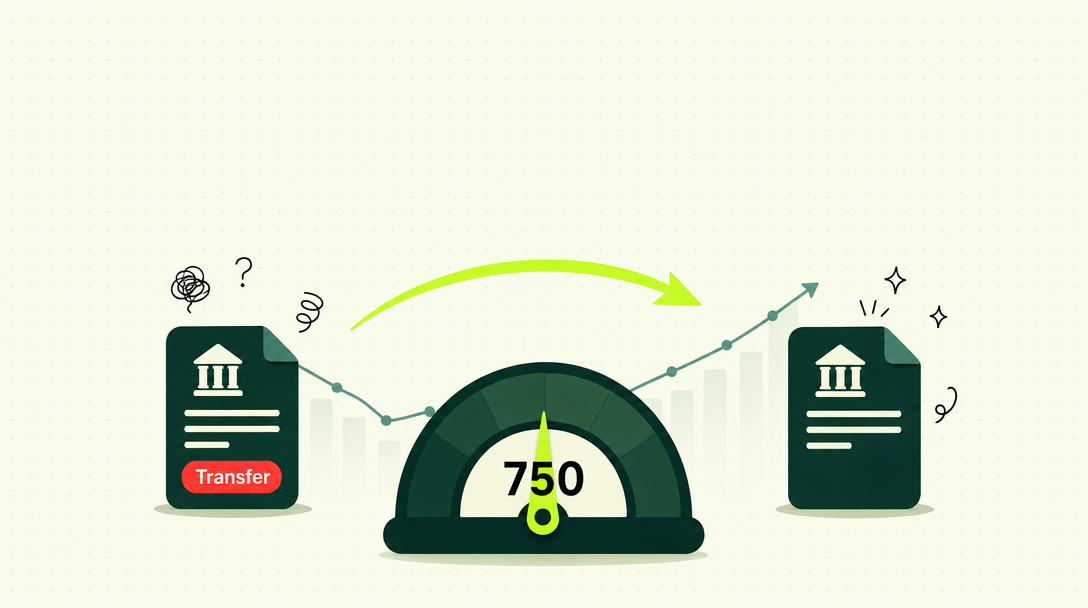
A personal loan balance transfer affects your CIBIL score in three distinct ways: a short-term dip from the hard inquiry when you apply, a temporary impact when the old loan account closes, and a medium-term improvement as you consistently pay the new loan. Understanding exactly what happens — and when — helps you plan the transfer at the right time and avoid surprises on your credit report.
The Three CIBIL Events During a Balance Transfer
Event 1: Hard Inquiry at Application (Immediate, −5 to −10 Points)
When you apply for the balance transfer loan, the new lender makes a hard inquiry on your CIBIL report. This signals to the credit bureau that you are seeking new credit. Every hard inquiry reduces your score by approximately 5–10 points. If you apply to multiple lenders simultaneously to compare offers, each application triggers a separate hard inquiry — if you apply to 4 lenders in one week, you could see a combined impact of 20–40 points. Strategy: get rate quotes through soft inquiry channels first, then apply to only one or two lenders that make the most sense.
Event 2: Old Loan Account Closure (Within 30–45 days, −5 to −15 Points)
When your existing personal loan account closes (because the balance transfer lender has paid it off), your CIBIL report reflects a “closed” account. This affects two components: credit account diversity (closed accounts reduce your active credit mix) and average credit age (if this was one of your older accounts, its closure reduces your average account age). The impact is typically 5–15 points and is temporary.
Event 3: Consistent Repayment on New Loan (3–6 Months, +10 to +30 Points)
As you begin making on-time payments on the new loan, CIBIL records each payment as positive repayment history. Payment history is the largest single factor in your CIBIL score (35% weight). Within 3–6 months of clean payments, most borrowers see their score fully recover and often exceed the pre-transfer level. The net effect of a well-executed balance transfer is typically a neutral-to-positive CIBIL outcome within 6 months.
Three Borrower Scenarios — CIBIL Before and After
| After 6 Months of Repayment | CIBIL Before Transfer | Post-Hard Inquiry (Month 1) | After 3 Months Repayment | After 6 Months Repayment |
|---|---|---|---|---|
| Anjali (Score: 750) | 750 | 735–740 | 745–755 | 755–765 |
| Rajeev (Score: 710) | 710 | 695–700 | 705–715 | 715–725 |
| Kavita (Score: 680) | 680 | 665–670 | 675–685 | 685–695 |
In all three cases, the initial dip recovers, and borrowers end up at or above their starting score within 6 months. The key prerequisite: zero missed payments on the new loan.
When to Do the Balance Transfer to Minimize CIBIL Impact
Timing matters for two reasons. First, avoid applying for any other credit (home loan, car loan, new credit card) within 3 months before or after your balance transfer — multiple hard inquiries in close succession compound the score impact. Second, if you are planning to apply for a home loan within 6 months, consider delaying the balance transfer until after the home loan is approved. A 15-point dip can sometimes push a borderline borrower into a higher rate tier.
What RBI Rules Say About Credit Reporting of Closed Accounts
Under RBI’s credit reporting guidelines, lenders must report the closure of a loan account to credit bureaus within 30 days of closure. If your old lender delays this reporting, the closed account may appear as active on your CIBIL report — a discrepancy that some new lenders flag as a risk. After your balance transfer is complete, check your CIBIL report after 45 days and confirm the old account shows “closed.” If it does not, file a dispute through the CIBIL dispute resolution portal [External: www.cibil.com/dispute].
Myths About CIBIL and Balance Transfers
- Myth: A balance transfer permanently damages your credit score. Fact: The impact is temporary and typically recovers within 3–6 months with clean repayment.
- Myth: Closing an old loan account always improves your CIBIL score. Fact: Closing a long-standing account can reduce average account age — whether this hurts or helps depends on your overall profile.
- Myth: Multiple balance transfers have no cumulative CIBIL impact. Fact: Each transfer creates a hard inquiry and account closure. Making multiple transfers within 12 months does cause meaningful deterioration in score.
How to Protect Your CIBIL During the Transfer Process
- Apply to a maximum of 2 lenders in a 30-day window to limit hard inquiry damage.
- Continue paying EMIs on the old loan until you receive written confirmation that the new lender has disbursed funds to the old lender. Do not stop paying on the old loan prematurely.
- Verify the old loan closure on CIBIL within 45 days. If not updated, raise a dispute.
- Set auto-debit for the new EMI immediately upon disbursement — the worst CIBIL outcome is missing a payment on the new loan.
Check your CIBIL score before applying for a balance transfer. If it is above 720, you likely qualify for the best rates. If it is below 700, focus on improving it first.
Frequently Asked Questions
Yes. The new loan appears as a new credit account, and the old loan shows as closed. Both events are reported to CIBIL by the respective lenders and appear on your credit report within 30–60 days.
Hard inquiries remain on your CIBIL report for 2 years, but they only impact your score for approximately 12 months. After 12 months, the inquiry becomes “soft” in terms of scoring impact.
Yes. Every credit application triggers a fresh CIBIL check. The new lender evaluates you as a new applicant — your existing loan’s payment track record is positive evidence, but your current CIBIL score, FOIR, and income still drive the approval decision.
The closed loan shows its full tenure history (closure included). The new loan starts a fresh tenure. This does not erase positive repayment history from the old loan — it remains as a positive mark on your report.
Yes, many NBFCs approve balance transfers for borrowers with scores as low as 650–680, but the offered interest rate will be higher (15–19% range). Run the cost-benefit calculation carefully at the higher offered rate before committing.
Q
Conclusion
Q
A balance transfer’s impact on CIBIL is real but manageable. The temporary 10–20 point dip from the hard inquiry and account closure is typically recovered within 6 months of consistent repayment on the new loan. If you are planning the transfer correctly — applying to only a couple of lenders, maintaining payments throughout the transition, and verifying the old account closure — the CIBIL impact should not deter you from a transfer that will genuinely save you money.