





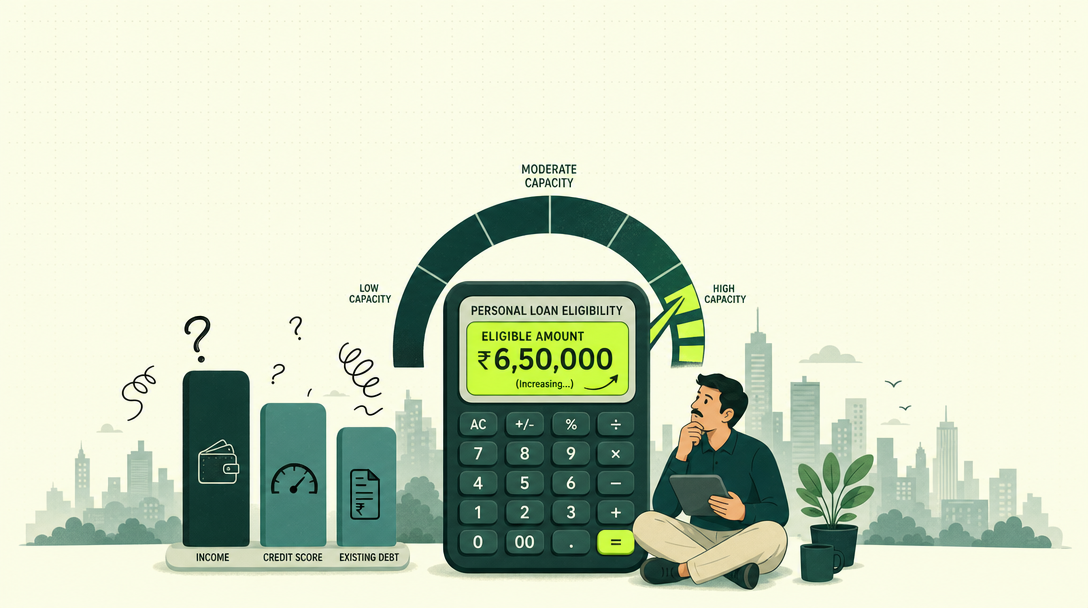
Run the same salary through five different lenders’ eligibility calculators, and you’ll get five different numbers. That’s not a bug;g each lender weighs income, existing debt, and employer category slightly differently, which is why the “how much can I borrow” question rarely has one correct answer.
This guide unpacks the actual formula lenders use, the variables that move it the most, and how to estimate your real number before you apply anywhere.
The Basic Formula Behind Every Eligibility Calculator
At its core, personal loan eligibility works backward from what EMI you can afford, not forward from a fixed multiple of your salary. Lenders start with your net monthly income, subtract existing EMI obligations, apply a maximum affordable-EMI ceiling, and then convert that EMI capacity into a loan amount based on the interest rate and tenure on offer.
A rough industry shorthand you’ll see quoted loan eligibility as roughly 10 to 24 times your monthly salary is really just this calculation pre-solved for a typical tenure and rate. It’s a useful ballpark, not a rule any lender is bound to.
FOIR: The Number That Matters More Than Your Salary
FOIR, or Fixed Obligation to Income Ratio, is the percentage of your monthly income already committed to EMIs, credit card minimums, and other fixed obligations. Most lenders cap total FOIR (existing obligations plus the new loan’s EMI) somewhere between 40% and 55% of net monthly income, though the exact ceiling varies by lender and income band.
This is why two applicants earning identical salaries can get very different offers: one with no existing loans has their full FOIR headroom available, while another already paying a car loan EMI has a much smaller slice left for a new personal loan.
How Your Employer Category Changes the Outcome
Salaried applicants are usually bucketed by employer type: government, listed private company, or unlisted/smaller private company, and each bucket gets a different eligibility multiple and interest rate. A government employee and a private-sector employee earning the same salary can be offered meaningfully different loan amounts, because the lender is pricing in job stability, not just income.
Self-employed applicants go through a parallel but different process, based on averaged, documented profit rather than a salary multiple covered in detail in our guide on personal loans for the self-employed.
Why the Same Salary Gets Different Offers
Beyond FOIR and employer category, a few other factors shift the number lender to lender:
- Existing relationship: a bank where you already hold a salary account or fixed deposit often extends higher eligibility than a lender seeing you for the first time.
- City and cost-of-living tier: some lenders apply a minimum net-income floor that varies by city tier.
- Credit score band: a stronger score can unlock a marginally higher FOIR ceiling, since the lender’s own risk model allows more headroom.
- Interest rate offered: at a lower rate, the same affordable EMI buys a larger loan amount, which is why comparing rates across lenders changes your eligibility, not just your cost.
Tenure’s Hidden Effect on Eligibility
Stretching the tenure from three years to five years lowers your EMI for the same loan amount, which is why extending tenure is one of the fastest ways to increase the loan amount a lender will approve. The trade-off is straightforward: a longer tenure raises your total interest paid over the life of the loan, even though it raises your approved amount today.
It’s worth deciding what you’re actually optimising for: maximum sanctioned amount, or minimum total interest, before you pick a tenure, rather than defaulting to whatever the calculator pre-fills.
How to Actually Estimate Your Number
A reasonably accurate self-estimate looks like this:
- Take your net monthly income (after tax, before existing EMI deductions).
- Subtract all current EMI and credit card minimum payments.
- Apply roughly 45% as your available FOIR ceiling to that net figure to estimate your maximum new EMI capacity.
- Use that EMI capacity, an expected interest rate, and your preferred tenure to back-calculate the loan amount or run it through a lender’s calculator directly.
This gives a workable estimate, but the real number still depends on which lender’s specific model you land on, which is why the same inputs can produce a meaningfully different final offer.
Key Takeaways
- Eligibility is calculated backward from affordable EMI, not forward from a fixed salary multiple.
- FOIR, typically capped between 40–55% of net income, is the single biggest lever, or more than your raw salary.
- Employer category (government, listed private, other) changes both your eligibility multiple and your rate.
- A longer tenure raises your approved amount but increases total interest paid.
- The same salary can produce meaningfully different offers across lenders, since each applies its own FOIR ceiling and rate.
- An existing banking relationship with a lender often improves the eligibility they’ll extend to you.
Frequently Asked Questions
Using common industry ranges of 10–24 times monthly salary, that’s roughly ₹5 lakh to ₹12 lakh before accounting for existing EMIs, employer category, and credit score;e the actual sanctioned amount depends heavily on those factors.
Yes, in most FOIR calculations, though how heavily it varies: some lenders count only the minimum due, others factor in a percentage of your total credit limit regardless of usage.
Yes, paying down or closing an existing loan, choosing a longer tenure, or adding a co-applicant’s income are the three most direct ways to raise your approved amount without a salary increase.
Online calculators are usually indicative and based on income alone; the final offer also factors in your credit score, employer category, and existing obligations pulled from your credit report at the time of formal underwriting.
Generally yes, since eligibility varies meaningfully by lender. Doing this through a soft-check comparison avoids the hard inquiries that come from applying to each one directly.
Conclusion
Your real eligibility isn’t a single number; it’s a range that shifts with the lender, the tenure you choose, and how much of your income is already committed elsewhere. Knowing the mechanics behind the calculation is what lets you negotiate tenure and rate deliberately, instead of accepting the first number a calculator shows you.
Run your numbers through TapTap’s eligibility check across 20+ lenders