





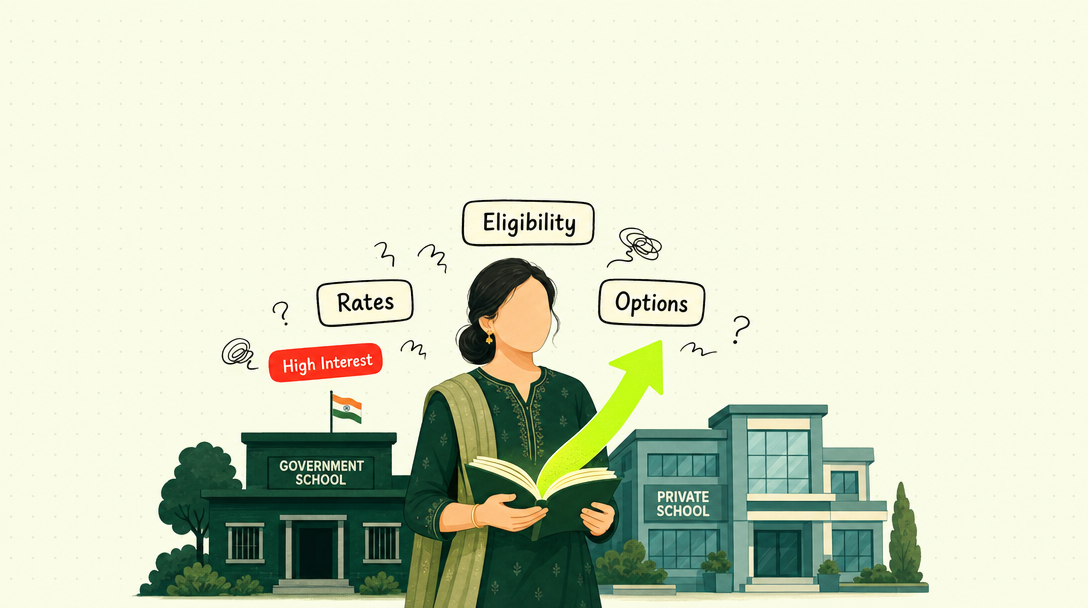
Two teachers with the same salary, the same qualifications, and the same CIBIL score can receive personal loan offers that differ by four or five percentage points. The difference is almost entirely about who pays the salary.
Lenders see a permanent government school teacher as one of the safest borrowers in the country. A private school teacher’s profile depends on the school. A contract or guest teacher often struggles to get a mainstream offer at all. This guide explains how lenders assess each group, what rates and amounts to expect, and how to present your application for the best terms.
How lenders classify teachers
Underwriting starts with the employer, because it predicts how stable your income will be over the loan’s life.
| Category | Typical employer | How lenders see it |
|---|---|---|
| Government teacher | Central or state government school, Kendriya or Navodaya Vidyalaya | Very low risk; often eligible for government-employee schemes |
| Government-aided teacher | Aided school with salary paid through the state | Low risk, close to government category |
| Private school teacher, large or branded school | Established chain or well-known school | Moderate risk; assessed like a mid-size corporate employee |
| Private school teacher, small school | Independent school with limited records | Higher risk; depends on salary credit history |
| College or university faculty | Government or private institution | Assessed by institution type, similar to schools |
| Contract, guest or ad hoc teacher | Fixed-term arrangement | Higher risk due to renewal uncertainty |
| Tutor or coaching owner | Self-employed | Assessed on ITR and bank statements, not salary |
If you are a government employee outside teaching, our guide to personal loans for government employees covers the wider category.
Eligibility criteria by teacher category
Common criteria across lenders:
- Age 21 to the lender’s maximum, often 58 to 60 at loan maturity, and sometimes linked to your retirement age
- Net monthly salary credited to a bank account, typically at least ₹15,000 to ₹25,000
- CIBIL score of 700 or more, and 750+ for the best rates
- Total EMIs within 40% to 60% of net income, with higher limits more common for government employees
Category-specific differences:
- Government and aided teachers often qualify for higher loan amounts relative to salary, longer tenure,s and lower rates, especially at the bank where their salary is credited.
- Private school teachers are usually asked for six to twelve months of salary credits and may need at least one year with the current school.
- Contract teachers are often asked for the contract, its remaining term, and proof of past renewals. Many mainstream lenders cap the tenure at the contract’s end date.
Indicative rates and what they cost
Rates below are indicative ranges for borrowers with a CIBIL score of 750 or above. Actual offers depend on the lender, loan amount,t and your full profile.
| Category | Indicative rate | EMI on ₹5 lakh, 5 years | Total interest |
|---|---|---|---|
| Government or aided teacher, salary account with lender | Around 10.5% to 12% | ₹10,809 at 10.75% | ₹1,48,539 |
| Private school teacher, established school | Around 12% to 16% | ₹12,027 at 15.5% | ₹2,21,596 |
| Contract or guest teacher | Around 16% to 24%, mostly NBFCs | Higher, often with shorter tenures | Higher |
On the same ₹5 lakh loan, the gap between 10.75% and 15.5% is about ₹73,000 in interest. For a private school teacher, the most effective way to narrow that gap is a strong credit score and a clean salary-credit history with the lender.
Documents teachers need
- PAN and Aadhaar
- Last three months’ salary slips
- Six months of bank statements showing salary credits
- Appointment letter or employee ID card
- Form 16 for the latest year, if available
- For contract teachers: the current contract and evidence of earlier renewals
- For tutors or coaching owners: two years of ITR and twelve months of bank statements
Government teachers applying to their salary-account bank often find much of this already on file, which speeds approval.
Challenges specific to teachers, and how to handle them
Salary paid in cash
Some smaller private schools pay part or all salaries in cash. Without bank credits, lenders cannot verify income. Ask the school to pay into your bank account for at least six months before you apply.
Unpaid or reduced vacation months
Some private schools do not pay full salary during summer vacations. Lenders reading 12 months of statements will see the gap. Apply when your statements show a full, regular year, or explain the pattern with a letter from the school.
Transfers and relocations
Government teachers transferred mid-application may face delays if the salary account changes. Keep your salary account unchanged until disbursement, al where possible.
Short service
Newly appointed teachers, even in government service, may have fewer than six months of salary history. Some lenders accept the appointment letter as proof of stability; others ask you to wait.
Alternatives before a personal loan
- Teachers’ co-operative credit societies often lend to members at modest rates with salary deduction. Check whether your school or district has one.
- Provident fund advances. If you are covered by GPF or EPF, a partial withdrawal may be cheaper for an emergency, though it slows your retirement savings. Our PF withdrawal vs personal loan guide compares the two.
- A loan against an FD or insurance policy, if you hold either, is usually at a lower rate than an unsecured loan.
Use cases
Sunita teaches at a Kendriya Vidyalaya, takes home ₹62,000 and has a CIBIL score of 781. She needs ₹4 lakh for her son’s college admission. Her salary-account bank offers 11% over four years, with an EMI of ₹10,338. A private lender’s offer at 14% would cost about ₹28,000 more over the same period.
Deepak teaches at a private CBSE school and earns ₹34,000, but two of his last twelve months show reduced pay during the summer break. He applies in October, with a letter from the school explaining the vacation salary policy, and is approved for ₹3 lakh over three years at 13.5%.
Key takeaways
- Lenders assess teachers primarily by employer type: government, aided, private, or contract.
- Government and aided teachers typically get lower rates, higher amounts, and longer tenures, especially from their salary-account bank.
- Private school teachers need a clean record of salary credits; cash salaries and irregular vacation pay are the most common obstacles.
- On a ₹5 lakh, five-year loan, the gap between 10.75% and 15.5% costs about ₹73,000 in interest.
- Check co-operative society loans and PF advances before taking an unsecured loan.
Frequently asked questions
Yes. Lenders look for salary credited to a bank account, at least six to twelve months with the school,l and a good CIBIL score. Rates are usually higher than for government teachers.
Generally, yes. Lenders treat permanent government employment as very stable, and many banks offer their best rates to government employees with salary accounts.
Some lenders approve them, often with tenures limited to the contract period and higher rates. A record of contract renewals and regular salary credits helps.
It depends on salary, existing EMIs, and employer type. Government teachers often qualify for higher multiples of income than private school teachers on the same salary.
There is rarely a scheme for teachers as such, but government teachers usually qualify for banks’ government-employee loan products, which carry better terms.
Conclusion
For teachers, the employer shapes the loan offer as much as the salary does. Government teachers should start with their salary-account bank, while private school teachers should build a clean salary-credit record and a strong score before applying. In both cases, comparing several lenders on APR is the simplest way to avoid overpaying.
Compare personal loan offers for salaried teachers on TapTap Loans.