





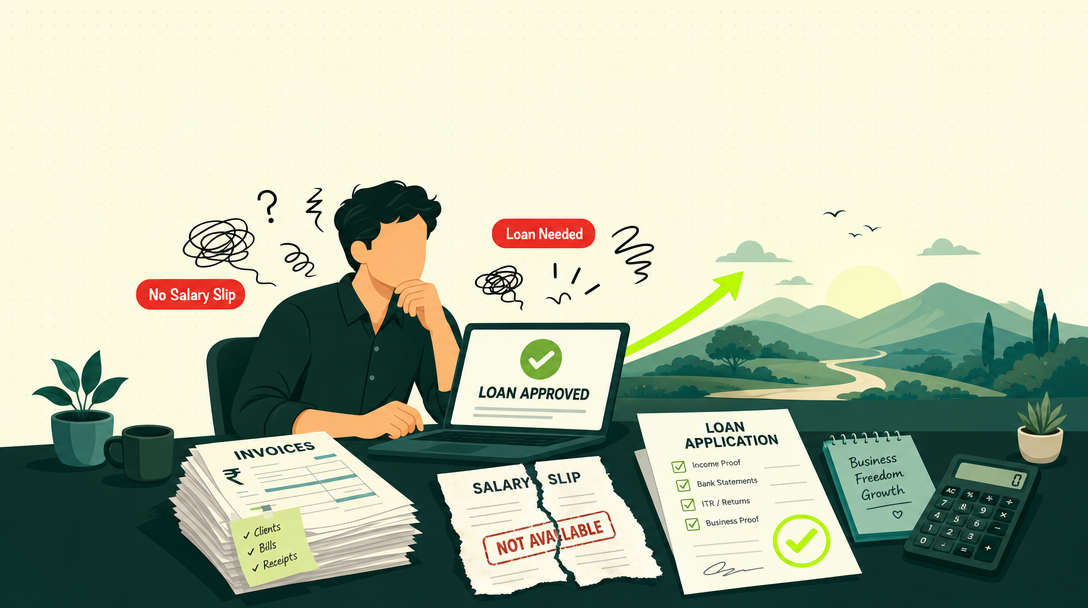
Yes, you can get a personal loan for self-employed without a salary slip in India. Lenders use ITR filings, GST returns, and bank statements instead. This guide covers exactly what documents work, and how to make your application as strong as possible.
Why Self-Employed Applicants Get Asked for Different Documents
Salary slips exist because salaried income is predictable. It’s easy to verify. Self-employed income isn’t structured the same way.
Lenders need different evidence to judge your personal loan ability. That evidence comes from three sources. Your tax filings. Your business transaction history. Your bank statements.
What You Can Use Instead of a Salary Slip
- Income Tax Returns: Usually 2 to 3 years’ worth. This is the single most important document.
- GST Returns: If your business is GST-registered, these show consistent turnover.
- Bank Statements: 6 to 12 months, showing regular income credits, not just the closing balance.
- Business Registration Proof: Shop license, Udyam or MSME registration, or partnership deed.
- Audited Financial Statements: For larger loans, some lenders ask for a CA-certified profit and loss statement.
How Lenders Assess Income Without a Salary Slip
Instead of one fixed number, lenders look at your average monthly income across your ITR and bank statements. They also weigh consistency. Steady income across 2 to 3 years matters more than one particularly good year.
Lenders check your FOIR too, the ratio of your total EMI obligations to your income. This works the same way for self-employed applicants as it does for salaried ones. Only the inputs differ.
Which Lenders Are Friendliest to Self-Employed Applicants
Banks tend to be more conservative. They often ask for longer business vintage and more paperwork. NBFCs are frequently more flexible. Some accept shorter business history, at a modestly higher rate.
Checking both categories at once, rather than assuming one path, usually surfaces better options. Compare personal loan offers
Minimum Business Vintage Required
Most lenders want at least 2 to 3 years of continuous business operation. Some NBFCs work with businesses as young as one year, especially with a strong personal credit score.
Newer than this? Building a track record for another year helps. So does applying with a co-applicant who has stronger documentation.
How to Strengthen Your Application
- File your ITR on time, every year. Gaps or late filings raise questions lenders would rather not ask.
- Keep personal and business bank accounts separate. Mixed transactions make your income harder to trace.
- Maintain a healthy personal CIBIL score. This matters as much as your business income.
- Avoid large, unexplained cash deposits before you apply. These often trigger extra scrutiny.
A Realistic Example
Consider a freelance graphic designer, with an average annual income of ₹9,00,000 across the last two years’ ITR, filed consistently. Bank statements show regular client payments, though amounts vary month to month.
With no formal salary slip, a bank might hesitate. But an NBFC evaluating the same ITR and bank history, alongside an increased CIBIL from 600 to 750, can often approve the loan comfortably. Usually at a rate only slightly higher than a salaried applicant with similar income.
What If Your Income Is Genuinely Irregular?
Freelancers, gig workers, and seasonal business owners often have income that swings month to month, even when the yearly total is solid. Present your annual income clearly. Add a note on seasonality if it applies, rather than letting lenders infer instability from a few weak months alone. personal loan for self-employed
Some lenders specifically build in flexibility for this pattern. Ask directly. Don’t assume irregular income disqualifies you.
Common Rejection Reasons for Self-Employed Applicants
A few patterns come up repeatedly. Inconsistent ITR filings, with gaps between years. A sudden, unexplained spike in income right before applying. Mixed personal and business banking, making the real income hard to isolate. And a business that’s simply too new to have a track record yet.
Each of these is fixable with time and better documentation, not a permanent barrier.
How TapTap Helps Self-Employed Borrowers
Approaching one bank, getting a conservative answer, and starting over wastes time. TapTap checks your eligibility across 20+ banks and NBFCs at once, with a soft credit check that doesn’t affect your score. We match you to the lender most likely to approve your specific documentation.
This saves you from repeated rejected applications, each of which can itself hurt your credit profile.
What to Prepare Before You Apply
Gather your ITR filings first, since they take the longest to organize if you haven’t kept them together. Then pull your last 6 to 12 months of bank statements. Finally, confirm your GST registration status, if applicable, and have your business proof documents ready. Having everything in one place before you apply speeds up the entire process.
Frequently Asked Questions About Personal Loans for Self-Employed Applicants
Yes. ITR, combined with bank statements and GST returns where applicable, is the standard substitute for a salary slip.
Most lenders ask for 2 to 3 years. Some NBFCs may accept one year for smaller loans, especially with a strong credit score.
Sometimes, modestly. This reflects perceived income variability, not a fixed penalty. Strong, consistent income can close much of this gap.
It’s not always mandatory. Bank statements and ITR alone can sometimes be sufficient, particularly for smaller loans or with a strong credit score.
Yes. The same principles apply. Consistent income evidence across ITR and bank statements, even if individual months vary.
Ready to check your options? See your eligibility with TapTap across 20+ lenders — a soft check with zero impact on your credit score.