





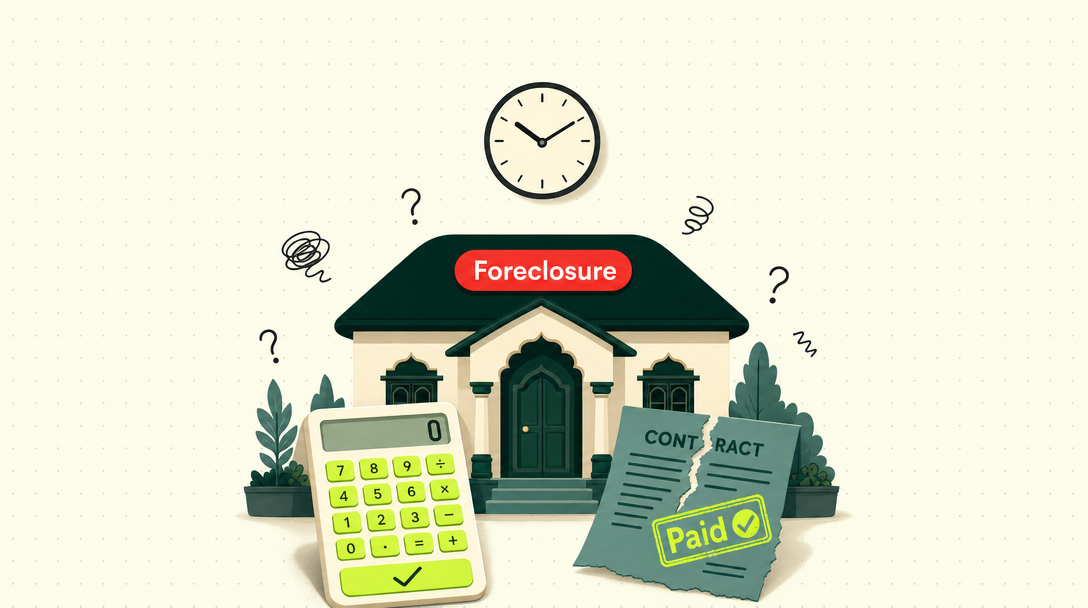
Foreclosure charges are fees a lender charges when you close a loan early. For floating-rate personal loans, RBI rules mean you often pay nothing at all. For fixed-rate loans, expect a charge, typically 2 to 5% of the outstanding amount.
This guide covers what you’ll pay, when, and how to check before you commit.
What Foreclosure Actually Means
Foreclosure means paying off your entire remaining loan in one go, before the tenure ends. This differs from a partial prepayment, where you pay down part of the balance but keep the loan running.
Lenders sometimes charge a fee for foreclosure. Early closure means they earn less total interest than expected.
Why RBI Banned This Charge on Floating-Rate Loans
RBI ruled that banks and NBFCs cannot charge foreclosure penalties on floating-rate personal loans for individual, non-business borrowers. This gives real flexibility, since floating rates are the most common structure for personal loans in India.
This is one of the most borrower-friendly rules in Indian lending. Many people don’t know it exists.
When You Might Still Pay a Foreclosure Charge
- Fixed-rate personal loans. These aren’t covered by the RBI’s exemption. Charges here can run 2 to 5% of the outstanding amount.
- Business loans, even at a floating rate. The RBI exemption specifically covers individual, non-business borrowing.
- Some older loans may have different terms. Always check your specific agreement.
How to Check What You’ll Actually Pay
- Check whether your loan is fixed or floating rate. This is usually stated clearly in your agreement.
- Read the foreclosure clause specifically, not just the general terms.
- Call your lender directly. Ask for the exact foreclosure amount before you commit.
- Get it in writing, especially if you’re timing a balance transfer.
A Worked Example
Say you have ₹3,00,000 outstanding on a fixed-rate loan. Your lender charges a 4% foreclosure fee. That’s ₹12,000, on top of repaying the ₹3,00,000 principal.
On a floating-rate loan with the same balance, under RBI’s rule, that ₹12,000 charge simply wouldn’t apply.
Foreclosure Charges and Balance Transfer: Why This Matters
Considering a balance transfer to a lower rate? Your existing lender’s foreclosure charge is a direct cost to factor into your savings math. A transfer that looks attractive on rate alone can be less compelling once a foreclosure charge is included, particularly on fixed-rate loans.
This is exactly why checking the foreclosure clause first matters, before assuming a transfer will save you money.
Does Foreclosure Affect Your Credit Score?
Closing a loan early, in full, is generally viewed positively by credit bureaus. It shows you can meet a full repayment obligation. It’s not the same as a default. If anything, a clean foreclosure, properly recorded, tends to support a healthy credit profile.
What to Do If You’re Overcharged
Lender tries to charge a foreclosure fee on a loan that should be exempt? Raise this directly, citing the RBI rule. If unresolved, escalate through the lender’s grievance officer, and further to the RBI’s Banking Ombudsman scheme if necessary.
A Quick Comparison Table
| Loan Type | Foreclosure Charge |
|---|---|
| Floating-rate personal loan, individual borrower | None, banned by RBI |
| Fixed-rate personal loan | Typically 2-5% of outstanding amount |
| Business loan, any rate type | May apply, RBI exemption doesn’t cover this |
| Home loan, floating rate | None, similar RBI protection applies |
Why This Matters More Than Most Borrowers Realize
Many borrowers assume switching lenders always costs a fee, and quietly stay with an expensive loan rather than check. On a floating-rate personal loan, that assumption is often wrong. Knowing this single fact can be the difference between staying stuck at a high rate and switching to a genuinely cheaper one at no extra foreclosure cost.
Frequently Asked Questions About Foreclosure Charges
Depends on whether your loan is fixed or floating rate. RBI bans foreclosure charges on floating-rate personal loans for individual, non-business borrowers. Fixed-rate loans may still carry a charge.
Where applicable, typically 2-5% of the outstanding principal. This varies by lender. Always confirm the exact figure directly.
Foreclosure means paying off the entire remaining balance at once. Prepayment can mean the full amount too, or just a partial amount while keeping the loan active.
No, generally the opposite. A properly recorded, full early repayment is typically viewed positively.
Worth asking, particularly with a strong repayment history. Some lenders have flexibility, though it’s not guaranteed.
Planning to close or transfer an existing loan? Check your savings with TapTap’s free calculator; we factor in fees, not just the headline rate.