





The rejection email from a bank is short, polite, and useless. “Dear customer, we regret that we are unable to process your loan application at this time.” No specific reason. No path forward. Just a closed door and an unspoken 5–10 point hit on your CIBIL from the hard inquiry.
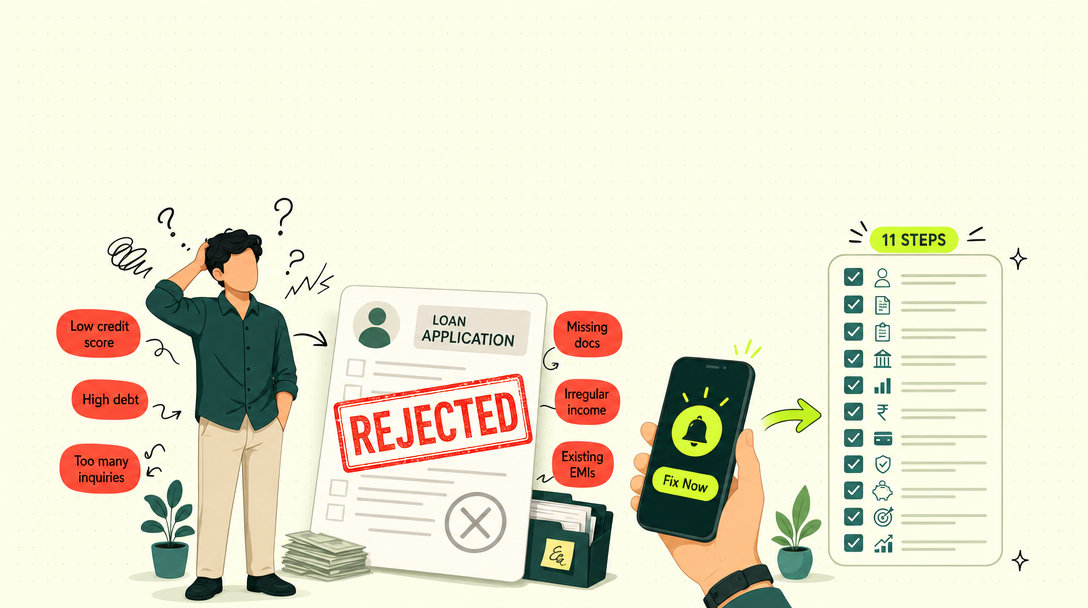
Indian banks reject roughly 30–40% of personal loan applications. Most rejections cluster around 11 specific reasons. Once you know which one applies to you, the fix is usually clear — and the wait before reapplying is shorter than people think. This guide walks through the 11 reasons ranked by frequency, the CIBIL damage from each, the exact fix, and how long you should wait before reapplying.
The Hidden Cost of Every Rejection
Before we look at reasons, the math you need to know: each rejected application costs you a hard inquiry on your CIBIL. A single hard inquiry typically drops your score by 5–10 points. Five rejections in 30 days can compound to a 30–50 point fall, plus the “multiple inquiries” negative flag.
This is why scattered applications across many banks are the worst strategy after a rejection. The smart play is to diagnose the reason, fix it, then apply selectively to 1–2 lenders who fit your repaired profile.
11 Reasons Banks Reject, Ranked by Frequency
| # | Rejection Reason | Frequency (Our Estimate) | CIBIL Damage | Reapply Wait |
|---|---|---|---|---|
| 1 | Low CIBIL score (below lender’s cutoff) | ~28% | 5–10 pts | 60–90 days |
| 2 | High FOIR (existing EMIs > 50% of income) | ~18% | 5–10 pts | After clearing an EMI |
| 3 | Multiple recent applications | ~12% | Compounded | 90 days |
| 4 | Employment gap or recent job change | ~10% | 5–10 pts | 6 months in current job |
| 5 | Address or KYC mismatch | ~8% | Minimal | After update (1–2 weeks) |
| 6 | Low or unstable income | ~7% | 5–10 pts | Once income stabilises |
| 7 | Documents incomplete or wrong format | ~5% | Minimal | Immediate, with correction |
| 8 | Banking habits (low average balance, bounced cheques) | ~4% | 5–10 pts | 3–6 months of better behaviour |
| 9 | Employer not on bank’s approved list | ~3% | 5–10 pts | Try a different lender |
| 10 | Age mismatch (too young or near retirement) | ~3% | 5–10 pts | Lender selection issue |
| 11 | Industry risk (real estate broker, crypto, etc.) | ~2% | 5–10 pts | Lender selection issue |
Reason 1: Low CIBIL Score
The most common rejection cause. Banks have rigid CIBIL cutoffs — usually 700+ for private banks, 680+ for selective lenders, and 650+ for NBFCs.
Fix:
- Pull your free CIBIL report and identify what is dragging your score (utilisation, missed payments, errors).
- Bring credit card utilisation below 30%.
- Dispute any errors via cibil.com.
- Wait 60–90 days before reapplying.
- Consider NBFCs (Bajaj Finance, Poonawalla, Tata Capital, Aditya Birla) which approve lower CIBIL bands at higher rates.
Reason 2: High FOIR (Fixed Obligation to Income Ratio)
FOIR is the percentage of your monthly income already committed to EMIs and credit card minimum payments. Most banks cap this at 50–60%. If your current EMIs + the proposed new EMI exceed this, you are rejected even with great CIBIL.
Fix:
- Pay off a smaller existing EMI before applying.
- Increase tenure on the new loan to reduce the EMI size.
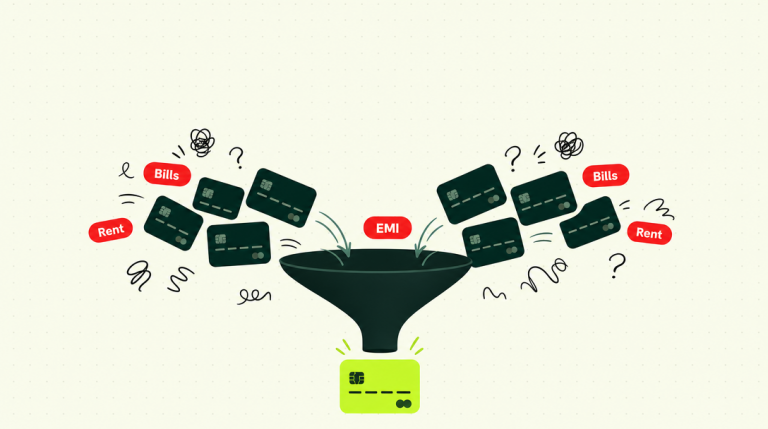
- Or consider consolidation — merging multiple EMIs into one usually drops your FOIR enough to qualify.
Our complete guide on FOIR explains how to calculate yours and the exact ratio each major bank looks for: FOIR in Personal Loan India.
Reason 3: Multiple Recent Applications
If your CIBIL report shows 4–5 personal loan or credit card applications in the last 60 days, lenders interpret this as “desperate borrower” and reject defensively.
Fix:
- Wait 90 days for the inquiry density to drop.
- Apply to only 1–2 lenders at a time.
- Use platforms like TapTap Loans that pre-check eligibility across lenders WITHOUT triggering multiple hard inquiries.
Reason 4: Employment Gap or Recent Job Change
Banks like to see at least 6 months in the current job and 2 years of continuous employment. A recent job change — even to a better company — raises a temporary flag.
Fix:
- Complete 6 months in the new job before applying.
- If urgent, apply with a co-applicant who has stable employment.
- Some NBFCs and digital lenders are more flexible — they look at the new salary’s stability rather than tenure.
Reason 5: Address or KYC Mismatch
Your PAN, Aadhaar, bank statement address, and salary slip address must match. Even a small mismatch (“Flat 304” vs “Flat No 304”) can trigger a system rejection.
Fix:
- Update Aadhaar and PAN with the current address.
- Get a fresh bank statement reflecting the same address.
- Reapply after 1–2 weeks once records are consistent.
Reason 6: Low or Unstable Income
Most banks have a minimum income cutoff: ₹25,000–35,000/month for tier-1 cities, ₹20,000–25,000 for tier-2/3. Even if you meet this, irregular salary credits (variable bonus-heavy structure, freelance income) can trigger rejection.
Fix:
- Wait until you have 6+ months of stable salary credits.
- If self-employed or a freelancer, target NBFCs that consider UPI-based income (Fi, Niyo, Slice) or apply through a co-applicant.
- A loan against an asset (FD, gold, MF) bypasses income requirements entirely.
Reason 7: Document Issues
The most fixable rejection. Common issues: blurry document uploads, address on bank statement doesn’t match KYC, missing latest salary slip, ITR not e-verified, salary slip without official seal/header.
Fix:
- Request a fresh document from the source (employer for salary slip, bank for statement).
- Make sure scans are clear and complete — every page, every field.
- Reapply immediately with corrected documents.
Reason 8: Banking Habits
Banks look at your bank statement for: average monthly balance, salary credit consistency, EMI bounce history, cheque return history. Low average balance (₹5,000 on a ₹70,000 salary) signals poor cash management.
Fix:
- Maintain an average balance of at least 25–40% of your monthly salary in your account.
- Avoid bounced cheques and failed auto-debits — they show on statements for 6+ months.
- Build 3–6 months of clean banking before reapplying.
Reason 9: Employer Not on Approved List
Some banks have internal “approved employer” lists. If you work at a small startup, lesser-known firm, or proprietorship, you may not be on the list — even if your salary is good.
Fix:
- Try a different lender. NBFCs are more flexible on employer lists.
- Some banks (IDFC First, Bajaj Finance) consider non-listed employers if income and CIBIL are strong.
- This is a lender-selection problem, not a borrower-fitness problem.
Reason 10: Age Mismatch
Most lenders require a minimum age of 21 and a maximum age of 60–65 at loan maturity. If you are 58 applying for a 5-year loan, you mature at 63 — above the cap.
Fix:
- Apply for a shorter tenure that ends before the cap.
- Add a younger co-applicant.
- Some NBFCs extend up to age 75 for retirees with pension income.
Reason 11: Industry Risk
Some lenders quietly avoid borrowers from certain industries: real estate brokers (volatile income), cryptocurrency, gambling-adjacent businesses, and certain commission-only sales roles.
Fix:
- Apply to lenders without industry restrictions — NBFCs are usually more open.
- Strong banking history and CIBIL can override industry concerns.
How to Find Out the Exact Reason
Banks rarely disclose the specific reason in the rejection email. To find out:
- Email customer support: Send a polite request asking for the specific rejection reason for your reference. Banks are required to respond within 30 days under the Fair Practices Code.
- Pull your CIBIL: If CIBIL has dropped or shows multiple inquiries, the rejection is likely score-related.
- Calculate your FOIR: If your existing EMIs + new EMI exceed 50% of salary, that’s the issue.
- Use a loan advisory platform: Platforms like TapTap Loans can review your profile and identify the likely rejection cause without triggering more inquiries.
Best Alternatives If You Keep Getting Rejected
After 2–3 rejections, applying to more banks is counterproductive. Consider:
- Loan against asset: FD, gold, mutual funds, insurance. Rates 9–12%, CIBIL not a primary factor.
- Co-applicant loan: Adding a high-CIBIL co-applicant transforms approval odds.
- Secured credit card: Backed by FD, builds CIBIL while giving immediate borrowing capacity.
- Consolidation: If your rejections are FOIR-driven, consolidating existing EMIs into one is often more useful than a fresh loan.
If you’re carrying multiple EMIs and getting repeatedly rejected, explore whether consolidation suits your situation.
Frequently Asked Questions
Q
Because the application triggered a hard inquiry, which drops the score by 5–10 points regardless of the approval outcome.
No. Immediate reapplication signals desperation and almost always gets rejected. Wait at least 60–90 days unless the issue is a quick fix like documents.
Sometimes, if the reason was lender-specific (employer list, industry restriction), if the reason was CIBIL or FOIR, other lenders will likely reject it too.
Yes — the right platform identifies which lenders match your specific profile and avoids triggering more inquiries on lenders likely to reject.
The inquiry appears, but not the rejection outcome. CIBIL shows that you applied; it doesn’t disclose approved vs rejected.
Bottom Line
Every rejection has a specific reason. Find the reason, fix it, wait the right amount of time, and apply selectively — not desperately. The cost of getting this wrong is more CIBIL damage. The cost of getting it right is the right loan at a fair rate.
Avoid another rejection. TapTap Loans pre-checks eligibility across 15+ lenders before triggering any hard inquiry on your CIBIL.