





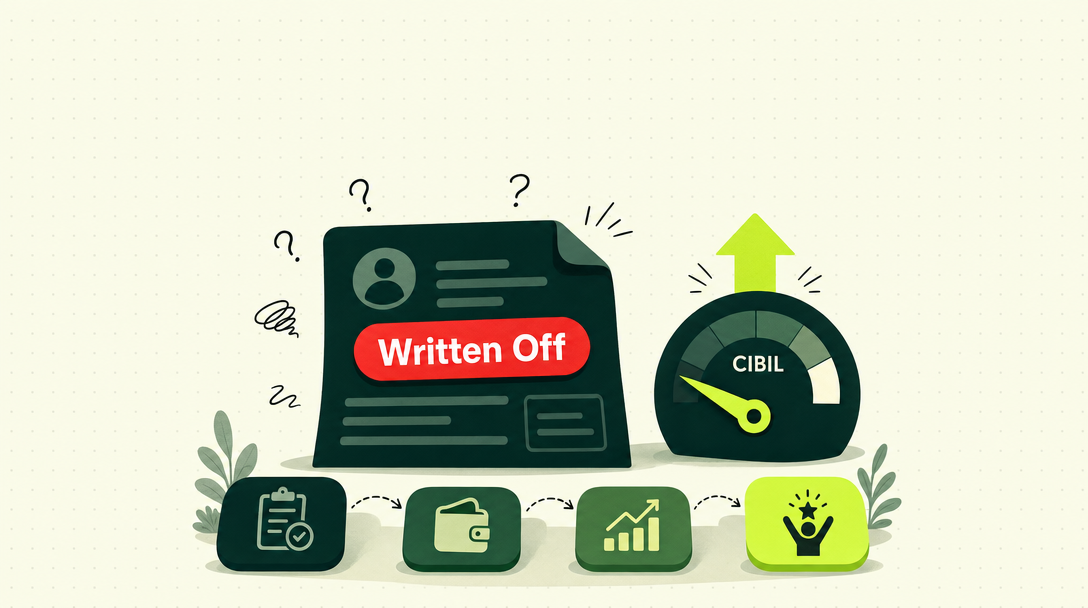
You apply for a loan, get rejected, pull your CIBIL report, and find one line you did not expect: an old credit card or app loan marked “Written-off”. Many borrowers read that word as “cancelled” and assume the debt is gone. It is the opposite.
A written-off status is one of the most damaging entries a credit report can carry. It tells every future lender that a previous lender gave up on recovering the money. This guide explains what the status means, how it compares with “settled”, how long it affects you, and the realistic steps to repair it.
What “written off” means in CIBIL
A write-off is an accounting decision by the lender. When a loan has been unpaid for a long time, and the lender judges it unlikely to be recovered, it removes the amount from its books as a loss.
The lender then reports the account to credit bureaus with the status “Written-off”. Your report will usually show two amounts alongside it: the total written-off amount and the principal written-off amount.
A write-off typically follows a sequence: missed payments, the account classified as SMA and then NPA after 90 days past due, recovery attempts, and finally the write-off. Our explainers on SMA status and NPA meaning cover the earlier stages.
Does a write-off cancel the debt?
No. The write-off is on the lender’s books, not on your liability. You still legally owe the amount, and the lender or an assigned recovery agency can continue to pursue it.
Many borrowers learn this only when recovery calls resume years later, or when a loan is declined because of the status. The debt can also be sold to an asset reconstruction company, which then collects it.
Written off vs settled vs closed
These three statuses look similar to borrowers but read very differently to lenders.
| Status | What happened | How lenders read it |
|---|---|---|
| Closed | Loan repaid in full as per terms | Positive |
| Settled | Borrower paid a reduced amount agreed with the lender; the rest was waived | Negative: lender lost money |
| Written-off | Lender stopped expecting repayment and booked a loss; debt still owed | Severely negative: no resolution |
| Post (WO) settled | Account was written off, then settled for less than due | Negative, but better than open write-off |
The order of preference, from a future lender’s view, is: closed, then settled, then post-write-off settled, then written-off with nothing paid. Our guide to loan settlement vs closure explains the settled status in more depth.
How a write-off affects your loan chances
Most banks treat an unresolved write-off in the last several years as a near-automatic rejection for unsecured loans. Many NBFCs do the same. The size of the write-off matters less than its presence: a ₹8,000 written-off app loan can block a ₹5 lakh personal loan.
The score usually drops sharply as well, but the status itself is often what triggers the decline, because many lender policies filter on account status before they look at the score.
Secured loans, such as a loan against a fixed deposit or gold, remain available because the lender holds collateral. These are also useful tools for rebuilding.
How long a written-off status stays
Credit information in India is generally retained and visible for up to seven years. A written-off account that remains unpaid will keep appearing with that status.
Paying it later does not erase the history, but it changes what lenders see. An account that moves from “Written-off” to “Closed” or “Post (WO) settled” shows that you resolved it, and the date of resolution matters. A write-off resolved three years ago reads very differently from one still open today.
How to fix a written-off account
Step 1: Get your full report
Download your CIBIL report and check the other bureaus too: Experian, Equifax and CRIF High Mark. Note the lender, account number, written-off amounts, and reporting date.
Step 2: Contact the lender for the current outstanding amount
Ask for a written statement of the total amount due, including principal, interest and charges. If the debt has been sold, the lender must tell you to whom.
Step 3: Choose full closure over settlement where you can
Paying the full outstanding amount lets the lender update the status to “Closed”, which is the best outcome for your report. If you cannot afford it, a negotiated settlement is still better than leaving the write-off open, but the report will show “settled”.
Many lenders will waive part of the accrued penalty charges or interest while still reporting the account as closed, if you ask. Get any such agreement in writing before paying.
Step 4: Collect the closure documents
Once paid, get a no-dues certificate or closure letter stating the account is fully repaid. Our guide on the loan closure letter and NOC lists what it should contain.
Step 5: Confirm the bureau update
Since January 2025, lenders report credit information to bureaus at least fortnightly, so updates are faster than before. Check your report 30 to 45 days after payment. If the status has not changed, raise a dispute with the bureau and attach the closure letter.
If the write-off is a mistake
Write-offs are sometimes reported in error: a loan you never took (identity misuse), an account already paid, or a disputed charge on a closed card.
In those cases, raise a dispute directly with the credit bureau. It forwards the dispute to the lender, which must respond. Under RBI’s framework on credit information, a borrower is entitled to compensation of ₹100 per day if a complaint is not resolved within 30 days. Our CIBIL dispute guide walks through the process.
Rebuilding after the account is closed
Once the write-off is resolved, rebuilding is about adding new positive history:
- Secured credit card against a fixed deposit, used lightly and paid in full each month
- Small loan against FD or gold, repaid on time
- No new missed payments on any existing account
- Few applications, so that new hard enquiries do not pile up
Most borrowers see meaningful improvement within 12 to 24 months of consistent on-time history after resolution. For a step-by-step plan, see how to increase your CIBIL score from 600 to 750.
Use cases
Old app loan. A borrower had a ₹12,000 app loan written off in 2023 and was rejected for a personal loan in 2026. Paying the outstanding amount with a partial waiver of penal charges, getting a closure letter, and confirming the “Closed” status took six weeks. Approval came three months later from an NBFC.
Credit card write-off during job loss. A borrower with a ₹1.4 lakh written-off card negotiated a settlement at 70%. The status changed to “Post (WO) settled”. With a secured card and on-time EMIs, the borrower qualified for a bank personal loan about two years later.
Key takeaways
- “Written-off” means the lender booked a loss; you still owe the money.
- It is more damaging than “settled” and far more than “closed”.
- Most lenders decline unsecured loans while a write-off is unresolved.
- Paying in full to get “Closed” status is the best fix; settlement is the next best.
- Keep closure documents, verify the bureau update, and rebuild with secured credit.
Frequently Asked Questions
It means the lender has removed the unpaid loan from its books as a loss after long non-payment. The borrower still owes the amount.
No. Settled shows the debt was resolved for a reduced amount. Written-off shows no resolution. Lenders view written-off accounts more negatively.
A correct write-off cannot simply be deleted, but paying the dues allows the lender to update the status to closed or post-write-off settled. An incorrect write-off can be removed through a bureau dispute.
Unsecured loans are difficult until the account is resolved. Secured options such as loans against FD or gold are usually still available.
Not necessarily. Recovery can continue through the lender, an agency,y or an asset reconstruction company. Recovery agents must still follow RBI’s code of conduct.
Conclusion
A written-off account does not fade on its own. It keeps blocking credit until you resolve it, and the longer it stays open, the longer your rebuild takes.
The steps are clear: find out what is owed, close it on the best terms you can, get proof, and confirm the bureau update. When your profile is ready to borrow again, TapTap Loans can assess it with a soft check that does not affect your score and point you to lenders that consider rebuilt profiles.