





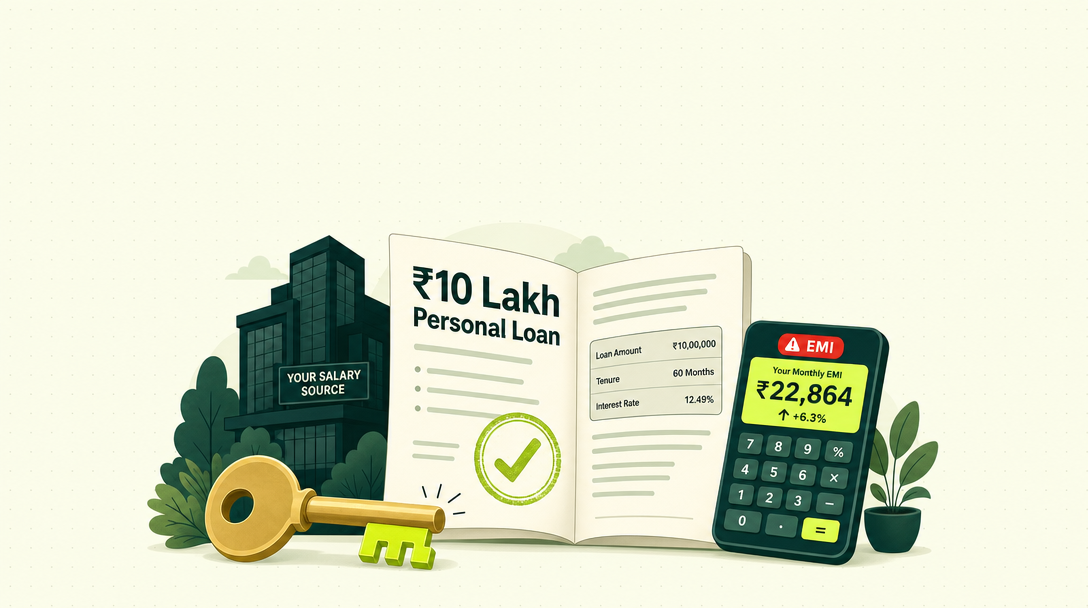
A ₹10 lakh personal loan sits at the upper end of what most salaried borrowers in India take unsecured. It is large enough that a 2-point difference in rate changes your total cost by more than ₹1 lakh, and large enough that lenders look carefully at your income and existing EMIs before saying yes.
This guide gives you the EMI for every common tenure, the salary lenders expect, the documents you will need, and the specific levers that move you from “not eligible” or “eligible at 16%” to “approved at 11%”.
₹10 lakh personal loan EMI table
EMIs below use the standard reducing-balance formula. Rates are illustrative of the 2026 market range.
| Tenure | 10.5% p.a. | 12% p.a. | 14% p.a. | 16% p.a. |
|---|---|---|---|---|
| 2 years | ₹46,376 | ₹47,073 | ₹48,013 | ₹48,963 |
| 3 years | ₹32,502 | ₹33,214 | ₹34,178 | ₹35,157 |
| 4 years | ₹25,603 | ₹26,334 | ₹27,326 | ₹28,340 |
| 5 years | ₹21,494 | ₹22,244 | ₹23,268 | ₹24,318 |
| 6 years | ₹18,779 | ₹19,550 | ₹20,606 | ₹21,692 |
At 12% over 5 years, the EMI is ₹22,244 and total interest is about ₹3.35 lakh. Stretch to 6 years, and the EMI falls to ₹19,550, but total interest rises to about ₹4.08 lakh.
How much a 2% rate difference costs
Rate matters more on a ₹10 lakh loan than on almost any other personal loan decision. Over 5 years:
| Rate | EMI | Total interest |
|---|---|---|
| 10.5% | ₹21,494 | ₹2.90 lakh |
| 12% | ₹22,244 | ₹3.35 lakh |
| 14% | ₹23,268 | ₹3.96 lakh |
| 16% | ₹24,318 | ₹4.59 lakh |
| 18% | ₹25,393 | ₹5.24 lakh |
The gap between a 12% and a 16% offer is about ₹1.24 lakh over the life of the loan. That is why accepting the first approval you get is expensive at this ticket size.
Salary required for a ₹10 lakh loan
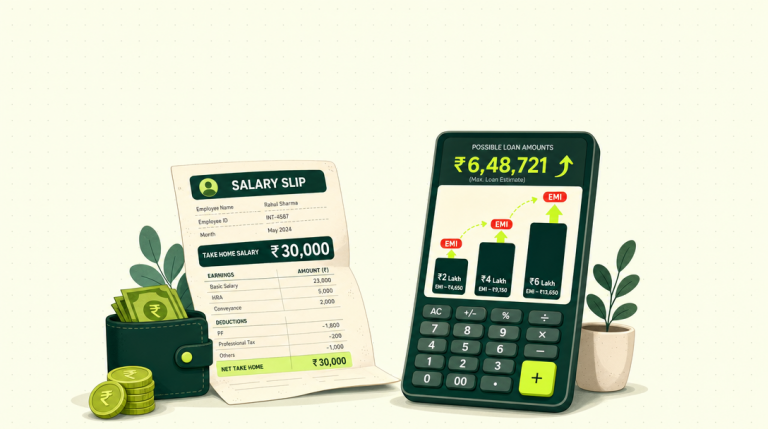
Lenders size your loan from your EMI capacity, not from a fixed salary rule. The key measure is FOIR (fixed obligations to income ratio): your total EMIs, including the new one, as a share of net monthly income.
Most banks and NBFCs cap FOIR between 40% and 55%, depending on your income band and employer category. Applying that to a ₹10 lakh loan at 12% for 5 years (EMI ₹22,244):
| Existing EMIs | Net salary needed at 50% FOIR | At 40% FOIR |
|---|---|---|
| None | about ₹44,500 | about ₹55,600 |
| ₹10,000 | about ₹64,500 | about ₹80,600 |
| ₹20,000 | about ₹84,500 | about ₹1,05,600 |
In practice, a net salary of ₹50,000 to ₹60,000 with no other EMIs puts a ₹10 lakh loan within reach at most lenders. Every existing EMI raises the bar by roughly twice its amount.
Our FOIR guide explains how lenders treat credit card outstanding and co-applicant income in this calculation.
Eligibility criteria lenders apply
Beyond income, lenders look at:
- Credit score. 750 or above typically unlocks the best rates for a loan of this size. Between 700 and 750, approval is common, but pricing is higher.
- Employer category. Employees of government bodies, listed companies, and large MNCs are often offered lower rates and higher FOIR. See our guide to company categories in personal loans.
- Employment stability. Usually at least one year of total experience and six months with the current employer.
- Age. Commonly 21 to 60 years at loan maturity for salaried borrowers.
- Recent enquiries. Several hard enquiries in the last three to six months can reduce your chances.
Self-employed borrowers can also get ₹10 lakh unsecured, usually with two to three years of ITR showing stable income and a business vintage of at least three years. Rates tend to be 1 to 4 points higher than for salaried borrowers with similar credit.
Documents required
Salaried
- PAN and Aadhaar (for e-KYC)
- Last three months’ salary slips
- Six months’ salary account statement
- Form 16 or latest ITR, requested by some lenders for larger tickets
Self-employed
- PAN and Aadhaar
- Last two to three years’ ITR with computation of income, and audited financials where applicable
- 12 months’ bank statements
- Business registration proof (GST, Udyam, or professional registration)
Most of this can be shared digitally, including bank statements through the RBI’s Account Aggregator framework.
How to get a lower rate
Reduce FOIR before you apply
Closing or consolidating a small loan or clearing a credit card balance before applying can move you into a better pricing band. Even ₹5,000 less in monthly obligations improves the calculation.
Apply where your profile is strongest.t
Your salary bank often has the most data on you and may offer a pre-approved rate. NBFCs may be more flexible on FOIR but price higher. Matching your profile to the right lender is where most savings come from.
Limit hard enquiries
Applying to five lenders in a week creates five hard enquiries. A platform that checks eligibility with a soft pull and submits only to the best-fit lender protects your score.
Negotiate processing fees
On ₹10 lakh, a 2% fee is ₹20,000 plus GST. Fees are often negotiable for strong profiles. Compare offers on APR, which includes fees, not just the headline rate.
Consider a co-applicant
Adding an earning spouse or parent as a co-applicant can raise the eligible amount and, with some lenders, improve pricing.
Choosing the right tenure
A longer tenure lowers the EMI and eases FOIR, but it costs more in total. A practical approach:
- Choose the shortest tenure whose EMI keeps your total FOIR under about 45%.
- If you expect salary increments or bonuses, take a slightly longer tenure and prepay. Check the prepayment terms in your Key Fact Statement first.
For how prepayment changes your total cost, see our guide to personal loan part payment.
Use cases
IT professional, ₹95,000 net, one car loan EMI of ₹14,000. FOIR after a ₹10 lakh, 5-year loan at 11.5% would be about 38%. Eligible with most lenders; the right match can get a rate near the lower end.
Mid-level manager, ₹55,000 net, ₹8,000 app-loan EMIs. At 12% over 5 years, FOIR would be about 55%. Folding the ₹1 lakh still owed on the app loans into an ₹11 lakh loan over 6 years brings FOIR to about 39%, with one EMI instead of three.
Key takeaways
- A ₹10 lakh personal loan at 12% for 5 years costs ₹22,244 a month and about ₹3.35 lakh in interest.
- A net salary of about ₹50,000 to ₹60,000 with no other EMIs is typically enough.
- A 4-point rate difference costs more than ₹1.2 lakh over 5 years.
- FOIR, credit score, and employer category decide both approval and rate.
- Compare offers on APR and protect your score by limiting hard enquiries.
FAQs
At 12% p.a., about ₹22,244. At 10.5%, it is about ₹21,494, and at 14%, about ₹23,268.
Typically, a net monthly salary of about ₹45,000 to ₹60,000 is required if you have no other EMIs. Existing EMIs increase the requirement.
It is possible with some lenders, especially if income is high and FOIR is low, but the rate will usually be higher than for scores above 750.
Yes, with stable ITR-declared income, a few years of business vintage, and clean bank statements. Rates are usually higher than for salaried borrowers.
Five years costs about ₹73,000 less in interest at 12%. Choose 6 years only if the lower EMI is needed to keep your FOIR comfortable.
Conclusion
At ₹10 lakh, the difference between an average offer and a good one is measured in lakhs, not hundreds. The borrowers who get the best rates do three things: they apply with low FOIR, they choose lenders that suit their profile, and they compare on APR.
TapTap Loans does the comparison across 20+ banks and NBFCs, checks eligibility with a soft pull that does not affect your score, and submits only where approval and pricing look strongest.