





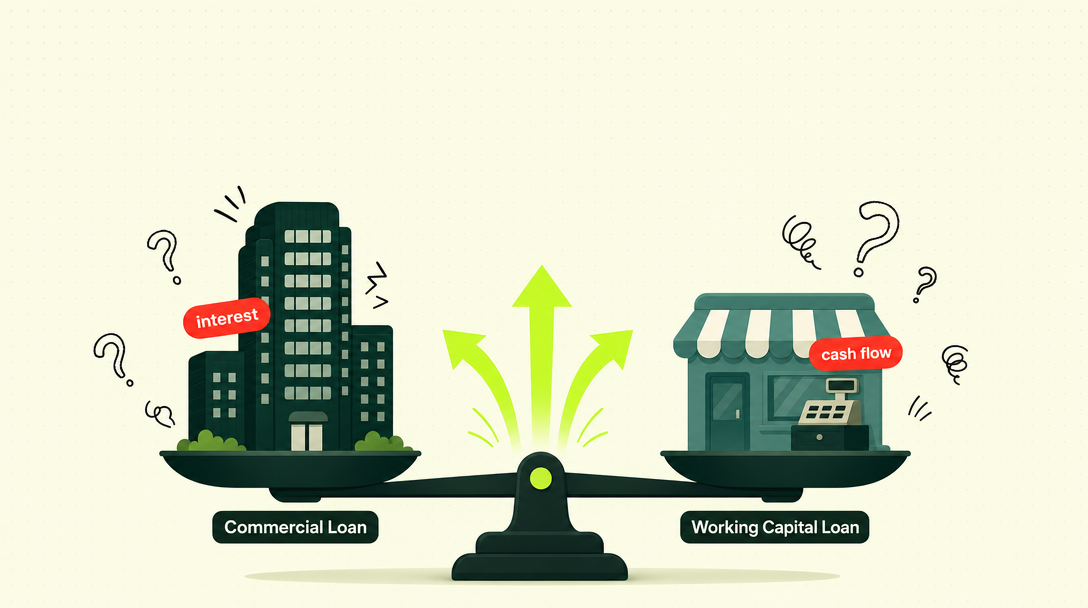
Quick answer first. In a working capital loan vs commercial loan, the difference comes down to purpose. Working capital covers daily operations. Commercial loans typically finance a specific asset, like property or equipment. This guide covers the full comparison.
What Is a Working Capital Loan?
A working capital loan provides short-term funds for a business’s everyday operational needs. Inventory purchases, payroll, supplier payments, and bridging gaps between when expenses are due and when customer payments arrive.
These loans are often unsecured, or backed by receivables and inventory rather than a fixed asset, and typically run 12 months or revolve, renewing periodically.
What Is a Commercial Loan?
A commercial loan, in the narrower sense used here, typically finances the purchase of a specific asset, commercial property, equipment, or a vehicle. It’s usually secured against that asset, with a longer tenure, sometimes up to 15 years.
Comparison Table
| Factor | Working Capital Loan | Commercial Loan |
|---|---|---|
| Purpose | Daily operations, cash flow gaps | Specific asset purchase |
| Collateral | Often unsecured, or receivables-backed | Usually secured against the asset |
| Tenure | 12 months, often revolving | Up to 10-15 years |
| Interest rate | 12%-18% | 9.5%-15% |
| Best for | Inventory, payroll, short-term gaps | Property, equipment, vehicles |
Can You Use Both Together?
Yes, and many established businesses do. A commercial loan finances the long-term asset base, the office, the equipment, the vehicles. A working capital facility handles the day-to-day cash flow fluctuations that come with running the business month to month.
Using the wrong tool for either need tends to cost more. Financing daily operations with a long-tenure secured loan ties up an asset unnecessarily. Financing a major asset purchase with short-term working capital creates repayment pressure that doesn’t match the asset’s useful life.
Which Suits Your Business Stage?
Early-stage businesses, without major assets yet, often rely more heavily on working capital financing, since there’s less to secure a commercial loan against.
Growing, established businesses, with property or equipment needs, increasingly use commercial loans for those specific purchases, while maintaining working capital facilities for ongoing operations.
A Practical Example
Consider a small manufacturing business that needs ₹8,00,000 for a new production machine, and separately needs ₹3,00,000 in flexible working capital to manage seasonal inventory swings.
The machine purchase fits a commercial loan, secured against the equipment itself, at a lower rate over a longer tenure. The seasonal inventory need fits a working capital facility, providing flexible access to funds as needed, without tying up the new machine as additional collateral.
How Lenders Assess Each Type Differently
Working capital lenders focus heavily on your cash flow cycle, how quickly you convert inventory and receivables into cash, since this directly affects your ability to repay a short-term facility. Commercial loan lenders focus more on the asset’s value and your ability to service a longer-term, larger EMI from overall business income.
Choosing Based on Repayment Comfort
If your business has predictable, recurring cash flow, a working capital facility that revolves annually can be more efficient than repeatedly taking new short-term loans. If you’re financing something with a long useful life, matching the loan’s tenure to that asset’s life, through a commercial loan, generally makes more financial sense than repeatedly renewing shorter-term debt for the same purpose.
Frequently Asked Questions
Short-term, typically running 12 months, though many working capital facilities revolve and renew periodically rather than requiring a fresh application each time.
Yes, and it’s common for established businesses to use both, matched to different needs: daily operations versus specific asset purchases.
Commercial loans are usually secured against the specific asset being financed. Working capital loans are often unsecured, or backed by receivables and inventory rather than a fixed asset.
A working capital facility, ideally a revolving one, tends to fit seasonal cash flow needs better than a fixed-tenure commercial loan.
Not sure which type of financing your business needs? TapTap helps match you to the right lender across both secured and unsecured options