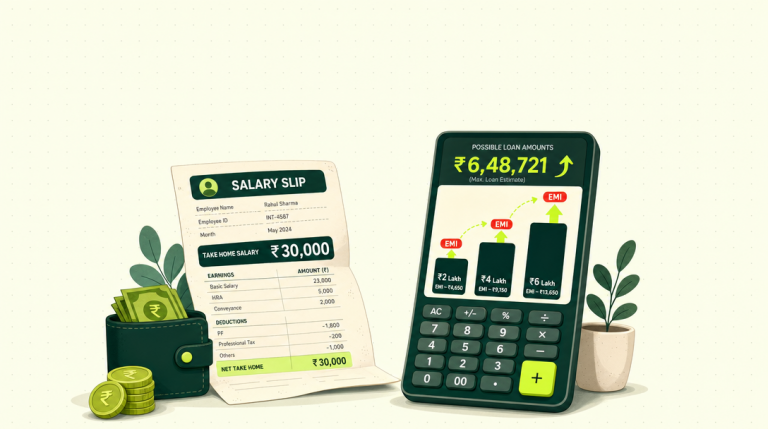







A salary advance loan lets salaried employees borrow against their upcoming salary, usually for a short term, with the loan sized around their monthly income. This guide explains how it works and when it genuinely makes sense.
The Simple Idea
You’re a salaried employee, with a predictable monthly income coming. A salary advance loan lets you access some of that value early, typically repaid within one to a few salary cycles, rather than waiting for your next payday.
How It Differs From a Standard Personal Loan
A standard personal loan can run for years, with a larger amount and a longer tenure. A salary advance loan is shorter, smaller, and tied closely to your salary cycle, often repaid within a month or a few months, not years.
Who Typically Uses This Product
Salaried employees facing a short-term cash gap before their next payday. Those with an urgent, smaller need who don’t want the commitment of a longer-term loan. First-time borrowers, sometimes, given the often simpler eligibility criteria.
How Eligibility Works
Lenders typically check your salary amount and consistency, your employer, and sometimes your bank statement pattern. Credit score requirements are often more flexible than standard personal loans, though this varies by lender.
What These Loans Cost
Interest rates can vary widely, and it’s essential to check the effective annual rate, not just a short-term figure. Some salary advance products charge a flat fee for the short tenure, which can translate into a high effective annual rate once calculated out.
A Quick Comparison Table
| Factor | Salary Advance Loan | Standard Personal Loan |
|---|---|---|
| Tenure | Days to a few months | 1-5 years |
| Amount | Tied to your salary | Based on broader eligibility |
| Speed | Often very fast | 1-3 days typically |
| Best for | Short-term cash gaps | Larger, planned needs |
A Worked Example
Borrow ₹20,000 through a salary advance product, repaid in 30 days, with a flat fee of ₹800. This looks modest in rupee terms. But calculated as an annual rate, this fee alone can represent a rate well above what a standard personal loan would charge for the same amount over a longer period.
Why the Effective Annual Rate Matters So Much Here
Short-term loans often advertise a flat fee, or a low-sounding short-term rate, that can obscure a genuinely high annualized cost. Always convert any quoted cost to an annual percentage before comparing it against other borrowing options.
When a Salary Advance Loan Makes Sense
For a genuine, short-term gap, where you’re confident of repaying quickly once your salary arrives, and where the fixed fee, even if modest in rupee terms, is worth the speed and convenience for your specific situation.
When It Might Not Be the Right Choice
If you find yourself needing this repeatedly, every month, that’s a signal of an ongoing budget gap, not a one-off need. Repeated use of short-term, higher-cost credit can quietly cost more than addressing the underlying gap directly, through budgeting or a different loan structure.
How This Differs From an Employer-Based Salary Advance
Some employers offer their own salary advance facility directly, often interest-free or at minimal cost, as an employee benefit. This is different from a third-party lending product, and worth checking with your HR department before turning to an external lender for the same need.
What to Check Before Using a Salary Advance Product
Confirm the lender is RBI-regulated, the same check that applies to any lending product. Calculate the true annual cost, not just the flat fee. And confirm the exact repayment date and method, since these products often use automatic deduction tied closely to your salary credit.
Building a Buffer to Avoid Needing This Repeatedly
If short-term cash gaps recur often, even a small emergency buffer, built gradually over time, can reduce your reliance on repeated short-term borrowing. This buffer doesn’t need to be large to make a real difference; even one month’s essential expenses provides meaningful protection.
Frequently Asked Questions
The terms overlap significantly; both are short-term, salary-tied products. The specific structure, cost, and regulation can vary by lender, so always check the details directly.
Often yes, when converted to an annual rate, even though the flat fee looks modest in rupee terms for the short tenure involved.
Often more accessible than a standard personal loan, since eligibility frequently focuses more on your salary consistency than your credit history alone.
Yes, worth checking. Some employers offer their own advance facility, often at lower or no cost, as an employee benefit.
Check the total repayment amount, fees, annualized cost, repayment date, and lender’s terms. Also compare it with an employer-provided salary advance or other lower-cost options.
Conclusion
A salary advance loan can help cover a short-term cash gap, but its convenience can come with a high effective cost. Check the total cost and repayment terms carefully, and consider employer-provided advances or other affordable alternatives before borrowing.
Facing a recurring cash gap before payday? See how consolidating your obligations into one manageable EMI could help.