





Two personal loan offers land on your phone: 11.5% from one lender, 12.5% from another. Most borrowers pick the lower number. But if the first lender charges a 3% processing fee plus insurance and the second charges almost nothing, the “cheaper” loan can cost more than a full percentage point extra every year.
The document that reveals this is the Key Fact Statement. Since 1 October 2024, every regulated lender in India must give you one before you accept a retail loan. It is the most useful two pages in any loan journey, and most borrowers never read it. This guide shows you how.
What a Key Fact Statement is
A Key Fact Statement is a standardised summary of a loan’s terms, in a format prescribed by the Reserve Bank of India. It sets out the amount, rate, EMI, tenure, every fee, the all-in annual cost (APR), penal and contingent charges, and how to raise a complaint.
Because the format is the same across lenders, two KFS documents can be compared line by line. That is the point: a common yardstick for offers that are otherwise presented in very different ways.
Which loans need a KFS
RBI’s circular of 15 April 2024 on Key Facts Statement for Loans and Advances applies from 1 October 2024 to all regulated entities (banks, NBFCs, housing finance companies and co-operative banks) for:
- Retail loans to individuals, including personal, auto, home and education loans
- MSME term loans
- All digital loans from regulated lenders
- Microfinance loans
Credit card receivables, working capital facilities and lines of credit are excluded. Existing loans sanctioned before 1 October 2024 did not need a fresh KFS.
What the KFS must contain
The prescribed format has three parts.
Part 1: Interest rate and fees
- Loan amount and amount to be disbursed
- Tenure, number and amount of instalments, and start date
- Interest rate type (fixed or floating), benchmark and spread, and reset frequency for floating loans
- Fees payable to the lender and to third parties (insurance, valuation, legal), shown separately
- Annual Percentage Rate (APR)
- Contingent charges: penal charges, foreclosure or prepayment charges, bounce charges, switch fees
Part 2: Qualitative information
- Recovery agent engagement and conduct
- Grievance redressal: nodal officer name and contact
- Whether the loan may be transferred or securitised
- For digital loans: cooling-off period and details of lending service providers
Annex: Repayment schedule
- An illustrative amortisation schedule showing principal and interest in each instalment
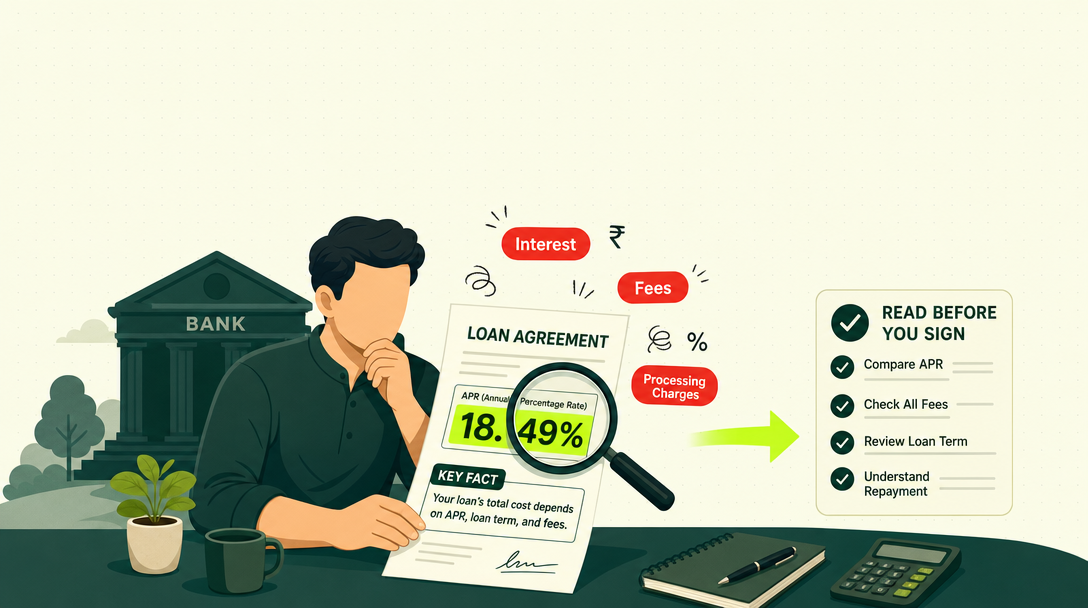
If you are comparing loans, Part 1 and the APR are where the decision is made.
APR vs interest rate
The interest rate is the price of the money. The APR is the price of the loan.
RBI defines APR as the annual cost of credit to the borrower, including the interest rate and all other charges associated with the credit facility. It includes third-party charges collected by the lender, such as insurance premiums, where they are part of the loan. Contingent charges, such as penalty or foreclosure charges, are disclosed separately and not included.
In practice, the APR is the effective annual rate you pay on the money you actually receive.
Worked example: how fees change the APR
Take ₹5 lakh for 5 years at 12% interest, EMI ₹11,122. The APR depends on what is deducted before disbursal:
:
| Upfront deductions | Net amount received | APR |
|---|---|---|
| None | ₹5,00,000 | 12.0% |
| 1% processing fee + GST (₹5,900) | ₹4,94,100 | 12.5% |
| 2% processing fee + GST (₹11,800) | ₹4,88,200 | 13.1% |
| 2% fee + GST + ₹5,000 insurance | ₹4,83,200 | 13.5% |
| 3% fee + GST + ₹8,000 insurance | ₹4,74,300 | 14.4% |
Now back to the two offers from the introduction. An 11.5% loan with a 3% fee and ₹8,000 insurance has an APR of about 13.8%. A 12.5% loan with a 0.5% fee has an APR of about 12.8%. The loan with the higher headline rate is about one percentage point cheaper a year.
Your rights under the KFS rules
- Before signing. The KFS must be given to you before you execute the loan agreement, in a language you understand.
- Time to decide. The terms in the KFS must remain valid for at least three working days for loans of seven days or longer, and one working day for shorter loans. The lender is bound by those terms if you accept within that window.
- No hidden fees. A fee or charge not mentioned in the KFS cannot be levied at any stage without your explicit consent.
- Your acknowledgement. You sign or digitally accept the KFS, confirming you received and understood it.
If a lender deducts or charges something that was not in your KFS, that is grounds for a complaint to the lender’s grievance officer and, if unresolved in 30 days, to the RBI Ombudsman.
A 7-point checklist before you sign
- Net disbursal. Is the amount you will receive what you expected?
- APR. How far is it above the headline rate? A gap of more than about 1.5 points means heavy fees.
- Rate type. Fixed or floating? If floating, what benchmark and how often does it reset?
- Insurance. Is it optional? Is the premium financed into the loan? See our loan insurance guide.
- Foreclosure and part-payment charges. Can you prepay, when, and at what cost? RBI rules now bar prepayment charges on floating-rate loans to individuals for non-business purposes sanctioned from 1 January 2026.
- Penal charges. What is charged for a late EMI or a bounce? Our explainer on penal charges covers the 2024 rules.
- Grievance contact. Save the nodal officer’s details now, not when you need them.
KFS for digital and marketplace loans
For digital loans, the KFS must be shown before the loan is executed, and the loan must come with a cooling-off period during which you can exit by repaying the principal and proportionate APR without penalty.
When a lending service provider or marketplace shows offers from several lenders, RBI’s Digital Lending Directions 2025 require it to display each matching lender’s name, amount, tenure, APR, monthly repayment, and penal charges, with a link to each lender’s KFS, so you can compare fairly. Our explainer on the RBI Digital Lending Directions 2025 covers these rules.
Use cases
Comparing two offers. A borrower has offers at 11.25% and 11.75%. The KFS shows the first includes a ₹9,000 insurance premium bundled into the loan. On APR, the second offer is cheaper.
Catching an unlisted fee. A borrower sees a ₹1,500 “documentation charge” on the first statement that was not in the KFS. A written complaint citing the KFS gets it reversed.
Key takeaways
- The KFS is a standard-format summary of your loan, mandatory for retail and MSME loans since 1 October 2024.
- APR includes interest and all fees; it is the right number for comparing offers.
- A 2% fee plus insurance can add 1.5 points or more to the effective cost.
- You get at least three working days to accept, and no fee outside the KFS can be charged without consent.
- Read net disbursal, APR, prepayment and penal charges before you sign.
FAQs
It is a standardised document, prescribed by RBI, that summarises a loan’s amount, interest rate, EMI, fees, APR, penal and prepayment charges, es and grievance contacts before you sign.
APR is the annual percentage rate: the yearly cost of the loan, including the interest rate and fees such as processing charges and bundled insurance.
It is mandatory for retail and MSME term loans, digital loans,s and microfinance loans from regulated lenders sanctioned on or after 1 October 2024. Credit card dues and working capital lines are excluded.
Not without your explicit consent. Fees outside the KFS can be challenged with the lender and escalated to the RBI Ombudsman.
Because APR includes processing fees, insurance premiums, and other charges deducted or added to the loan. The bigger the fees, the wider the gap.
Conclusion
The KFS turned loan comparison from guesswork into a two-minute exercise. The headline rate tells you how a lender wants to be seen; the APR tells you what you will actually pay.
TapTap Loans compares offers from 20+ banks and NBFCs on APR and total cost, not just the headline rate, and walks you through each lender’s KFS before you commit.