





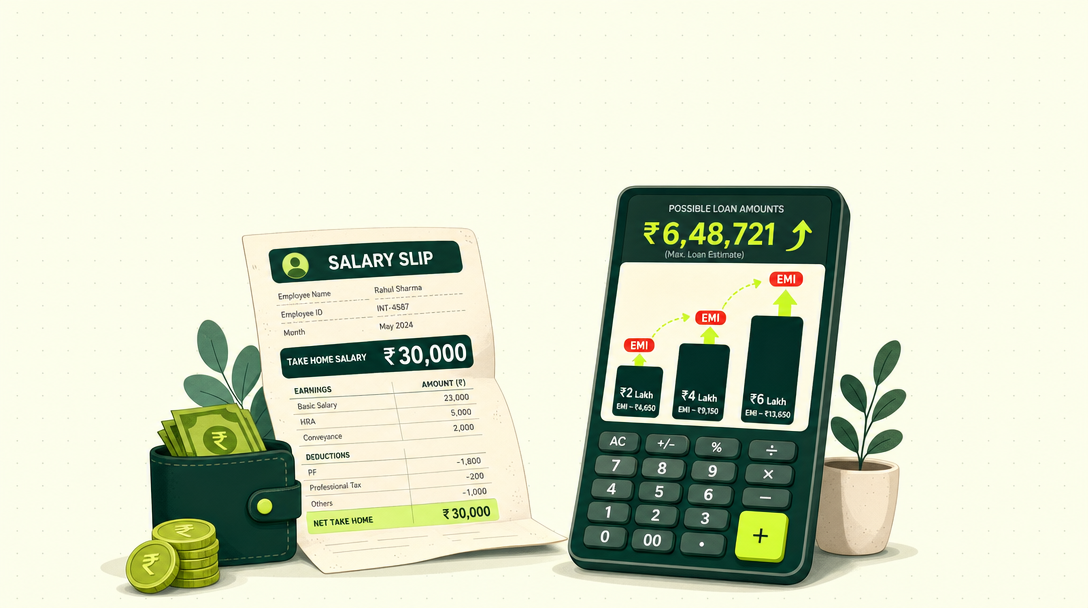
A take-home salary of ₹30,000 a month puts you above the minimum income most banks and NBFCs set for personal loans. The question is not whether you can borrow, but how much, at what rate, and whether the EMI leaves enough for the rest of your month.
The answer depends on four numbers: your net salary, the EMIs you already pay, the interest rate you qualify for, and the tenure you choose. This guide shows how lenders combine them, with worked tables you can read your own situation off.
Are you eligible on a ₹30,000 salary?
Most banks set a minimum net monthly income of ₹15,000 to ₹25,000 for salaried applicants, and many NBFCs go lower. At ₹30,000, income alone rarely blocks approval.
What lenders check alongside it:
- CIBIL score, ideally 750 or above for the best rates
- Employer category, which affects both approval and pricing for private-sector employees
- Job stability, typically at least six months to a year with the current employer
- Age, usually 21 to 58 or 60 at loan maturity
- Existing obligations, which decide how much room you have for a new EMI
If your salary is below ₹25,000, our guide to personal loans on a salary below ₹25,000 covers that band separately.
How lenders calculate your maximum loan
The core test is the Fixed Obligation to Income Ratio, or FOIR: all your monthly EMIs, including the new one, divided by your net monthly income. At this salary level, most lenders cap FOIR between 40% and 50%.
At 50% FOIR on ₹30,000, your total EMIs can be up to ₹15,000 a month. Subtract what you already pay, and the remainder is the most a new EMI can be. Our FOIR guide explains how lenders treat credit card balances, rent, and other obligations in this calculation.
That EMI capacity is then converted into a loan amount using the rate and tenure. A longer tenure supports a larger loan for the same EMI, at the cost of more total interest.
Eligibility table: loan amount by existing EMI and tenure
The table assumes ₹30,000 net salary, a 50% FOIR cap, and a 14% interest rate. Amounts are rounded to the nearest thousand.
| Existing EMIs | EMI room for new loan | 3 years | 4 years | 5 years |
|---|---|---|---|---|
| None | ₹15,000 | ₹4.39 lakh | ₹5.49 lakh | ₹6.45 lakh |
| ₹3,000 | ₹12,000 | ₹3.51 lakh | ₹4.39 lakh | ₹5.16 lakh |
| ₹5,000 | ₹10,000 | ₹2.93 lakh | ₹3.66 lakh | ₹4.30 lakh |
| ₹7,500 | ₹7,500 | ₹2.19 lakh | ₹2.74 lakh | ₹3.22 lakh |
If the lender applies a 40% FOIR instead, reduce the EMI room by ₹3,000 in each row, which typically lowers the loan amount by about ₹90,000 to ₹1.3 lakh.
The second limit: income multiples
FOIR is not the only cap. Many lenders also limit unsecured lending to a multiple of monthly income, often around 10 to 15 times net salary for this income band, and up to 20 times for very strong profiles.
At ₹30,000, that means:
- 10 times: ₹3 lakh
- 15 times: ₹4.5 lakh
- 20 times: ₹6 lakh
Your approved amount is the lower of the FOIR result and the multiple. That is why two applicants with the same salary can be offered very different amounts.
What rate to expect
The rate depends far more on your credit score and employer than on your salary. As a broad guide:
| Profile at ₹30,000 salary | Indicative rate range |
|---|---|
| CIBIL 750+, listed or large employer, salary account with lender | Around 11% to 14% |
| CIBIL 700 to 749, mid-size employer | Around 14% to 18% |
| CIBIL below 700, small employer or short job history | 18% and above, mostly NBFCs |
These ranges are indicative. Compare the annual percentage rate (APR) in the Key Fact Statement, which includes fees, rather than the headline rate.
On ₹4 lakh at 14%, the EMI is ₹10,931 over four years with ₹1.25 lakh in total interest, or ₹9,307 over five years with ₹1.58 lakh in interest. The shorter tenure saves about ₹34,00, if the higher EMI fits your budget.
How to increase your eligible amount
- Close small loans first. Clearing a ₹4,000 EMI on a nearly finished loan can add more than ₹1 lakh to your eligibility.
- Pay down credit card balances. Lenders often count a percentage of card outstandings as an obligation.
- Choose a longer tenure if you need the amount, then prepay when you can.
- Apply with a co-applicant. A working spouse or parent adds income to the calculation; see our guide to joint personal loans.
- Start with your salary-account bank. Pre-approved offers often use better FOIR limits and faster approvals.
- Declare other regular income. Rental income or a documented side income can count if you can show it in your bank statement or ITR.
- Avoid multiple applications. Each hard inquiry signals credit hunger; compare offers through soft checks first.
Use cases
Saurabh earns ₹30,000 in hand at a mid-size IT services firm, has no existing loans, and a CIBIL score of 762. A bank offers ₹4.5 lakh at 13.5% over four years. The FOIR result supports more, but the bank’s income multiple caps it at 15 times salary.
Pooja earns ₹30,000 and pays ₹6,500 a month across a bike loan and a small app loan. Her EMI room is only ₹8,500. She clears the app loan, which had six instalments left, before applying, and her eligible amount rises by roughly ₹70,000.
Key takeaways
- A ₹30,000 net salary meets most lenders’ minimum income criteria for a personal loan.
- At a 50% FOIR, your total EMIs can reach ₹15,000; existing EMIs reduce what remains.
- With no existing EMIs at 14%, that supports roughly ₹4.4 lakh over three years or ₹6.5 lakh over five.
- Income multiples of 10 to 20 times salary often set a lower ceiling, typically ₹3 to ₹6 lakh.
- Your CIBIL score and employer category matter more to your rate than your salary.
Frequently asked questions
Typically ₹3 lakh to ₹6 lakh, depending on existing EMIs, tenure, credit score, and the lender’s income multiple. With no other EMIs and a strong profile, the upper end is achievable.
At 14% over three years, about ₹10,253. Use our ₹3 lakh personal loan guide for EMIs across rates and tenures.
Net monthly take-home salary, as credited to your bank account. Deductions such as PF and tax are excluded.
Some NBFCs lend below 700, but at higher rates and lower amounts. Improving your score for a few months before applying usually saves more than it costs to wait.
It lowers the EMI and raises the loan amount, but increases total interest. Choose the shortest tenure whose EMI keeps your total obligations under about 40% of take-home pay.
Conclusion
On a ₹30,000 salary, the real constraint is not income but obligations. Clear small EMIs, keep card balances low and compare APRs, and you can borrow a useful amount at a reasonable rate without stretching your month.
Check your personal loan eligibility across multiple lenders on TapTap Loans.