





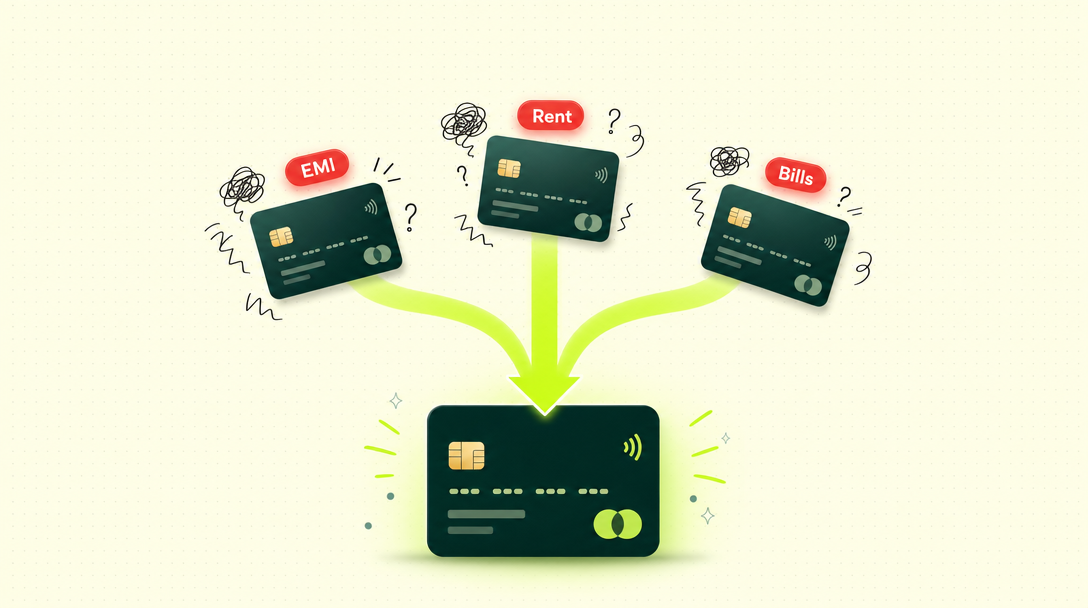
Card debt is cheap until the day you pay less than the full bill. From then on, interest runs on every rupee from the date of purchase, often at 3.5% to 3.75% a month, and the minimum due barely touches the principal.
Credit card consolidation replaces that open-ended debt with a fixed EMI and a fixed end date. Done well, it can cut total interest sharply; in the example below, by just over ₹1 lakh. Done badly, it adds a loan while the cards fill up again.
This guide explains how card interest is actually calculated, compares the three main consolidation routes, works through a ₹2.4 lakh example with real numbers, and sets out when consolidation is the wrong answer.
How credit card interest actually accrues
Three mechanics make revolving card debt expensive.
You lose the interest-free period.
If you do not pay the total amount due by the due date, the interest-free period disappears. Interest is then charged from the date of each transaction, not from the due date. Federal Bank’s card terms, for example, state that “if the Total Amount Due is not paid by the payment due date, there will be no interest-free period” (Federal Bank, Credit Card MITC, accessed 27 Oct 2026). [legal review]
Interest is charged on the daily balance at a monthly rate
The same MITC lists finance charges of 3.75% a month (45% a year) on balances up to ₹3 lakh, calculated by the average daily balance method, with revised rates applicable from 10 January 2026. It adds that GST applies to all fees, interest, nd other charges. Other issuers publish their own rates in their MITC; check yours.
The minimum due is designed to keep the account current, not to clear it.
Federal Bank’s minimum amount due starts at 5% of the total amount due. RBI rules require card issuers to set the minimum due so that there is no negative amortisation, meaning the balance should not grow if you pay it (RBI, Master Direction – Credit Card and Debit Card – Issuance and Conduct Directions, 21 Apr 2022, para 9(b)(ii)). That is a floor, not a repayment plan. Our post on why the minimum due keeps you in debt covers this in detail.
Three ways to do credit card consolidation
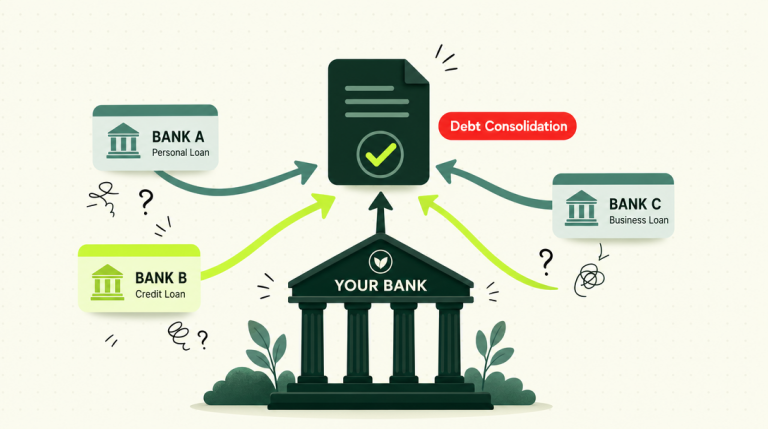
1. Personal loan used to repay the cards
You take one unsecured loan, close the card balances, and repay a fixed EMI over 12 to 60 months.
This is the most common form of credit card consolidation and the only one that covers several cards from different issuers at once. The lender must give you a Key Fact Statement showing the APR, which includes interest and all charges (RBI, KFS for Loans and Advances, 15 Apr 2024, effective 1 Oct 2024). [compliance review: confirm current Master Direction reference after RBI’s 28 Nov 2025 consolidation]
2. Card EMI conversion or balance transfer
Most issuers let you convert a purchase, or sometimes the outstanding balance, into EMIs at a rate below the revolving rate. Some also allow a balance transfer from another bank’s card.
RBI rules require the issuer to show the principal, interest, and any upfront discount before conversion, and interest-bearing EMIs cannot be presented as “no-cost” (RBI card directions, 21 Apr 2022, para 6(b)(iii)). Watch for processing and foreclosure charges: Federal Bank’s MITC, for example, lists 1% or ₹99 (whichever is higher) plus GST to convert, and 3% plus GST to foreclose.
3. Loan against a fixed deposit
If you hold an FD, it is usually priced at a small margin over the deposit rate, with no income assessment. It is the cheapest option for those who have savings but do not want to break them.
| Route | Covers multiple issuers | Typical cost driver | Main risk |
|---|---|---|---|
| Personal loan | Yes | Rate plus processing fee | Hard enquiry; cards refilled |
| Card EMI conversion or balance transfer | Usually one card at a time | Conversion fee, interest | Fees and foreclosure charges |
| Loan against FD | Yes | FD rate plus margin | Deposit stays locked |
Worked example: credit card consolidation on ₹2.4 lakh
Ankit is weighing credit card consolidation. He carries three card balances: ₹1,10,000, ₹80,000 and ₹50,000, a total of ₹2,40,000. He has stopped using the cards. Assume an illustrative card rate of 3.5% a month, before GST. In the first month alone, interest is ₹8,400 (₹9,912 once 18% GST is added).
He compares credit card consolidation with four other routes. Card figures exclude GST unless stated. The loan carries an illustrative 14% rate for 36 months with a 2% processing fee plus GST; to receive ₹2,40,000 after the fee is deducted, he borrows ₹2,45,801 and pays a fee of ₹5,801.
| Route (₹2.4 lakh) | Monthly outflow | Months to debt-free | Total interest and fees |
|---|---|---|---|
| Pay the 5% minimum due each month | ₹12,420, then falling | 319 (about 26.6 years) | ₹4,98,801 |
| Pay a fixed ₹12,420 on the cards | ₹12,420 | 33 | ₹1,67,288 |
| Consolidation loan, 14%, 36 months | ₹8,401 | 36 | ₹62,432 |
| Card EMI conversion, 16%, 24 months, 1% fee plus GST | ₹11,751 | 24 | ₹44,860 |
| Loan against FD, 8%, 24 months | ₹10,855 | 24 | ₹20,509 |
All rates are illustrative rates assumed for the calculation, not a lender quote. EMIs use the reducing-balance method. The minimum-due row assumes interest is charged before each payment and a minimum due of 5% of the balance with a floor of ₹100. The consolidation loan’s APR, including the fee, works out to about 15.69%.
What the table shows:
- On the minimum due, the balance is still ₹1,95,965 after a year and ₹1,30,651 after three years.
- Paying ₹8,401 a month on the cards, the same as the loan EMI, would barely exceed the first month’s ₹8,400 interest. Before GST, it would take more than 260 months, about 22 years, to clear; with GST, T the balance would not fall at all.
- The loan is not the cheapest route in the table, but it is the cheapest that combines three issuers without needing savings. Against a disciplined ₹12,420 fixed payment on the cards, it saves ₹1,04,856 in interest and fees and lowers the monthly outflow by ₹4,019.
Our consolidation calculator guide shows how to run these numbers for your own balances.
What credit card consolidation does to your CIBIL score
Two effects pull in opposite directions.
- Utilisation falls. Credit utilisation, the share of your card limits in use, is a major input in most scores. Clearing the balances drops it sharply. Lenders report to credit bureaus at least fortnightly (RBI, 8 Aug 2024, effective 1 Jan 2025), so the effect of credit card consolidation on utilisation usually shows within weeks.
- A new hard enquiry and a new account. The loan application adds an enquiry, and the new loan lowers the average age of your accounts. The effect is usually small if you then pay on time.
Keep at least your oldest card open with a low balance, unless you cannot trust yourself with it. Our guide to [internal link: what consolidation does to your CIBIL score covers the trade-offs.
The behaviour risk: refilling the cards
The most common way credit card consolidation fails is that the cards are used again. Six months later,r the borrower has the loan EMI and fresh card balances.
Practical safeguards:
- Ask whether the lender can pay the card issuers directly, so the money cannot be diverted.
- Treat credit card consolidation as a one-time reset: lower the limits on the cards you keep, or remove them from shopping apps and wallets.
- Set an auto-debit for the full card statement amount, not the minimum.
- Build a small emergency buffer so that the next surprise expense does not go on the card.
When not to consolidate, and what to do instead
Credit card consolidation is not always the right move. Avoid it when:
- The balance is small enough to clear from income within three or four months.
- The loan’s APR, after fees, is close to what an EMI conversion would cost.
- Spending, not interest, is the real problem and has not changed.
- You have already missed several payments. A new lender is unlikely to approve, and another application adds an enquiry.
If you are already behind, talk to your card issuer first: many offer repayment plans or restructuring. Accredited credit counselling can help build a plan.
Debt settlement closes accounts for less than owed but damages your report; see consolidation versus settlement
If an issuer does not resolve a complaint, you can escalate to the RBI Ombudsman through cms.rbi.org.in once 30 days have passed without a satisfactory reply, within 90 days after that, under the Reserve Bank – Integrated Ombudsman Scheme, 2026, in force from 1 Jul 2026 (Angel One, 9 Jul 2026; scheme summary published by Standard Chartered Bank India).
How to do credit card consolidation, step by step
- List every card: balance, monthly rate from the statement, and minimum due.
- Stop new spending on the cards.
- Get offers for a personal loan, an EMI conversion, and, if you have one, a loan against FD.
- Compare each on APR, including processing fee, GST, and foreclosure terms, using the KFS.
- Take the loan only for the amount needed to close the balances.
- Pay off the cards on the day of disbursal and keep the closure confirmations.
- Set up auto-debit for the new EMI and for any card you keep.
Use cases: three borrower scenarios
Salaried, Hyderabad, three cards
Pooja, 31, earns ₹78,000 net and has three cards totalling ₹2.4 lakh, paying around ₹12,000 a month. Her situation mirrors the worked example. A consolidation loan at an illustrative 14% for 36 months cuts her outflow to ₹8,401 and fixes the end date.
Salaried, Kochi, one large balance
Nikhil, 38, has ₹1.2 lakh on one card and ₹4 lakh in an FD. For him, credit card consolidation through a loan against the FD is cheaper than any unsecured option, and his deposit keeps earning interest.
Salaried, Nagpur, already behind
Sana, 35, has missed two card payments and carries a ₹15,000 personal-loan EMI. A new loan is unlikely to be approved. She asks her card issuers for a repayment plan and books a credit counselling session before considering consolidation.
How TapTap helps
Offer: a free EMI-reduction review. Share your current card balances and EMIs, and get an estimate of a single lower EMI.
TapTap Loans, a loan advisory platform that matches borrowers with 20+ banks and NBFCs, reviews whether consolidating your cards would reduce your monthly outflow and total cost, and tells you if it would not.
What happens after you submit: – We run a soft credit check to assess your profile. It does not affect your credit score; a hard enquiry happens only after you choose to proceed with a specific lender. – We estimate a consolidated EMI and match you with lenders whose criteria fit your profile. – We tell you which documents to share digitally with no branch visit. – We submit the application and follow up with the lender until disbursal. You get a callback after your enquiry and can reach us on WhatsApp.
Have ready: your latest statement for each card, details of other EMIs, PAN, Aadhaar, three months of salary slips, and six months of bank statements.
Cost: nothing for TapTap’s advisory service. Lender fees such as the processing fee still apply and are shown in the KFS.
TapTap Loans is a loan advisory platform. Loans are offered and approved by RBI-regulated banks and NBFCs at their discretion; rates, fees, and tenures vary by lender and borrower profile.
Key takeaways
- Once you pay less than the full bill, card interest runs from the transaction date at monthly rates such as 3.75% (45% a year) plus GST, per one bank’s published MITC.
- Credit card consolidation through a personal loan, EM conversion,n or loan against FD replaces that with a fixed EMI and end date.
- In the worked example, a 14% loan for 36 months costs ₹62,432 in interest and fees, against ₹4,98,801 on minimum dues and ₹1,67,288 on a fixed ₹12,420 card payment.
- Compare routes on APR in the KFS, including processing fee, GST, T, and foreclosure charges.
- Your score usually benefits from lower utilisation, but only if the cards are not refilled.
- If you are already behind, start with your issuer, credit counselling or the RBI complaint route, not a new loan.
Frequently Asked Questions
It is when the new loan’s APR, including fees, is clearly below your card rate and you stop adding to the cards. In the worked example, moving ₹2.4 lakh from a 3.5% monthly card rate to a 14% loan cuts interest and fees from ₹1,67,288 on a fixed card payment to ₹62,432.
Yes. This is the most common form of consolidation. You use the loan to close the card balances and then repay one EMI. Ask whether the lender can pay the issuers directly and read the KFS for the APR and foreclosure terms.
Usually only briefly. The application adds a hard enquiry, but clearing the cards lowers your utilisation, which tends to help once lenders report the closed balances. Missed EMIs on the new loan would do far more damage than the enquiry.
A balance transfer or EMI conversion can be cheaper for a single card if the fee and rate are low. A personal loan is more practical when you have balances on several cards from different banks. Compare both on total cost over the same tenure.
Conclusion
Credit card consolidation works because it changes the structure of the debt: from a revolving balance charged daily at a monthly rate to a fixed EMI with a known end date. The savings come from the rate gap; the success comes from not refilling the cards.
Run the numbers on your own balances, compare every option on AP, R, including fees, and choose the route that both cuts cost and fits your monthly budget. If consolidation does not lower either, the right move is a repayment plan, not a new loan.