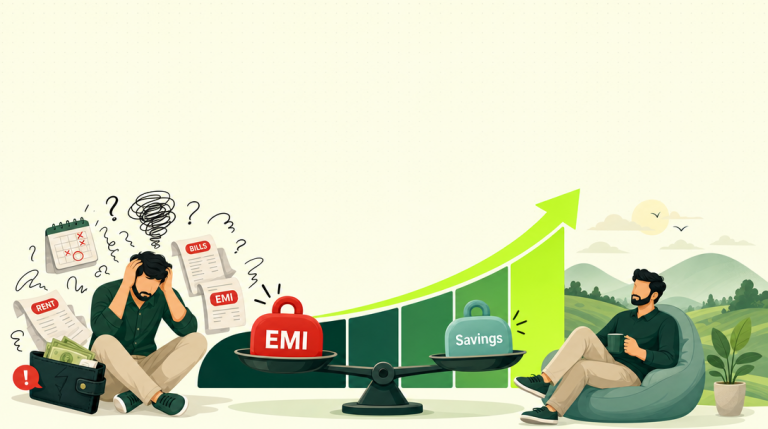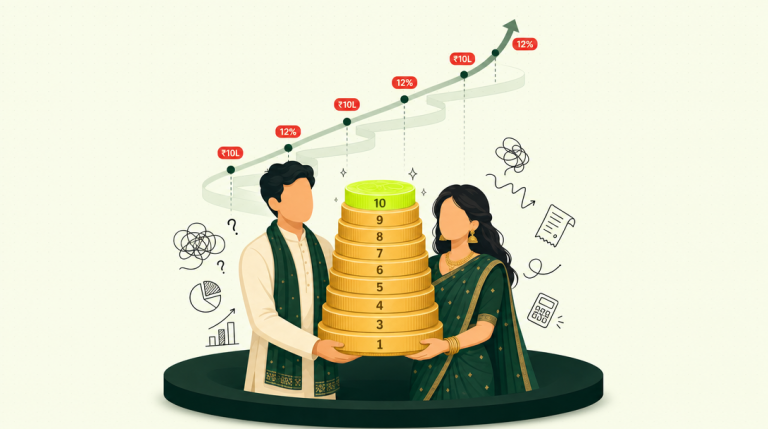






What Is Credit Card Consolidation?
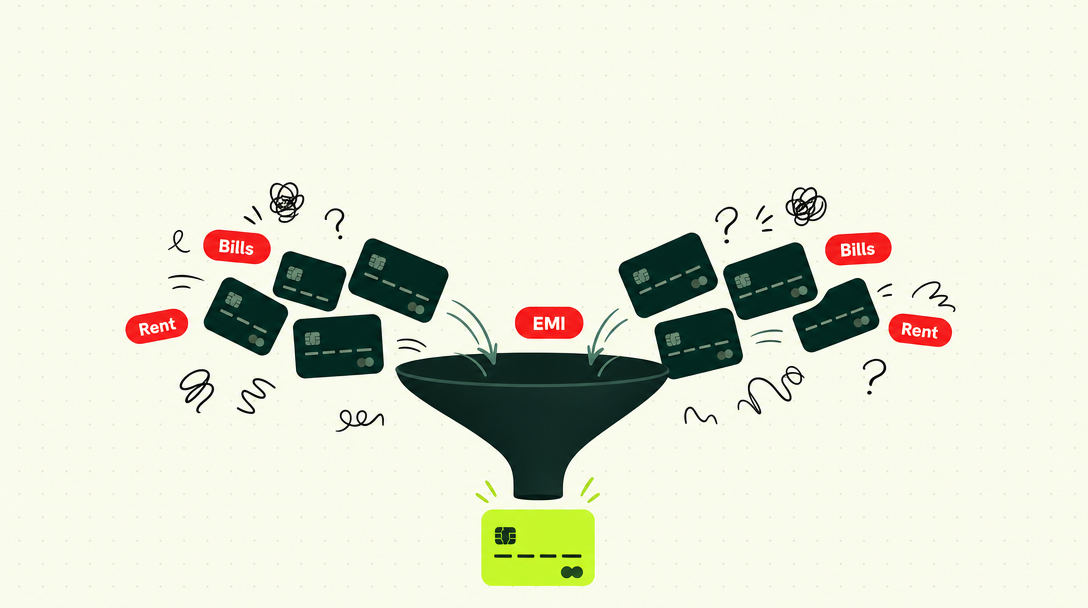
Credit card consolidation means combining the outstanding balances on two or more credit cards into a single loan with one fixed EMI, usually at a fraction of the interest rate the cards were charging. If you’re carrying dues on three cards at 34–42% annual interest and paying only the minimum due each month, consolidation replaces that revolving, compounding debt with a structured, closing-date-certain loan typically at 10–15% p.a.
This is one of the highest-impact financial moves available to Indian credit card holders, because credit card interest is, rupee for rupee, the most expensive retail debt in the country. Every month a balance is carried, roughly 3% of the outstanding gets added back as interest, which is why minimum payments so often feel like they’re not making a dent.
How Credit Card Consolidation Differs From a Balance Transfer
The two are often confused, but they solve the problem differently. A balance transfer moves your credit card debt to a new card (or a limited set of cards) offering a low or 0% introductory rate for 3–12 months,s after which the rate reverts, often higher than before. Consolidation takes out a separate personal loan sized to clear all your card balances at once, at a fixed rate for a fixed tenure, with no “teaser rate cliff” to worry about.
Balance transfer suits someone with a smaller balance they’re confident of clearing within the promotional window. Consolidation suits someone with multiple cards, a larger combined balance, or a preference for a fixed, predictable repayment schedule rather than a countdown clock.
Who Needs Credit Card Consolidation
You’re a strong candidate if:
- You’re carrying balances on two or more credit cards simultaneously, each with its own due date and minimum payment.
- Your combined credit utilization is pushing 50%+ of your total credit limit, which is already hurting your CIBIL score independent of any missed payments.
- You’ve noticed that paying the minimum due barely reduces the principal month to month,th a clear sign the interest is outpacing your repayment.
- You have stable income that can support one predictable EMI instead of multiple variable minimum-due amounts.
Interest Rate Savings: A Worked Example
Suppose you’re carrying ₹5,00,000 across three credit cards at a blended rate of roughly 36% p.a. At that rate, if you paid only the minimum due each month, you’d be paying well over ₹15,000 a month in interest alone, with the principal barely moving.
Now consolidate the same ₹5,00,000 into a personal loan at 12% p.a. over 5 years. Your new EMI comes out to approximately ₹11,,122 and unlike the credit card minimum-due trap, every rupee of that EMI is chipping away at a fixed, shrinking balance. Over the life of the loan, the total interest paid is a fraction of what continuing to revolve the credit card debt would have cost. This is the exact calculation TapTap’s savings calculator runs against your real numbers before you commit to anything.
Eligibility and Documents
Lenders assessing a credit card consolidation application typically look for:
- CIBIL score of 650+ (700+ unlocks the best rates)
- Stable income — salaried applicants need 3 months’ salary slips and 6 months’ bank statements; self-employed applicants need 2–3 years’ ITR and bank statements
- FOIR within limits — your total EMI obligations, including the new consolidated EMI, generally need to stay under 50–55% of monthly income
- Statements from each credit card you want to consolidate, showing the current outstanding balance
Step-by-Step Consolidation Process
- List every card and balance — issuer, outstanding amount, current interest rate, and minimum due.
- Check your eligibility for a consolidation loan sized to cover the total, ideally through a platform that checks multiple lenders with a single soft inquiry.
- Compare the offered rate against your current blended card rate — the gap is your real savings.
- Get approved and disbursed — funds are used to clear each card balance in full.
- Close or freeze the paid-off cards you don’t plan to actively use, to avoid re-accumulating debt on them.
- Make the single new EMI on time, every month, for the fixed tenure.
Credit Card Consolidation vs Paying Minimum Due
It’s worth being explicit about why paying only the minimum due on multiple cards is such an expensive habit. Card issuers typically set the minimum due at around 5% of the outstanding balance. On a ₹1,00,000 balance at 36% p.a., a 5% minimum payment (₹5,000) barely covers the interest accrued that month, meaning the principal shrinks by only a small amount, if at all. Extend this across three or four cards, and it’s easy to be paying ₹15,000–₹20,000 a month collectively while your total debt barely moves year over year. Consolidation breaks this cycle by converting revolving, interest-heavy minimum payments into a fixed, amortizing EMI where every payment reduces the principal on a defined schedule.
Bank vs NBFC for Credit Card Consolidation
Both banks and NBFCs offer consolidation loans, and the right choice depends on your profile:
- Banks generally offer the lowest rates for strong credit profiles (750+ CIBIL score, stable salaried income) but have stricter eligibility criteria and slower processing.
- NBFCs tend to be more flexible with credit score thresholds and self-employed applicants, process faster, but usually charge 2–4 percentage points more than a comparable bank offer.
Rather than choosing blindly, the smarter approach is to check your eligibility across both categories simultaneously; a stronger profile might unlock a bank’s lower rate, while a profile with some credit history gaps might only be approved through an NBFC, still at a rate far below what the credit cards were charging.
What Happens to Your Existing Credit Cards
Once your cards are paid off through consolidation, you have a choice: keep them open (unused) or close them. Financial advisors generally recommend keeping older cards open but inactive, since closing them can shorten your average credit history length and reduce your total available credit limit,t both factors that matter to your CIBIL score. The safer practice is to keep the cards accessible for emergencies but deliberately avoid using them for regular spending until your consolidated loan is well on its way to being repaid.
How Long Does Consolidation Take, Start to Finish?
For a straightforward salaried applicant with clean documentation, the full consolidation process from initial application to funds being disbursed and old card balances cleared typically takes anywhere from 2 to 7 working days. Self-employed applicants, whose income verification involves more documentation (ITR, GST returns, bank statement analysis), may take slightly longer, often 5–10 working days. The fastest part of the process is usually the eligibility check itself; the bulk of the time goes into document verification and, for larger amounts, additional underwriting checks. Applying through a platform that pre-checks your eligibility across multiple lenders before you formally apply can meaningfully shorten this timeline, since you avoid the back-and-forth of a rejected application with one lender before trying another.
A Realistic Scenario
Consider a 29-year-old marketing professional in Pune with a ₹1,20,000 monthly salary, carrying ₹1,80,000 across two credit cards at a blended 35% rate, plus an existing ₹80,000 personal loan at 15%. Her total monthly minimum payments and EMI were running close to ₹9,500, and despite paying consistently, her card balances had barely reduced over the previous eight months; the interest was outpacing her repayment.
After consolidating the full ₹2,60,000 into a single loan at 13% p.a. over 36 months, her new EMI came to roughly ₹8,7,70 slightly lower than her previous combined payments, but critically, every rupee of that new EMI was reducing an amortizing balance rather than treading water against compounding card interest. Over the 36-month tenure, she’ll pay meaningfully less in total interest than continuing to service the cards at 35% would have cost her, even accounting for a one-time processing fee of roughly ₹2,600 (1% of the consolidated amount) on the new loan.
Impact on Credit Score
In the short term, a new loan application triggers a hard inquiry, which can cause a small, temporary score dip. But the medium-term effect is usually positive: clearing credit card balances drops your credit utilization ratio sharply,y a factor that carries significant weight in CIBIL scoring, and a single consistent EMI payment history is easier to maintain flawlessly than juggling multiple card due dates. Most borrowers who consolidate responsibly see their score recover and improve within 6–12 months.
Frequently Asked Questions
Yes. Consolidation loans aren’t tied to a specific card issuer; the new loan simply needs to be sized to cover the combined outstanding across all your cards, regardless of which banks issued them. In practice, this is one of the main reasons people choose consolidation over balance transfer: a balance transfer typically moves debt to one new card, while consolidation can clear multiple cards from multiple issuers in a single transaction, since the new lender simply disburses funds that are then used to pay off each card individually.
No. A balance transfer moves your balance to a new card with a temporary low/0% rate that reverts to a standard (often high) rate after 3–12 months. Consolidation replaces the card debt entirely with a fixed-rate, fixed-tenure personal loan, with no rate reversion to worry about later. Balance transfer suits a single card balance you’re confident of clearing quickly; consolidation suits multiple cards or a balance you’ll need longer to repay.
There’s typically a small, temporary dip from the new credit inquiry when you apply. Over the following months, lower utilization (since your card balances drop to zero) and consistent on-time EMI payments generally push your score up compared to where it was while cards were near their limit. Most borrowers see a net positive score movement within 6–12 months of consistent repayment.
Rates for credit card consolidation loans in India typically range from 10.5% to 18% p.a., depending on your CIBIL score, income, and lender, a significant reduction from the 30–42% most cards charge on carried balances. Borrowers with scores above 750 tend to see offers toward the lower end of this range, while those in the 650–700 band should expect rates toward the upper end, primarily from NBFCs.
Most lenders set a practical minimum around ₹50,000–₹1,00,000 in combined outstanding balance, since smaller amounts don’t generate enough interest savings to be worth the processing fee. On the upper end, maximum loan amounts depend on your income and FOIR eligibility rather than a fixed cap, though very large consolidations (₹10 lakh+) may require additional income documentation or, in some cases, a co-applicant.
Not necessarily, and many advisors actively recommend against closing older cards, since doing so can shorten your average credit history length and reduce your total available credit limit, both factors in your CIBIL score. The more common recommendation is to keep the cards open but genuinely unused until the new consolidated loan is substantially repaid, avoiding the temptation to re-accumulate the same debt you just cleared.
See exactly how much you’d save by consolidating your cards with TapTap’s free savings calculator. No paperwork, no bank visit, no impact on your credit score just check.