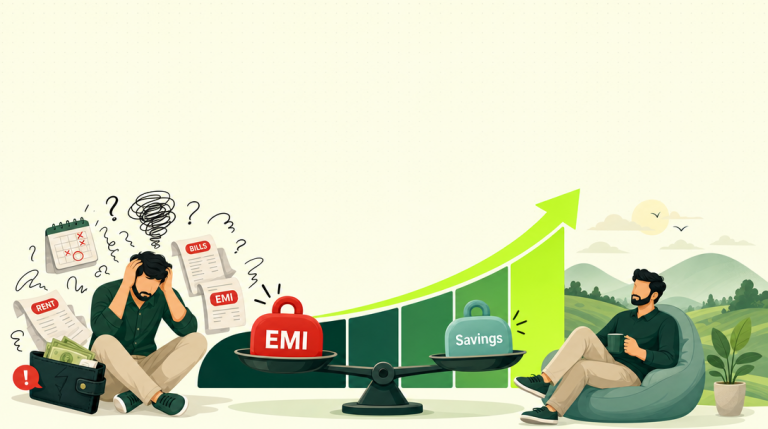






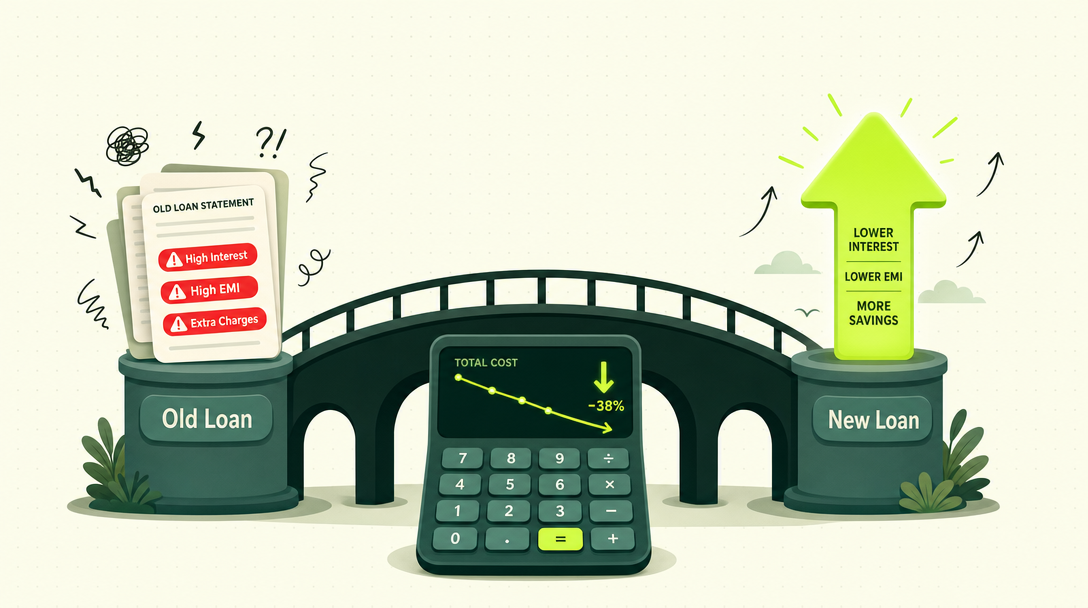
A personal loan balance transfer can help borrowers reduce EMI burden, lower interest costs, and improve repayment flexibility.
A personal loan balance transfer is the process of moving your outstanding loan balance from your current lender to a new lender who offers a lower interest rate, better terms, or both. Done at the right time and with the right calculation, it can save you ₹30,000–₹80,000 on a mid-size loan. Done at the wrong time, the fees eat most of the savings. This guide gives you the exact math to decide.
Quick Answer: When Does a Balance Transfer Make Sense?
- Your current interest rate is at least 2–3% higher than what new lenders are offering.
- You have at least 12–18 months of EMI remaining on the loan.
- Your CIBIL score is 720 or above, making you eligible for the best rates.
- Your net savings after deducting all transfer fees exceed ₹20,000.
How Balance Transfer Savings Are Actually Calculated
Most articles say “you’ll save thousands.” None shows you the actual math. Here it is.
The formula: Net Savings = (Interest under old loan for remaining tenure) (Interest under new loan for same tenure) (Foreclosure charge from old lender) (Processing fee to new lender).
Three Real Calculation Scenarios
Scenario 1: Amit — ₹8L Loan at 19%, 24 Months Remaining
Amit took a ₹10 lakh personal loan 2 years ago at 19% for 5 years. Outstanding principal today: approximately ₹8 lakh. Remaining tenure: 24 months. His current EMI is ₹21,742.
If he transfers at 13%: New EMI on ₹8L for 24 months = ₹37,748 total interest. Under the old loan for 24 months, approximately ₹48,600 in interest. Gross savings: ₹48,600 ₹37,748 = ₹10,852. Foreclosure charge from old lender (3% of ₹8L outstanding) = ₹24,000. Processing fee to new lender (1%) = ₹8,000. Total cost: ₹32,000. Net result: Amit would lose ₹21,148 on this transfer. It does not make sense at this stage.
Scenario 2: Sunita — ₹12L Loan at 20%, 42 Months Remaining
Sunita took a ₹15 lakh loan 18 months ago at 20%. Outstanding: approximately ₹12 lakh. Remaining tenure: 42 months. EMI: ₹35,148. Interest remaining under old loan for 42 months: approximately ₹2.75 lakh. At 13%: Interest for 42 months on ₹12L = approximately ₹1.73 lakh. Gross savings: ₹1.02 lakh. Foreclosure charge: 2% of ₹12L = ₹24,000 (her lender charges 2% after 24 EMIs per HDFC-style rules). Processing fee: 1% = ₹12,000. Total transfer costs: ₹36,000. Net savings: ₹1,02,000 − ₹36,000 = ₹66,000. This transfer makes strong financial sense.
Scenario 3: Vikram — ₹6L Loan at 17%, 18 Months Remaining
Vikram’s loan has 18 months remaining. At 17%, the remaining interest is approximately ₹72,000. At 13%, it would be approximately ₹55,000. Gross savings: ₹17,000. Foreclosure charge (3%): ₹18,000. Transfer makes no sense — he is better off staying with the existing lender and making one partial prepayment instead.
The Real Costs Nobody Tells You About
Foreclosure Charges From Your Existing Lender
Most fixed-rate personal loans carry prepayment/foreclosure charges. Typical structure: 4% of outstanding principal if closed within 12 months of disbursement, 3% between 12–24 months, 2% after 24 months. RBI has prohibited these charges only for floating-rate personal loans. If your loan has a fixed interest rate which most personal loans do, your lender is legally allowed to charge these fees.
Processing Fee at the New Lender
New lenders treat a balance transfer as a fresh loan application. Processing fees typically range from 0.5–2% of the loan amount, sometimes up to ₹15,000 flat for smaller loans. Always ask for this to be waived or reduced; many lenders waive it for balance transfer customers with a CIBIL 750+.
The 18-EMI Observation Window
Most experienced bankers recommend waiting until you have completed at least 18 EMIs before transferring. Two reasons: foreclosure charges are usually lower after 24 months, and you have demonstrated repayment discipline, which gives you more negotiating power with the new lender.
RBI Guidelines You Need to Know
The Reserve Bank of India issued directions in 2014 (updated periodically) governing prepayment charges. Key point: banks and NBFCs cannot levy prepayment charges on floating-rate personal loans. For fixed-rate loans, they may charge as per their loan agreement. This means before transferring, you must check whether your loan agreement specifies fixed or floating interest, and read the prepayment clause carefully.
CIBIL Impact of a Balance Transfer
A balance transfer does affect your CIBIL score, but the impact is manageable and temporary. When you apply, the new lender performs a hard inquiry — this typically drops your score by 5–10 points. Once the old loan is closed and the new one shows regular payments, your score typically recovers within 3–6 months. Long-term, if the lower EMI helps you pay on time and reduces your credit utilization, your CIBIL often improves compared to where it started.
Decision Framework: Transfer or Stay?
| Remaining Tenure | Rate Difference | Recommendation |
|---|---|---|
| Less than 12 months | Any | Do not transfer — fees will exceed savings |
| 12–18 months | Less than 3% | Marginal — calculate case-specific |
| 12–18 months | 4% or more | Transfer if CIBIL is 720+ |
| 18–36 months | 2% or more | Transfer — savings are significant |
| 36+ months | 1.5% or more | Transfer — compounding savings are large |
Check if you qualify for a lower rate. Enter your loan details and get a real savings estimate in under 2 minutes.
Step-by-Step: How to Apply for a Balance Transfer
- Get your outstanding loan statement from your current lender showing principal balance, remaining tenure, and interest rate.
- Check your CIBIL score. Scores above 720 qualify for the best transfer rates (11–13%). Scores 680–720 will get 14–17%.
- Compare offers from at least 3 lenders not just the rate, but the processing fee and foreclosure clause of the new lender.
- Run the net savings calculation: gross interest savings minus total transfer costs. If positive and above ₹25,000, proceed.
- Apply with the chosen lender and submit: current loan statement, NOC request from old lender (some lenders issue this only after approval), income proof, and KYC documents.
- The new lender disburses funds directly to your old lender. Your old account closes. New EMI schedule begins.
Frequently Asked Questions
You can transfer to any bank or NBFC that offers personal loan balance transfers which includes most major private banks, PSU banks, and RBI-registered NBFCs. The new lender will evaluate you as a fresh applicant, so eligibility depends on your current income, CIBIL score, and FOIR.
Typically, 7–15 working days from application to disbursement. The main variable is how quickly your existing lender provides the NOC and outstanding statement. Online lenders can sometimes process in 5–7 days.
Yes, temporarily. The hard inquiry drops your score by 5–10 points. The old loan closes (which can briefly reduce average credit age). But if you pay the new loan consistently, your score recovers and often improves within 6 months.
Lenders are legally required to issue a no-objection certificate once you prepay the outstanding amount. If they refuse or delay, you can escalate to the Banking Ombudsman under RBI’s grievance redressal framework.
Yes. Many lenders offer a top-up loan along with the balance transfer you get your existing loan transferred plus additional funds. The total loan amount is evaluated against your income and FOIR. This is called a balance transfer with top-up.
Conclusion
A balance transfer is one of the most powerful tools available to Indian borrowers, but only when the math works. The key variables are remaining tenure, rate difference, and transfer costs. If your outstanding loan has more than 18 months remaining and the new rate is at least 2% lower, the savings are almost always substantial. Run the numbers first. If the net savings exceed ₹25,000, the case for transferring is strong. Before choosing a personal loan balance transfer, always calculate the net savings after deducting foreclosure and processing charges.