





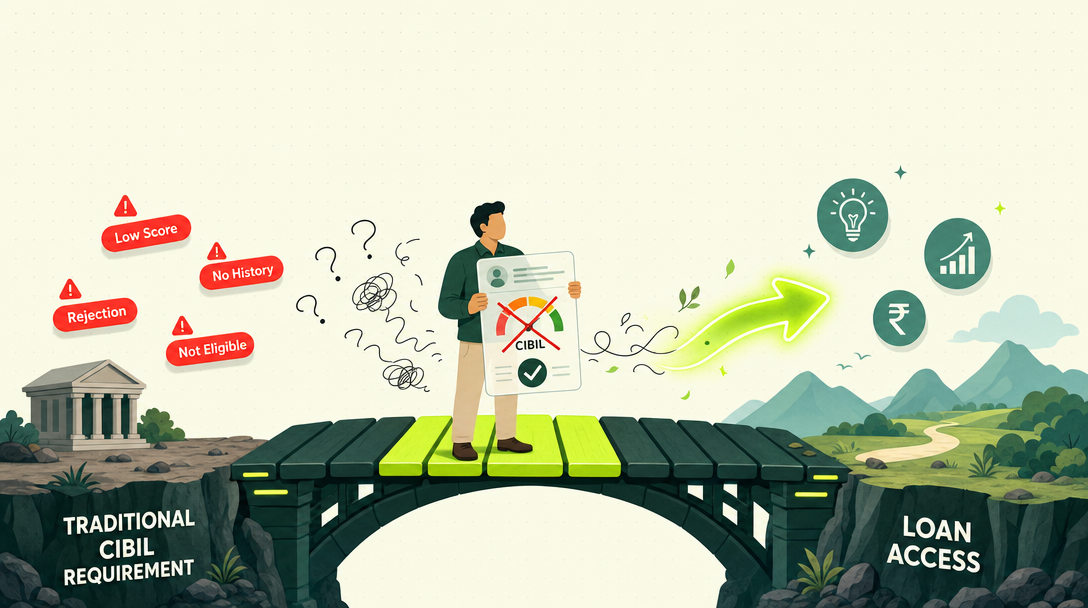
Your CIBIL score is missing. Or it’s 600. Or you’ve never taken a loan in your life, and the bureau has no record of you. You search for a personal loan, and every bank website says the same thing: 750+ CIBIL required.
But here’s the truth: millions of Indians get personal loans without a CIBIL score or with no score at all. The path is narrower, the rates are sometimes higher, and the risks of falling into a bad loan are real. But there are legitimate options, and knowing the difference between a genuine solution and a predatory trap can save you from serious financial damage.
This article explains exactly what works, what doesn’t, and how to approach this situation intelligently.
Why CIBIL Score Matters and When It Doesn’t
CIBIL score ranges from 300 to 900. A score above 750 is considered excellent, 700–749 is good, 650–699 is fair, and below 650 is poor. Scores below 300, or the absence of a score entirely, mean the bureau has insufficient data.
Banks use the CIBIL score as a proxy for repayment behaviour. The higher the score, the lower the perceived default risk, and the better the interest rate offered. But a CIBIL score is not the only lever lenders pull.
Many NBFCs and digital lenders use alternative credit assessment models that look at:
- Bank statement analysis — cash flow consistency over 6–12 months
- Salary credit pattern — regularity and stability of income deposits
- Existing asset ownership — property, vehicle, fixed deposits
- Employment type — government employees and PSU staff often are approved more easily
- Employer category — employees of large corporations often get more flexibility
The absence of a CIBIL score is different from a bad CIBIL score. New-to-credit borrowers (no bureau history) are actually easier to work with than those who have active defaults.
Legitimate Options for Getting a Loan Without CIBIL
1. Salary-Based Loans from Your Own Bank
If you have a salary account at a bank and your salary has been credited regularly for 6+ months, that bank may offer a personal loan based entirely on your salary history without requiring a CIBIL score. This works especially well at cooperative banks and smaller regional private banks.
This is one of the lowest-risk paths for new-to-credit borrowers. The interest rates are usually within the 13–18% range, and the process is relatively fast.
2. NBFCs with Alternative Credit Models
Several licensed NBFCs in India explicitly serve borrowers with thin credit files or below-700 CIBIL scores. They use proprietary scoring models based on bank statements, employment data, and repayment patterns of similar profiles.
Rates are typically higher, 18–28% p.a., but the loans are legitimate, RBI-regulated, and structured. Avoid any lender that cannot show you an RBI registration number.
3. Secured Loans as an Alternative
If the personal loan route is difficult, a secured loan is often faster and cheaper:
- Gold loan: Typically 7–12% interest, no CIBIL required, disbursed within hours. Lenders like Muthoot and Manappuram operate thousands of branches nationally.
- Loan against FD: If you have a fixed deposit, most banks offer loans of 85–90% of the FD value at 1–2% above the FD rate;e no CIBIL check needed.
- Loan against PPF/Insurance: SCSS, LIC policy, or PPF can be pledged for a loan at very low rates.
These secured options are often the smarter financial choice when CIBIL is the bottleneck.
4. Microfinance Institutions (MFIs)
For smaller loan amounts (₹10,000–₹2 lakh), NBFC-MFIs are regulated by the RBI and specifically designed for borrowers with no credit history. Interest rates are capped by RBI regulations. These are primarily useful for borrowers in semi-urban and rural areas or those needing small amounts for productive purposes.
What to Avoid Completely
The ‘no CIBIL loan’ space in India has a significant predatory fringe. Avoid:
- Apps or websites offering loans with no documentation, no income verification, and no CIBIL check at rates below 15% — these are either illegal operations or structured loan traps.
- Advance fee scams: Any ‘lender’ asking for processing fees, insurance payments, or advance deposits before disbursing the loan is running a scam. Legitimate lenders deduct fees from the disbursed amount.
- Unregistered lending apps: Always verify the lender’s RBI registration. The RBI publishes a list of registered NBFCs at rbi.org.in. If the app isn’t on that list, walk away.
The most expensive loan you’ll ever take is one you took in desperation without comparing. Even with a low CIBIL score, you have options that don’t involve predatory lenders.
→ CIBIL Score for Personal Loan: What You Need & How to Fix It Fast
The Fastest Way to Build CIBIL and Access Better Rates
If you have 3–6 months before you absolutely need the loan, building your CIBIL score is the most financially intelligent path:
- Apply for a secured credit card (FD-backed) and use it for small, regular purchases.
- Pay the full credit card balance every month — not just the minimum due.
- Check your CIBIL report for errors (incorrect defaults, wrong loan records) and dispute them.
- Avoid applying for multiple loans or cards in quick succession.
- Maintain regular salary credits in one consistent bank account.
With disciplined behaviour, a score can move from 600 to 700+ in 4–6 months. That difference alone can reduce your personal loan interest rate by 4–8 percentage points.
Read more about building your score:
→ How to Improve Your CIBIL Score Fast: What Actually Moves the Number in 2026
How TapTap Loans Helps Low-CIBIL Borrowers
Most borrowers with low or absent CIBIL scores don’t know which lenders are worth approaching — and every rejected application makes the situation worse. TapTap Loans assesses your full profile before any application is made, identifies lenders specifically suited to your credit situation, and ensures you’re not wasting hard inquiries on rejections.
→ Loan Without CIBIL Score in India: What Actually Works in 2026
Key Takeaways
- Zero CIBIL history is different from poor CIBIL; new-to-credit borrowers have more options than those with active defaults.
- Salary-based loans at your own bank and secured loans (gold, FD) are the cleanest paths when CIBIL is a barrier.
- Always verify the RBI registration of any lender before applying; the no-CIBIL space has significant predatory activity.
- Building your CIBIL score for 3–6 months before applying can reduce your eventual interest rate by 4–8 percentage points, often worth the wait.
- A loan advisory platform like TapTap Loans helps you identify genuinely suitable lenders without wasting hard inquiries on likely rejections.
Frequently Asked Questions
Yes, especially if you have a salary account at a bank. Your salary history and bank statement patterns can substitute for a CIBIL score at many NBFCs and cooperative banks. Secured loans (gold loan, FD loan) are also available without any CIBIL check.
New-to-credit borrowers typically receive rates between 15–22% at NBFCs, compared to 10.5–14% for borrowers with strong CIBIL scores. The exact rate depends on your income, employer, and the specific lender’s risk model.
Only use RBI-registered lending apps. Before downloading any loan app, verify the parent company’s NBFC registration number on the RBI website. Unregistered apps have been known to engage in illegal practices, including harassment and data misuse.
Yes, positively, if you repay on time. Gold loans and FD loans that are repaid as agreed add positive repayment history to your credit bureau file, helping build your CIBIL score over time.
With a credit card used regularly and paid in full each month, a new borrower can establish a CIBIL score within 6 months. Reaching 700+ typically takes 12–18 months of consistent positive repayment behaviour
Conclusion
Getting a personal loan without a CIBIL score is possible, but your options are more limited than those available to borrowers with strong credit histories. Salary-based loans, NBFCs using alternative credit assessment, and secured loans such as gold or FD-backed loans can provide legitimate alternatives. Before applying, always verify the lender’s RBI registration and avoid advance-fee scams or unverified loan apps. If the loan is not urgent, building a positive credit history first can help you qualify for better rates and more loan options.