





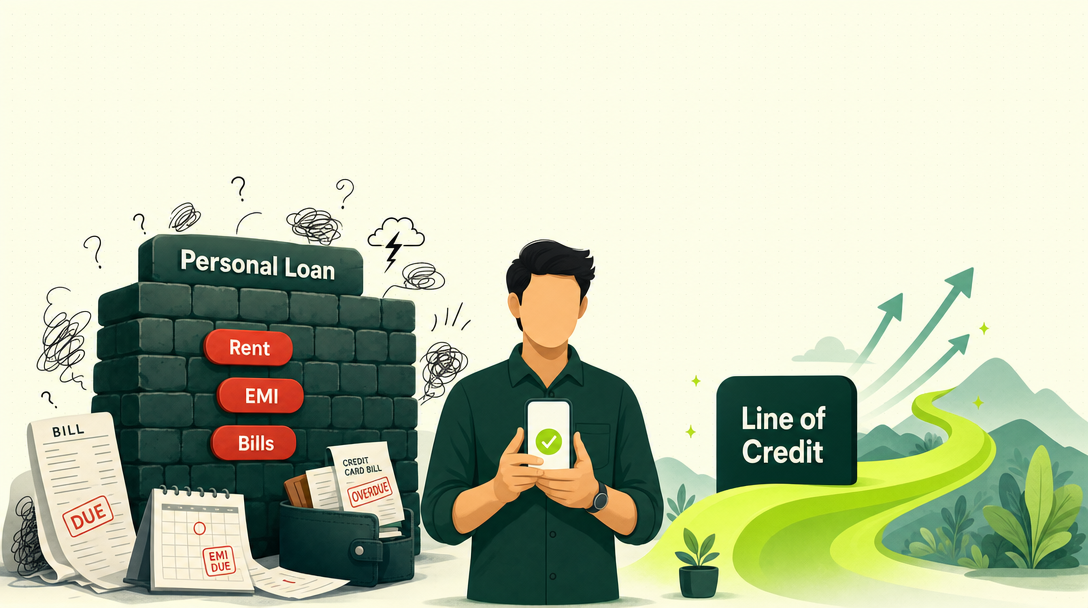
When you need access to funds, most Indian borrowers know about personal loans. Fewer are aware of personal lines of credit, a different borrowing structure that works better for specific situations. The choice between the two affects not just your interest cost but also how you access money, how much you pay, and how flexible your repayment is.
This guide explains both products clearly, compares them across the factors that matter cost, flexibility, interest structure, and CIBIL impact and helps you identify which one is right for your specific financial situation.
What Is a Personal Loan?
A personal loan is a lump-sum disbursement. You borrow a fixed amount, receive it in full upfront, and repay it in fixed equal monthly instalments (EMIs) over a fixed tenure. The interest rate is usually fixed for the tenure. Interest is charged on the entire disbursed amount from Day 1, regardless of whether you have used all the funds. Personal loans are ideal for one-time, known expenses: a medical procedure, a home renovation, a wedding, or debt consolidation.
What Is a Personal Line of Credit?
A personal line of credit is a revolving credit facility. The lender approves a maximum credit limit, and you draw from it as needed Rs. 30,000 today, Rs. 80,000 next month, Rs. 50,000 two months later. You pay interest only on the amount you have drawn, not on the full approved limit. As you repay, the credit becomes available again for future use. In India, personal lines of credit are available from fintech platforms like MoneyTap, FlexSalary, KreditLine (by KreditBee), and some banks through overdraft facilities.
Side-by-Side Comparison
| Feature | Personal Loan | Personal Line of Credit |
|---|---|---|
| Disbursement | Full amount at once | Draw as needed, up to approved limit |
| Interest Charged On | Entire loan amount from Day 1 | Only the amount drawn |
| Repayment | Fixed EMI each month | Flexible — minimum payment or full repayment |
| Interest Rate | Fixed, typically 10.5-24% p.a. | Variable or fixed, typically 12-30% p.a. |
| Tenure | Fixed (12-84 months) | Revolving — renews as you repay |
| Best For | One-time, known expenses | Ongoing or unpredictable expenses |
| Processing Fee | One-time (0.5-3%) | Annual or per-withdrawal fee |
| CIBIL Impact | Hard enquiry + EMI affects FOIR | Hard enquiry + utilisation affects score |
Interest Structure: The Critical Difference
The most important practical difference between the two products is how interest is calculated. Personal loan example: You borrow Rs. 2 lakh at 14% p.a. for 24 months. You pay interest on Rs. 2 lakh every month for 24 months, regardless of whether you used all Rs. 2 lakh or had Rs. 50,000 sitting idle in your account.
Line of credit example: Your credit limit is Rs. 2 lakh at 15% p.a. You draw Rs. 50,000 in Month 1. You pay interest only on Rs. 50,000 that month, approximately Rs. 625. If you draw another Rs. 80,000 in Month 2, you pay interest on Rs. 1,30,000 approximately Rs. 1,625. This structure is significantly more efficient if you do not need the full amount immediately.
| If you need a fixed, known amount and will use it immediately, a personal loan is almost always cheaper due to lower interest rates. If you need variable access to funds over time and will not use the full limit immediately, a line of credit can be cheaper despite a higher nominal rate. |
When a Personal Loan Is the Better Choice
- You know exactly how much you need and will use the full amount immediately (medical procedure, home renovation, wedding)
- You want a fixed repayment schedule, the same EMI every month, and predictable budgeting
- You qualify for a lower interest rate (10.5-13%) that offsets the disadvantage of paying on the full amount.
- You need a tenure longer than 36 months;s personal loans offer up to 84 months, and lines of credit rarely exceed 36 months.
- You are consolidating multiple loans or credit card debts into a single EMI.
When a Personal Line of Credit Is the Better Choice
- Your expenses are ongoing or unpredictable: home renovation in phases, recurring business expenses, education fees paid semester by semester
- You want to pay interest only on what you use; your credit limit is Rs. 3 lakh, but you use only Rs. 80,000 at a time
- You want flexibility to repay and reborrow; a revolving facility suits irregular income earners or those managing cash flow gaps
- You need a safety net rather than a fixed sum; the credit is there when you need it, at zero cost when you do not use it
Which Products Offer Personal Lines of Credit in India?
| Lender / Product | Credit Limit | Interest Rate | Key Feature |
|---|---|---|---|
| MoneyTap | Up to Rs. 5 lakh | 13%-36% p.a. | Pay only for what you use |
| FlexSalary | Up to Rs. 2 lakh | 18%-36% p.a. | Designed for salaried employees |
| KreditLine (KreditBee) | Up to Rs. 2 lakh | 15%-30% p.a. | Quick approval, fintech model |
| HDFC Overdraft (salary a/c) | Up to 3 months salary | 10%-14% p.a. | Interest on actual utilisation |
| Axis Bank Overdraft | Varies | 10%-15% p.a. | For existing account holders |
How TapTap Loans Helps
Whether you are evaluating a personal loan or a line of credit, the decision should be based on your specific expense pattern, income stability, and credit profile, not just what is easiest to find. TapTap Loans helps you identify the right borrowing structure for your situation.
Key Takeaways
- A personal loan gives you a fixed lump sum at a fixed rate; a line of credit gives you a revolving credit limit with interest charged only on the amount drawn.s
- Personal loans typically have lower interest rates (10.5-24%) than lines of credit (12-30%), but you pay on the full disbursed amount from Day 1
- If you will use the full loan amount immediately, a personal loan is almost always cheaper
- If your expenses are phased or unpredictable, a line of credit can be more efficient despite the higher nominal rate
- Lines of credit are available from MoneyTap, FlexSalary, KreditBee, and select banks through overdraft facilities
Frequently Asked Questions
A personal line of credit is a revolving credit facility where the lender approves a maximum credit limit. You draw from it as needed, pay interest only on the amount drawn, and the available credit replenishes as you repay. It is similar to a credit card but typically at lower interest rates and used for larger amounts.
If your renovation costs are predictable and you need the full amount upfront, a personal loan is better (lower rate). If renovation is phased, a line of credit is more efficient since you pay interest only on drawn amounts.
Yes. Like a personal loan, a line of credit generates a hard enquiry when you apply. Once approved, the credit limit and drawn amounts appear on your CIBIL report. High utilisation of the credit limit negatively affects your credit utilisation ratio.
Personal lines of credit in India typically carry interest rates between 12% and 36% p.a., depending on the lender and your credit profile. This is generally higher than personal loan rates (10.5-24%), but the interest-on-drawn-amount structure can make them cheaper for low-utilisation scenarios.
Some fintech providers (MoneyTap, FlexSalary) accept bank statement-based income verification for personal lines of credit. Traditional banks typically require salary proof for overdraft facilities.
Conclusion
The choice between a personal loan and a personal line of credit is about which structure fits your specific financial need. For one-time, known expenses where you use the full amount immediately, a personal loan is the more cost-effective choice. For phased, unpredictable, or recurring expenses, a line of credit’s interest-on-drawn-amount structure can save you significant money. TapTap Loans can help you identify the right structure for your situation.
| Ready to take the next step? TapTap Loans provides personalised loan advisory with no hard enquiries and no pressure. Visit taptaploans.in today. |