





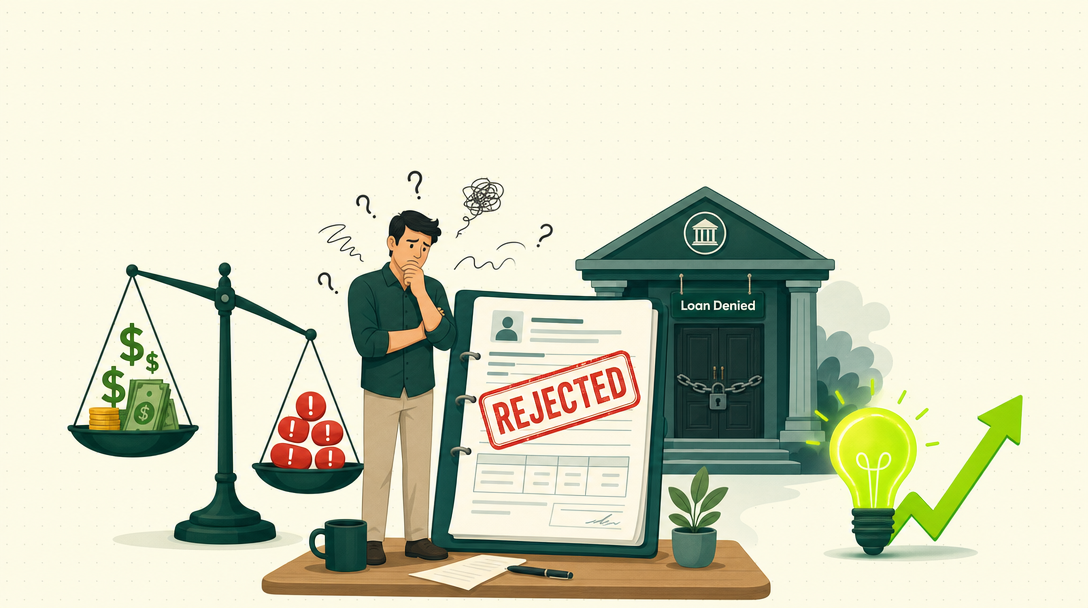
FOIR and loan rejection are closely linked because lenders use your Fixed Obligation to Income Ratio to check whether you can comfortably afford another EMI. Even with a reasonable salary and strong credit score, a high FOIR can reduce your loan eligibility or lead to rejection.
This guide explains what FOIR is, why it causes rejections, and the exact steps to fix it.
What FOIR Actually Measures
FOIR measures how much of your monthly income is already committed to fixed obligations. Existing EMIs, credit card minimum payments, and similar recurring debts, including the new loan you’re applying for.
The formula is simple. FOIR equals total monthly EMI obligations, including the new loan, divided by net monthly income, times 100.
Why Lenders Cap FOIR
Lenders want confidence you can comfortably repay a new loan without strain. Most cap total FOIR at 50 to 60% of net income. That leaves at least 40 to 50% of your income free for living expenses and unexpected costs.
New loan’s EMI would push total obligations above this threshold? The application gets rejected, or the eligible amount gets reduced, regardless of how strong your income otherwise looks.
A Worked Example of FOIR Rejection
Say your net monthly income is ₹70,000. You already pay ₹15,000 toward a car loan, and ₹8,000 in credit card minimums. That’s ₹23,000 already committed, roughly 33% of your income.
Now apply for a new personal loan, with an EMI of ₹20,000. Total FOIR becomes ₹43,000 out of ₹70,000, about 61%. Likely above most lenders’ comfort threshold. The application may be rejected, or approved for a smaller amount instead.
Common Reasons FOIR Gets Miscalculated
Lenders count existing EMIs you may have forgotten about. A small phone EMI, or a card minimum payment, still counts, even if it feels minor.
Income calculation varies by lender. Some use gross income, others net. Some average your last three months, others use your latest payslip only. Same profile, different FOIR outcome, at different lenders.
Co-applicant income can help. Apply with a co-applicant, and their income typically gets added to the FOIR calculation. This can meaningfully raise your eligible loan amount.
How to Fix a FOIR-Related Rejection
- Pay down or close a smaller existing loan before reapplying, to free up FOIR headroom.
- Add a co-applicant with steady income, if available, to boost the combined income figure.
- Apply for a smaller loan amount, or a longer tenure. Both reduce the new EMI itself.
- Consolidate existing debts first. High EMIs from unfavorable rates? Consolidating into one lower-rate loan can reduce your total FOIR, potentially unlocking eligibility for what you originally wanted.
- Check multiple lenders. FOIR calculation methods vary, so a rejection at one lender doesn’t mean rejection everywhere.
FOIR vs Credit Score: Which Matters More?
They measure different things, and both matter, for different reasons. Your credit score reflects your repayment history and reliability. FOIR reflects your current capacity to take on more debt, regardless of how reliably you’ve paid in the past.
It’s entirely possible to have an excellent credit score and still get rejected on FOIR grounds. If your existing obligations are simply too high relative to your income, that alone can block a new loan.
Why Consolidation Often Fixes a FOIR Problem
Here’s a detail many borrowers miss. High-interest existing debts, cards especially, mean your current EMIs are larger than they need to be. This inflates your FOIR unnecessarily.
Consolidating those debts into a single loan, at a lower blended rate, can reduce your total monthly EMI obligation, even while covering the same underlying debt. Lower total EMI means lower FOIR. That can improve your eligibility for future borrowing, or simply free up breathing room in your existing budget.
A Quick FOIR Self-Check
Add up every EMI and minimum card payment you currently pay each month. Divide by your net monthly income. Multiply by 100. Result already above 40 to 50%? Adding a new loan will likely be difficult without first addressing your existing obligations.
Frequently Asked Questions About FOIR and Loan Rejection
Most lenders prefer total FOIR, including the new loan, to stay under 50-60% of net income. Lower is generally safer for approval odds.
Yes, two ways. Add a co-applicant’s income. Or reduce the new loan’s EMI by choosing a smaller amount or longer tenure.
Yes, the underlying principle is the same. The income figure used may be calculated differently, based on ITR and bank statements for self-employed applicants, versus salary slips for salaried ones.
A strong score reflects reliable past repayment. FOIR reflects your current capacity to take on more debt. You can have both a great score and a high FOIR that blocks new borrowing.
Yes, if consolidation reduces your total monthly EMI obligation, typically by moving high-rate debt to a lower blended rate. Your FOIR improves as a direct result.
Think a high FOIR might be holding back your eligibility? Check how consolidation could lower your total EMI and improve your FOIR in the process.