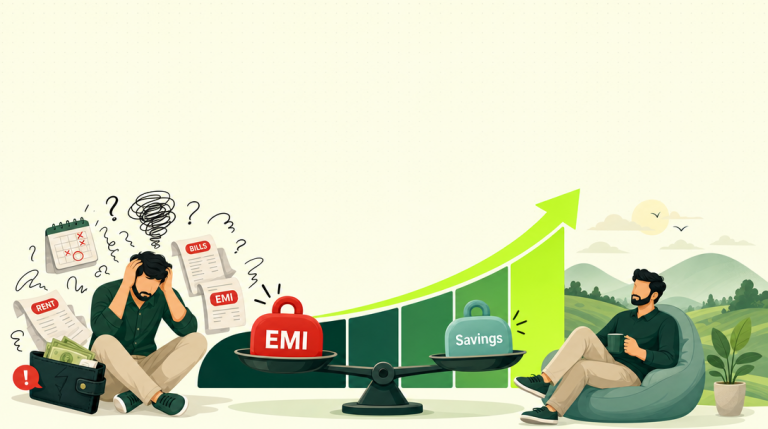






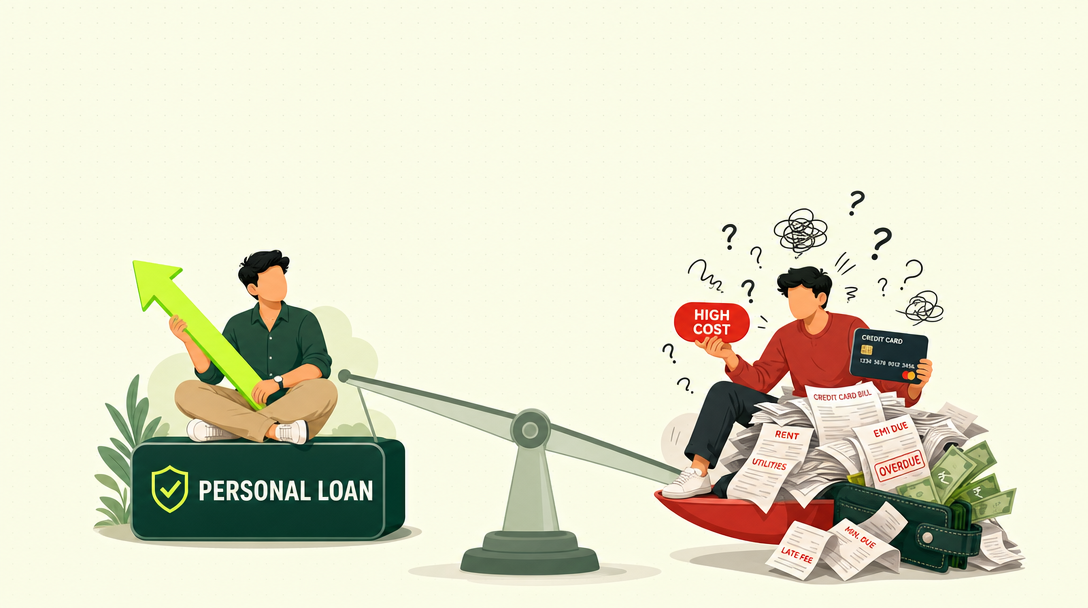
The personal loan vs. credit card debate becomes important whenever borrowers face a large expense they cannot repay immediately. In India, credit card debt can cost 30–45% annually, while personal loans usually range between 11–18%, making the right choice financially significant in 2026.
This guide provides the exact cost comparison framework, identifies the specific scenarios where each product is the right choice, and explains the no-cost EMI option that changes the calculus for certain purchases.
Personal Loan vs Credit Card: Cost Comparison
Credit card revolving debt in India in 2026 carries an interest rate of 2.5–3.75% per month on outstanding balances, equivalent to 30–45% per annum. The minimum payment trap is what makes this expensive: paying the minimum (5% of the outstanding balance) while carrying the rest generates an interest charge of 30–45% on the balance carried forward.
A personal loan for the equivalent amount carries 11–18% per annum for most salaried borrowers with adequate CIBIL scores.
The practical comparison: Rs. 1 lakh spent on a credit card, with minimum payment made each month for 12 months, results in interest of approximately Rs. 22,000–Rs. 32,000 while barely reducing the principal. The same Rs. 1 lakh as a 12-month personal loan at 14% results in interest of approximately Rs. 7,800, and the principal is fully cleared at month 12.
When a Credit Card Is Actually Cheaper
- When you can clear the full balance by the due date: Credit cards offer a genuine interest-free window of 20–52 days,s depending on the billing cycle. If you can pay the full statement balance by the due date, the cost is zero, significantly cheaper than any personal loan.
- For amounts under Rs. 20,000–25,000 that you are confident of clearing next month: For small, short-duration uses where full repayment within one cycle is realistic, the credit card is the right tool.
- For purchases where reward points or cashback provide meaningful value: On purchases of Rs. 30,000 or more with a credit card offering 2–5% cashback, the reward can partially or fully offset short-term interest if the balance is cleared within 2 billing cycles.
When a Personal Loan Is Better Than a Credit Card
- Any amount above Rs. 50,000 that cannot be cleared within one billing cycle
- Planned large expenses where the repayment timeline is known in advance (wedding, education fees, renovation, travel)
- When your credit card utilisation is already high, adding a large purchase increases utilisation further, suppressing your CIBIL score. A personal loan does not affect credit card utilisation.
- When you need a fixed repayment schedule. A personal loan EMI is predictable and fixed. Credit card debt has a variable minimum payment that adjusts with the balance, making financial planning harder.
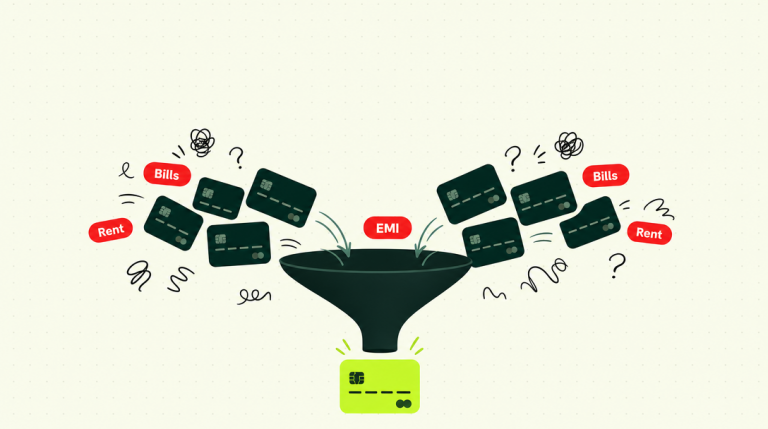
- Consolidating existing credit card debt is the most common and financially impactful use case (as detailed in the debt consolidation blog in this series).
Credit Card EMI vs Personal Loan
Most banks offer to convert large credit card purchases into EMIs at 13–24% per annum, seemingly similar to personal loan rates. However, several hidden differences make credit card EMIs structurally more expensive:
- The credit limit is blocked: When a credit card purchase is converted to EMI, that amount blocks your credit limit for the entire tenure. If your limit is Rs. 1 lakh and you convert Rs. 60,000 to EMI, only Rs. 40,000 remains available. This affects your credit utilisation ratio.
- Processing fees: Credit card EMI conversions typically charge a one-time processing fee of 1–2% that is often bundled invisibly into the effective rate.
- No prepayment flexibility: Most credit card EMI facilities carry foreclosure charges, whereas many personal loan lenders (particularly IDFC FIRST Bank) offer zero prepayment penalty.
- Rate transparency is lower: Credit card EMI rates are quoted by banks in ways that are harder to compare against personal loan reducing balance rates. Always convert to an APR before comparing.
Is No-Cost EMI Really Free?
No-cost EMI schemes offered on e-commerce platforms (Amazon, Flipkart) and consumer electronics stores present the loan as interest-free. In most cases, this is technically accurate: the merchant subsidises the interest cost by discounting the product price or paying the financing cost to the NBFC. However:
- The interest savings are real only if you would not have been offered the same discount without the EMI arrangement. Some merchants offer the same price with and without no-cost EMI, in which case the no-cost element is genuine.
- Processing fees on no-cost EMI vary from Rs. 0 to Rs. 999. These should be factored into the true cost calculation.
- The credit limit is blocked for the tenure, as discussed above — a non-trivial cost if your limit is limited.
For purchases where a genuine no-cost EMI is available (verified by checking the non-EMI price) and the amount is within your manageable credit limit, the no-cost EMI is effectively zero-cost credit, cheaper than a personal loan. Use it.
Balance Transfer: The Middle Ground
If you are currently carrying a credit card balance at 36% p.a. and want a structured repayment at a lower rate, a balance transfer to another credit card (typically offered at 0–1.99% per month for a promotional period of 3–9 months) or a personal loan balance transfer is available. The mathematics:
- Balance transfer credit card (0% for 6 months): Effective cost is the processing fee (1–2%) plus the post-promotional rate if the balance is not cleared within 6 months.
- Balance transfer to personal loan at 13% p.a.: Fully amortises the balance over 12–36 months with full cost transparency from day one.
For borrowers with Rs. 2 lakh or more in credit card debt that they cannot clear within 6 months, the personal loan balance transfer is almost always the more financially sound choice.
Key Takeaways
- Credit card revolving debt costs 30–45% p.a. in India. A personal loan for the same amount costs 11–18% p.a. for eligible borrowers.
- A credit card is the right tool only for amounts cleared within 1–2 billing cycles.
- No-cost EMI is genuinely cost-free only when the non-EMI price is the same; verify before using.
- Credit card EMI conversions block your credit limit and often carry hidden fees; compare the total cost against a personal loan before converting.
- Consolidating credit card debt into a personal loan is among the most cost-effective financial decisions available to over-leveraged Indian borrowers.
Frequently Asked Questions
If you can repay the Rs. 1 lakh in full within one billing cycle, a credit card (no interest). If you will repay over 6–12 months, a personal loan at 13–15% p.a. costs approximately Rs. 4,300–8,300 in interest; the same amount on a credit card at 36% p.a. costs Rs. 20,000–30,000.
Yes. Paying down credit card debt reduces your credit utilisation ratio — a significant component of the CIBIL score. Additionally, on-time repayment of the personal loan builds a positive payment history. Most borrowers who consolidate credit card debt into a personal loan see a measurable score improvement within 6–12 months.
You can, but closing a credit card reduces your total available credit limit, which can increase your utilisation ratio on remaining cards and shorten your average credit history. It is generally better to keep the card open with zero or minimal balance rather than closing it after payoff.
Yes. Personal loans generally have lower interest rates than revolving credit card balances, especially for large expenses repaid over several months.
No-cost EMI is only genuinely free if the product price remains the same without EMI, and no hidden processing fees apply.
Conclusion
The personal loan versus credit card question resolves into a simple rule: credit cards are for short-duration, in-cycle expenses; personal loans are for multi-month, large-amount commitments. The cost difference between the two for any amount held beyond one billing cycle is substantial — and consistently underestimated by borrowers who focus on minimum payment amounts rather than the interest accumulation they represent.
Making the right choice for any significant expense reduces your total financing cost by thousands of rupees. TapTap Loans helps borrowers evaluate this decision and, when a personal loan is the right choice, identifies the lender whose rate best fits their profile.