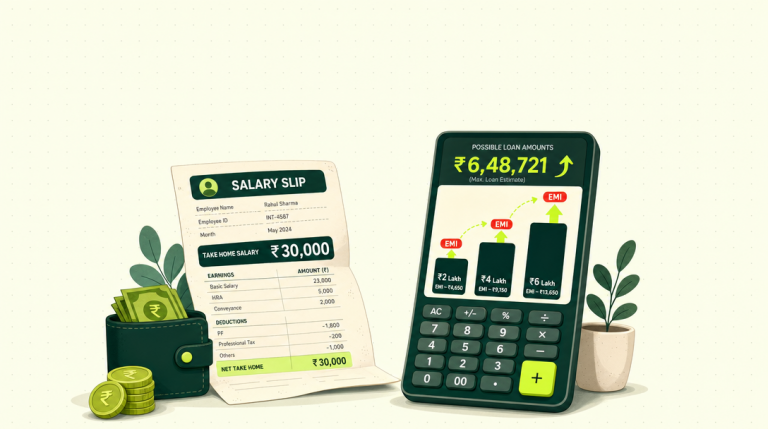






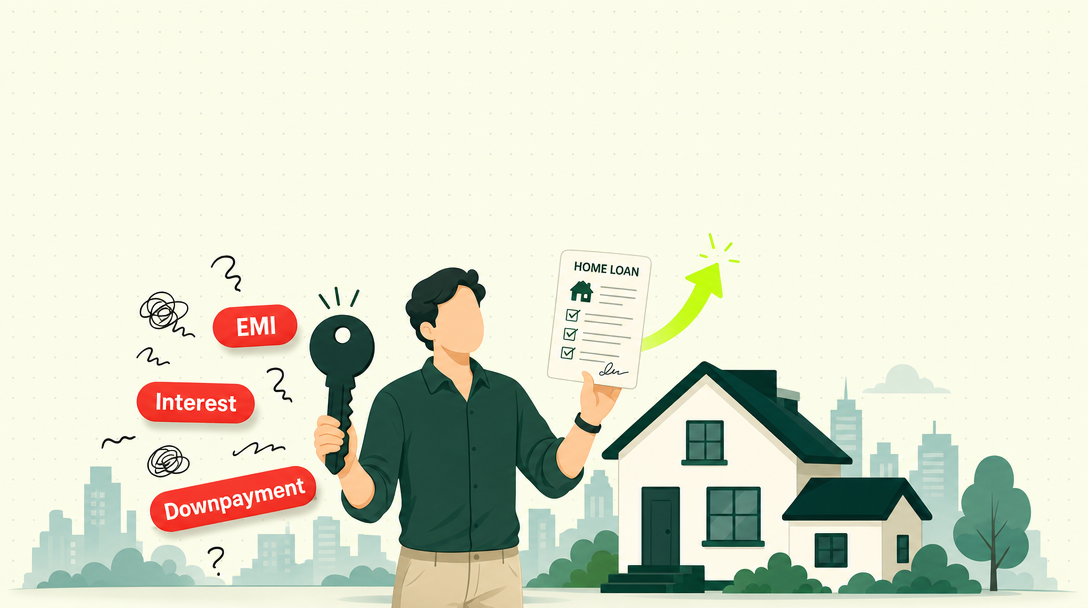
A common first question for anyone buying a home loan in India: how much can I actually borrow? As a rough rule of thumb, lenders typically extend home loans up to roughly 50–60 times your net monthly salary, loan eligibility factors subject to your credit score, existing obligations, and the property’s value — though the exact figure depends heavily on individual circumstances. The rest of this guide walks through everything else you need to know before applying.
What Is a Home Loan?
A home loan is a secured loan taken specifically to purchase, construct, or renovate residential property, with the property itself serving as collateral. Because it’s secured, home loans typically carry lower interest rates than unsecured personal loans, and tenures can stretch up to 20–30 years, making monthly EMIs manageable even on large loan amounts.
Eligibility Criteria
- Age: Typically 21–65 years at loan maturity (varies by lender)
- Income: Both salaried and self-employed applicants are eligible, with income thresholds varying by lender and city
- Credit score: 700+ significantly improves both approval odds and the rate offered; below 650 makes approval considerably harder
- Employment/business stability: Salaried applicants typically need 2+ years of work experience with at least 6 months in the current job; self-employed applicants need 2–3 years of business continuity
- FOIR: Your total EMI obligations, including the new home loan EMI, generally need to stay within 50–60% of monthly income
Interest Rate Types: Fixed vs Floating
Floating-rate home loans are far more common in India and move with the lender’s benchmark rate (typically linked to the RBI repo rate), meaning your EMI or tenure can change over time as rates move. Fixed-rate loans lock in a rate for a defined period (rarely the full tenure), offering predictability at the cost of typically starting slightly higher than floating rates and not benefiting if rates fall. Most first-time buyers opt for floating-rate loans, partly because RBI rules prohibit foreclosure/prepayment penalties on floating-rate home loans to individual borrowers, giving more flexibility to prepay or transfer later.
Documents Required
- KYC: PAN, Aadhaar, passport-size photographs
- Income proof (salaried): Salary slips (3–6 months), Form 16, bank statements showing salary credit
- Income proof (self-employed): 2–3 years’ ITR, GST returns if applicable, business continuity proof, bank statements
- Property documents: Sale agreement, title deed, approved building plan, No Objection Certificate from the builder/society, encumbrance certificate
- Address proof and photographs of the property
Step-by-Step Application Process
- Check your eligibility and budget — factor in down payment (typically 10–25% of property value), processing fees, and stamp duty alongside the loan amount.
- Compare lenders on interest rate, processing fee, and prepayment terms — even a 0.25% rate difference matters significantly over a 20-year tenure.
- Submit your application with income and KYC documents.
- Property valuation and legal verification — the lender independently assesses the property’s value and legal clarity before approval.
- Loan sanction — you receive a sanction letter specifying the approved amount, rate, and tenure.
- Disbursement, either in full (for a ready property) or in stages (for an under-construction property, tied to construction milestones).
How Much Loan Can You Get
Lenders typically calculate your eligible loan amount based on your net monthly income, existing EMI obligations, and the property’s assessed value — commonly capping the loan at a level where your total EMIs (including the new one) don’t exceed roughly 50–60% of your monthly income. As a very rough guide:
| Net Monthly Salary | Approx. Eligible Home Loan (illustrative) |
|---|---|
| ₹50,000 | ~₹30-35 lakh |
| ₹75,000 | ~₹45-55 lakh |
| ₹1,00,000 | ~₹60-70 lakh |
| ₹1,50,000 | ~₹90 lakh-1 crore |
These figures are illustrative and vary meaningfully by lender, existing obligations, co-applicant income, tenure chosen, and interest rate — always confirm your specific eligibility with a lender rather than relying on rules of thumb alone.
Under-Construction vs Ready-to-Move Property Loans
The type of property you’re buying changes both the disbursement process and some of the costs involved. For ready-to-move properties, the full loan amount is typically disbursed at once after all verifications are complete, and EMIs begin immediately. For under-construction properties, disbursement happens in stages tied to construction milestones (foundation, superstructure, finishing, etc.), and many lenders offer a “pre-EMI” option during this phase — where you pay interest only on the disbursed amount rather than a full EMI on the eventual total loan, keeping costs lower until the property is ready and full EMIs begin. Under-construction properties also typically attract GST (currently 5% for non-affordable housing, 1% for affordable housing, on the property value, not the land portion), a cost ready-to-move resale properties don’t carry — worth factoring into your total budget from the start.
Choosing Between a Longer and Shorter Tenure
A longer tenure (25-30 years) lowers your monthly EMI, making a larger loan amount feel more affordable month to month, but substantially increases total interest paid over the life of the loan — often more than doubling the total interest compared to a 15-year tenure for the same principal. A shorter tenure means a higher EMI but meaningfully less total interest and faster equity build-up in the property. Many first-time buyers default to the longest available tenure to minimize the immediate EMI, without fully appreciating the long-term cost difference — it’s worth running both scenarios and choosing based on genuine affordability rather than simply the lowest possible monthly number.
Common First-Time Buyer Mistakes
- Underestimating total costs — stamp duty, registration charges, processing fees, and GST (on under-construction property) can add 7–10% on top of the property price and loan.
- Maximizing loan eligibility instead of comfortable affordability — just because you qualify for a larger loan doesn’t mean the resulting EMI fits comfortably within your budget alongside other expenses.
- Not comparing lenders thoroughly — many first-time buyers accept the first offer, often through the builder’s tie-up bank, without checking whether a better rate is available elsewhere.
- Skipping legal due diligence on the property — always verify clear title and necessary approvals independently, even when the lender conducts its own verification.
- Ignoring the down payment savings timeline — start saving for the down payment well before you plan to buy, since a larger down payment reduces both your loan amount and total interest paid.
Frequently Asked Questions
As a general guide, lenders often extend home loans up to roughly 50-60 times your net monthly salary, subject to your credit score, existing EMI obligations, and the property’s assessed value — actual eligibility varies by lender.
RBI’s Loan-to-Value (LTV) norms generally require a minimum down payment of 10% for loans up to ₹30 lakh, 20% for loans between ₹30-75 lakh, and 25% for loans above ₹75 lakh.
Yes, significantly. A score of 750+ typically unlocks the best available rates, while scores below 650 make approval considerably harder and may limit you to a narrower set of lenders.
For a straightforward application with clear property documentation, approval can take anywhere from a few days to 2-3 weeks, with disbursement following shortly after sanction, depending on the lender and property type.
Ready to explore your home loan options? TapTap compares offers across 20+ banks and NBFCs to help you find the best rate for your profile — no bank visits required.