






What Counts as a Missed EMI?
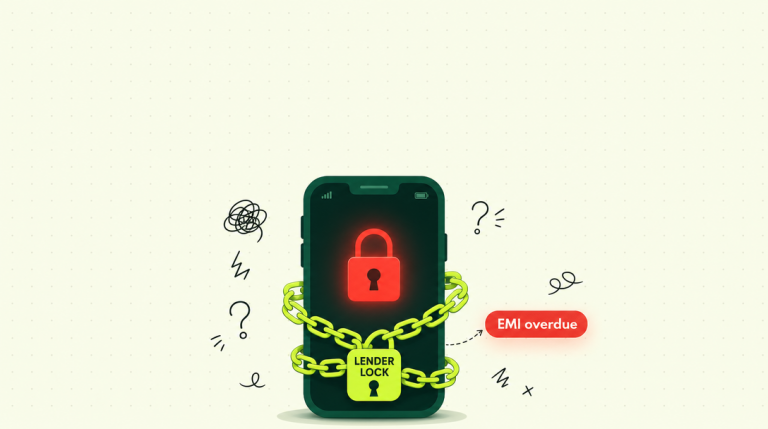
A missed EMI is any scheduled loan payment that isn’t made by its due date, whether the auto-debit failed, you forgot to arrange funds, or a cheque bounced. Lenders typically distinguish between a payment that’s a few days late but resolved quickly, and one that stays unpaid long enough to be formally reported as overdue to the credit bureaus.
Late Payment Penalty & Interest
Missing an EMI usually triggers two separate costs:
- A late payment/bounce charge, typically ₹250–₹750 depending on the lender
- Additional interest on the overdue amount for the days it remains unpaid, calculated at your loan’s penal interest rate (often 2–3% above your regular rate)
These charges add up quickly if left unresolved, which is why addressing a missed EMI within days, not weeks, meaningfully limits the total cost.
Grace Period: Does Every Lender Offer One?
Most lenders build in a short grace period, commonly 3 to 7 days,s before formally marking a payment as “missed” for credit bureau reporting purposes. This isn’t universal, and grace periods vary significantly by lender and loan type, so it’s worth checking your loan agreement rather than assuming you have leeway. Within this window, clearing the payment (plus any applicable charge) typically prevents the miss from being reported at all.
CIBIL Score Impact Timeline
- 0–30 days overdue (DPD 0-30): If reported, this is the earliest and least damaging stage — resolving quickly limits lasting impact.
- 30–60 days overdue (DPD 30-60): More significant score impact; the missed payment is now clearly visible on your credit report.
- 60–90 days overdue (DPD 60-90): Substantial score damage; lenders begin treating the account as a serious risk.
- 90+ days overdue: The loan risks being classified as a Non-Performing Asset (NPA) under RBI norms, with the most severe and longest-lasting credit impact.
The earlier you act, the smaller and more reversible the impact tends to be.
Missed EMI on a Joint Loan or With a Guarantor
If your loan has a co-applicant or guarantor, a missed EMI affects their credit report too, not just yours. This is a critical point many joint borrowers underestimate. Lenders typically report the missed payment against every party attached to the loan, meaning a guarantor’s credit score can take the same hit as the primary borrower’s, even though they never received or spent the loan funds. This is worth communicating clearly to any co-applicant or guarantor the moment a payment looks at risk, both out of fairness and because a co-applicant may have resources or willingness to help cover a temporary shortfall that the primary borrower doesn’t.
Step-by-Step Recovery Plan
- Pay the missed EMI immediately, along with any late fee, as soon as you’re able.
- Contact your lender directly — proactive communication is viewed far more favourably than silence, and many lenders will work with borrowers who reach out before the account escalates.
- Request written confirmation that the payment has been received and, where applicable, ask whether the miss has been or will be reported to credit bureaus.
- Monitor your credit report over the following months to confirm the account status has updated correctly.
- Build a buffer to prevent recurrence — whether that’s a savings cushion, a revised EMI date, or restructuring your obligations.
How Different Loan Types Handle a Missed Payment
Not all loans treat a missed EMI identically. Credit cards typically report to bureaus fastest and add compounding interest on the entire outstanding balance, not just the missed installment, making card debt the most urgent to address. Personal loans generally follow a defined DPD (days-past-due) reporting cycle, with most lenders giving a short window before formal reporting. Secured loans like home loans and auto loans often have somewhat more lender flexibility for a first-time miss, given the underlying collateral, though repeated misses are treated seriously regardless of loan type. Knowing which category your missed payment falls into helps calibrate how urgently to act; credit card debt deserves the fastest response of all.
Building a Buffer to Prevent Recurrence
Beyond the immediate fix, the more durable solution is structural. Many borrowers who experience a missed EMI find, on closer look, that their total monthly obligations were already stretched close to their income limit, leaving no margin for even a small disruption a delayed reimbursement, an unexpected expense, a late salary credit. A practical fix is maintaining a dedicated buffer equal to at least one month’s total EMI obligations in a separate, untouched account, refreshed as soon as it’s used. For borrowers juggling multiple EMIs specifically, reducing the number of due dates through consolidation often does more to prevent future misses than any amount of individual vigilance, simply because there’s less that can go wrong with one payment date instead of several.
When to Contact Your Lender Proactively
Don’t wait for a call from the bank. If you know in advance that an EMI is at risk due to a temporary cash flow gap, a delayed salary, or an unexpected expense, contacting your lender before the due date is almost always better than dealing with the aftermath. Lenders have more flexibility to offer short-term solutions (a few days’ extension, adjusted due date, or in some cases a formal deferment) when approached proactively, compared to after a payment has already failed and been reported.
If missed EMIs are becoming a recurring pattern rather than a one-off event, it’s worth examining whether your total monthly obligations are simply too high relative to your income. In that case, restructuring or consolidating your debt into a single, more affordable EMI is often a more sustainable fix than repeatedly managing the fallout of individual missed payments.
Frequently Asked Questions
This varies by lender, but many offer 3–7 days before formally reporting the payment as overdue. Some lenders have no grace period at all — check your specific loan agreement rather than assuming.
Not always immediately — most lenders report to credit bureaus on a monthly cycle, so a payment resolved quickly within the grace period may never appear as “missed” on your report. Once reported, however, it typically remains visible for a period even after being cleared.
Rarely without any charge — most lenders apply at least a late fee, and often additional penal interest, for any payment made after the due date, even if it’s within a stated grace period for reporting purposes.
Under RBI norms, a loan is generally classified as a Non-Performing Asset after 90 days of overdue payment (DPD 90+). This is a formal regulatory classification with significant credit consequences, and lenders typically make multiple contact attempts well before this threshold.
If tracking multiple EMIs is making missed payments more likely, see how much you could simplify with a single consolidated EMI.