





Introduction
The difference between a 12% personal loan and an 18% personal loan on ₹5 lakh over 3 years is ₹50,580 in total interest paid. That’s not a rounding error — it’s a meaningful sum that either stays in your pocket or goes to the bank.
And yet most Indian borrowers apply to the bank they already have an account with, accept the first offer they receive, and never discover that another lender would have charged them significantly less for the same loan.
This guide provides a comprehensive comparison of personal loan interest rates across India’s major lenders in 2026 — and more importantly, explains what actually determines the rate YOU receive.
Personal Loan Interest Rates: Major Lenders in 2026
| Lender | Interest Rate (p.a.) | Processing Fee | Min CIBIL | Max Loan Amount |
|---|---|---|---|---|
| SBI (Xpress Credit) | 11.45% – 14.60% | 1% + GST | 700+ | ₹35 lakh |
| HDFC Bank | 10.75% – 21.50% | 0.5%–2.5% | 700+ | ₹40 lakh |
| ICICI Bank | 10.85% – 19% | Up to 2.5% | 700+ | ₹50 lakh |
| Axis Bank | 11% – 22% | 1.5%–2% | 700+ | ₹40 lakh |
| Kotak Mahindra Bank | 10.99% – 24% | Up to 3% | 700+ | ₹40 lakh |
| IndusInd Bank | 10.49% – 26% | Up to 3% | 700+ | ₹50 lakh |
| IDFC FIRST Bank | 10.49% – 23% | Up to 3.5% | 700+ | ₹1 crore |
| Bajaj Finserv | 11% – 35% | Up to 3.93% | 685+ | ₹35 lakh |
| Tata Capital | 10.99% – 35% | Up to 3% | 685+ | ₹35 lakh |
| Poonawalla Fincorp | 9.99% – 30% | Up to 3% | 700+ | ₹30 lakh |
Rates shown are ranges. The actual rate offered to you depends on your CIBIL score, income, employer category, employment tenure, and whether you have an existing relationship with the lender. The same lender can offer rates that differ by 5–8 percentage points to two different borrowers.
What Determines YOUR Personal Loan Interest Rate
Every lender prices loans on an individual basis. The five factors that have the greatest impact on the rate you receive:
1. CIBIL Score
This is the single most influential variable. A borrower with a CIBIL score of 800+ typically gets the base rate or close to it. A borrower at 700 gets a rate 2–4 percentage points higher. At 650, add another 3–5 points on top.
2. Income Level and Stability
Higher incomes signal capacity to repay. But consistency matters as much as absolute amount — a borrower with ₹40,000/month in the same job for 4 years may get a better rate than one at ₹80,000/month who joined 3 months ago.
3. Employer Category
Banks maintain internal employer lists. Central government and defence employees get the best rates. Listed company employees get the next tier. Employees of unlisted or unrated employers face higher rates. Self-employed professionals face higher rates still.
4. Existing Relationship with the Lender
Salary account holders and existing customers consistently receive better rates and faster approvals than new-to-lender customers. If your salary goes into an HDFC account, HDFC’s personal loan rate for you is typically 1–3% lower than its rate for someone who isn’t a customer.
5. Loan Amount and Tenure
Larger loan amounts and shorter tenures sometimes attract lower rates from banks — they prefer to deploy more capital for shorter, more predictable periods. Smaller loans (under ₹2 lakh) sometimes carry rate premiums at major banks.
PSU Banks vs Private Banks vs NBFCs: Who Actually Offers the Best Deal?
The answer is: it depends on your profile. Here is the practical framework:
- PSU banks (SBI, BOB, PNB): Best rates for government employees, PSU staff, and those with long-standing salary accounts. Slightly slower processing but most regulated and transparent.
- Private banks (HDFC, ICICI, Axis, Kotak): Best combination of competitive rates and fast processing for salaried professionals with 700+ CIBIL. Rates vary most widely here — the same bank can quote 11% or 20% depending on profile.
- New-age private banks (IDFC FIRST, IndusInd): Often more aggressive on rates to gain market share. IDFC FIRST Bank at 10.49% base is the most competitive private bank rate in the current environment.
- NBFCs (Bajaj Finserv, Tata Capital, Poonawalla): Higher maximum rates but more flexible eligibility. Best for self-employed borrowers, those with shorter employment histories, or amounts smaller banks won’t consider.
Why the Published Rate Is Never the Rate You Get
Every lender advertises their lowest rate — the rate reserved for the best possible borrower profile: CIBIL 800+, high income, government employer, existing customer. Most borrowers receive rates in the middle-to-upper part of the range.
When a bank advertises 10.75%, but you’re quoted 17%, that’s not a mistake. It’s how risk-based pricing works. The published rate is a marketing number; the quoted rate is the real number.
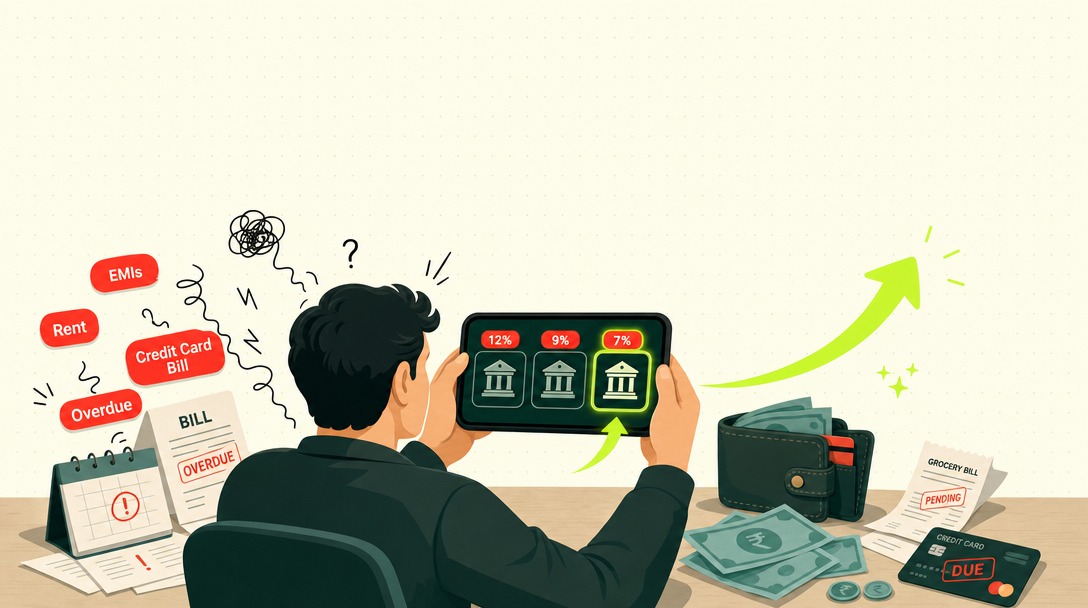
This is why comparison — not application — should be the first step. Seeing indicative rates from multiple lenders before applying tells you which lender has priced your specific profile most competitively.
→ Personal Loan Interest Rates in India Explained for 2026 [https://www.taptaploans.in/blog/personal-loan-interest-rates-india/]
→ Personal Loan Rates in India 2026: Banks & NBFCs [https://www.taptaploans.in/blog/personal-loan-interest-rates-india-2026/]
The True Cost of a Personal Loan: Beyond the Interest Rate
Two loans at the same interest rate can cost very different amounts depending on fees:
- Processing fee: Typically 0.5%–3.5% of the loan amount, deducted from the disbursed amount or charged upfront. On ₹10 lakh, this is ₹5,000–₹35,000.
- Prepayment penalty: Ranges from 0% to 5% of outstanding principal. If you want to close early, this matters enormously.
- Late payment penalty: Typically 2–3% per month on the overdue EMI — adds up quickly if you miss payments.
- GST on fees: All processing fees and charges attract 18% GST, adding to the actual cost.
The effective interest rate — accounting for all fees — can be 1–3 percentage points above the stated rate for loans with high processing fees.
How to Get the Best Personal Loan Rate for Your Profile
- Check your CIBIL score first — know your starting position.
- List all lenders where you have salary accounts or existing products — these are your best prospects for rate concessions.
- Compare through a loan advisory platform that can show you indicative rates from multiple lenders without triggering hard inquiries.
- When you receive a rate, always ask: ‘Is this your best rate? What would it take to improve it?’ Many lenders have unpublished rate-reduction programs for certain profiles.
- Calculate the total cost including processing fees, not just the EMI — a 12% loan with a 2.5% processing fee may cost more than a 13% loan with a 0.5% fee on shorter tenures.
→ Loan Advisory Platform vs Bank: Which Saves You More Money in India? [https://www.taptaploans.in/blog/loan-advisory-platform-vs-bank-india/]
Compare personal loan rates from 20+ lenders in one place. TapTap Loans shows you indicative rates from SBI, HDFC, ICICI, and more — without a credit inquiry. Visit taptaploans.in.
Frequently Asked Questions
For qualified borrowers (700+ CIBIL, salaried), IDFC FIRST Bank and Poonawalla Fincorp currently advertise starting rates of 10.49% and 9.99%, respectively. For PSU bank borrowers, SBI’s Xpress Credit at 11.45% is very competitive. However, the lender offering the lowest rate for the average borrower varies significantly by profile — comparison is essential.
Most personal loans in India are fixed-rate products. Some lenders offer floating rates linked to MCLR or repo rate. In a falling rate environment, floating can be advantageous. In a rising rate environment, fixed provides certainty. Given the fixed nature of most offers, focus on comparing fixed rates rather than seeking floating-rate products.
Yes, typically 1–3 percentage points lower than the standard rate at the same bank. Salary account customers are known to the bank, have their income validated automatically, and are considered lower risk. Always check your own bank’s rate before applying elsewhere.
Yes, especially if you have a CIBIL score above 750, have been with the bank for 3+ years, and can credibly mention a lower competing offer. Banks have some discretion at the branch level. The negotiation success rate is higher at the relationship manager level than through app-based applications.
The RBI repo rate influences lenders’ cost of funds, which in turn affects personal loan rates. When the repo rate falls, personal loan rates tend to follow — though with a lag and only partially. Fixed-rate personal loans already taken are not affected by repo rate changes.
Q
Key Takeaways
Personal loan rates in India range from 9.99% to 36%+ — a massive spread. Your credit profile determines where in that range you land.
CIBIL score is the most influential rate determinant. A 50-point improvement can translate to a 2–4% lower rate.
Existing salary account holders consistently receive better rates than new-to-lender customers. Check your own bank first
Always calculate the total cost of the loan (including processing fee and prepayment terms), not just the stated interest rate.
Comparing 3–5 lenders through an advisory platform before applying can save ₹30,000–₹1.5 lakh in total interest on a typical loan.