





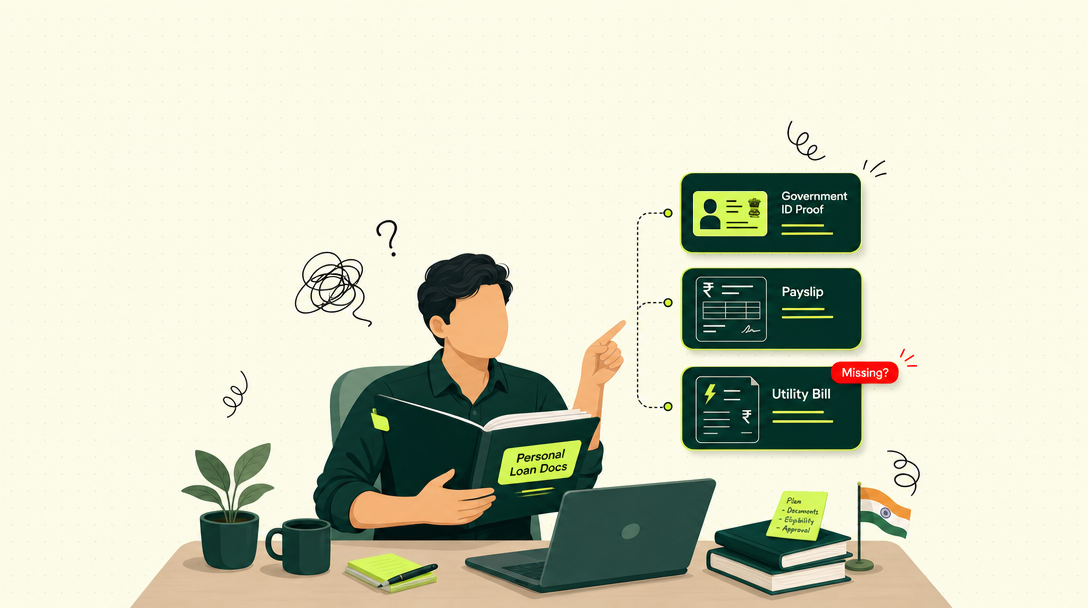
Most personal loan delays have nothing to do with income or credit score; they happen because an applicant uploads the wrong version of a document, or doesn’t realise a second document was required until three days in. The list itself is short; the confusion is almost always about which version of each document a specific lender wants.
This checklist separates what salaried and self-employed applicants each need, and flags the details that most commonly cause a document to get rejected on the first upload.
Identity and Address Proof (Same for Everyone)
Regardless of employment type, every lender will ask for:
- PAN card — mandatory for any loan application in India
- Aadhaar card — used for identity and address verification, and increasingly for e-KYC
- A recent passport-size photograph
- Address proof, if different from Aadhaar: utility bill, rent agreement, or passport
Most digital lenders now complete this step through e-KYC using Aadhaar-based verification, which is faster but still requires the Aadhaar-linked mobile number to be active for OTP verification.
Documents for Salaried Applicants
A salaried applicant’s list is comparatively short:
- Last 3 months’ salary slips
- Last 6 months’ bank statements showing salary credits
- Form 16 or the latest ITR, especially for loan amounts above a lender’s threshold
- Employee ID or an employment verification letter, occasionally requested for applicants at smaller companies
The most common rejection point here is inconsistent salary credit dates or amounts across the bank statement months, which prompts a lender to ask clarifying questions rather than approve immediately.
Documents for Self-Employed Applicants
Self-employed applicants need a more complete financial picture, since there’s no employer-issued document to lean on:
- ITR for the last 2–3 years, with computation of income
- Bank statements for the last 6–12 months, for the primary business account
- Business proof: GST certificate, Shop and Establishment license, or professional registration, depending on the trade
- Profit and Loss statement and Balance Sheet, CA-certified for larger loan amounts
- Proof of business continuity, such as trade license renewal history
For a deeper breakdown of how lenders actually evaluate these documents, see our guide on personal loans for the self-employed.
Common Reasons Documents Get Rejected
A handful of avoidable mistakes account for most document-related delays:
- Uploading scanned copies with blurred or cut-off text, especially on bank statements
- Submitting a bank statement that’s a screenshot rather than a bank-issued PDF or stamped copy
- PAN name mismatches: even a minor spelling difference between PAN, Aadhaar, and salary slip can trigger a manual review
- Outdated address proof that no longer matches your current residence
- Incomplete ITR filings: submitting only the acknowledgement page instead of the full computation of income
Catching these before submission, rather than after a lender flags them, is usually the difference between a same-day and a week-long approval.
What a Soft Credit Check Does and Doesn’t Need
A soft credit check, used at the initial eligibility-matching stage, typically only needs your PAN and basic income details, not the full document set. The complete document list above is required once you move to a formal application with a specific lender, which is also when a hard credit inquiry gets triggered.
This two-step structure is useful precisely because it lets you find out which lenders are realistically interested before gathering every document for a lender that was never going to approve you.
How to Prepare Everything Before You Apply
A short prep routine avoids almost every delay above:
- Scan documents at 300 DPI or higher, in PDF where possible, not phone photos.
- Confirm your name is spelled identically across PAN, Aadhaar, and salary slips or ITR.
- Download bank statements directly from net banking rather than screenshotting a mobile app.
- Keep the last 2–3 years of ITR filings, not just the most recent one, even if not immediately requested.
- Have a co-applicant’s documents ready in the same format if you plan to add one.
Key Takeaways
- PAN, Aadhaar, a photograph, and address proof are required across every lender and employment type.
- Salaried applicants typically need 3 months of salary slips and 6 months of bank statements; self-employed applicants need 2–3 years of ITR and 6–12 months of bank statements.
- Name mismatches across ID documents are one of the most common, most avoidable causes of delay.
- A soft credit check at the matching stage needs far less documentation than the formal application that follows.
- Preparing scanned, correctly named documents in advance is the single biggest lever over how fast your application moves.
Frequently Asked Questions
Rarely. Bank statements are how most lenders verify income consistency, whether or not you also submit salary slips or ITR. A small number of fully digital lenders use account-aggregator-based data sharing instead of manually uploaded statements.
Not always. Many lenders accept salary slips and bank statements alone for smaller loan amounts, but Form 16 or ITR is commonly required above a certain threshold, which varies by lender.
This is a common, fixable issue. Correcting the mismatch through the respective issuing authority before applying avoids a manual review delay later.
No, nearly all lenders now accept digital uploads or e-KYC verification, and physical copies are rarely required except in edge cases involving disputed documents.
Bank statements and salary slips are typically only valid for 2–3 months from the date of application, so it’s worth downloading fresh copies close to when you actually apply rather than reusing older ones.
Conclusion
The personal loan document list hasn’t changed much in years; what changes is how strictly a specific lender enforces the details, and that’s exactly where most applications lose time. Getting the paperwork right the first time is a bigger lever on approval speed than most applicants realise.
Start your application with TapTap, and we’ll tell you exactly which documents your matched lenders need nothing more, nothing you don’t already have.