





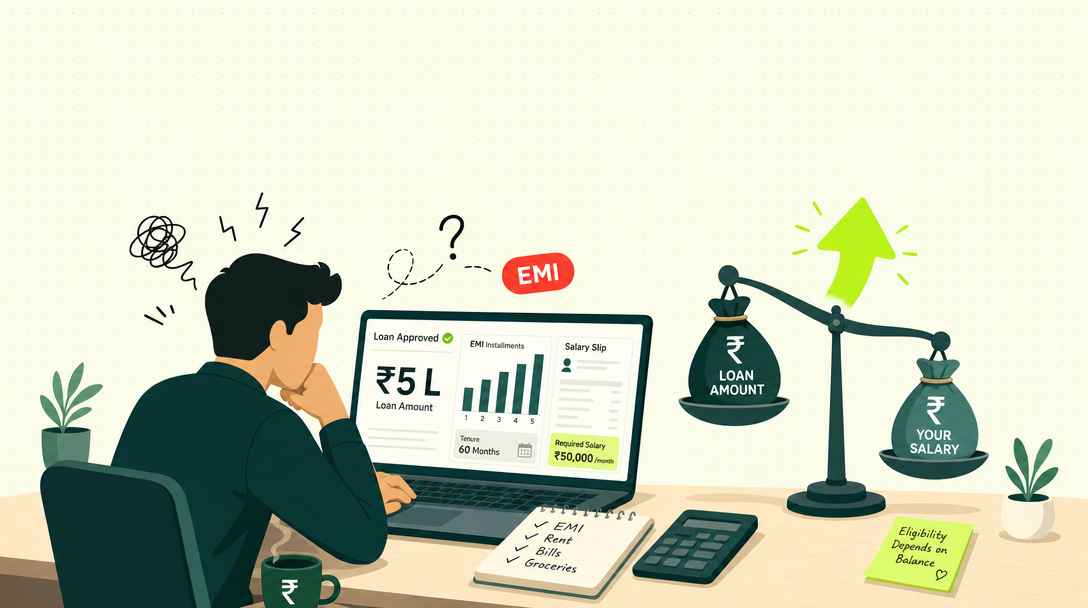
₹5 lakh is one of the most common personal loan amounts in India. It covers a wedding contribution, a medical bill, a home repair, or clearing two or three smaller debts. It is also the amount where borrowers most often accept the first offer they see, because the EMI looks manageable either way.
That is a costly habit. On ₹5 lakh over 5 years, the difference between a 12% and an 18% offer is over ₹94,000. This guide shows the EMI at each tenure and rate, what salary lenders expect, and what separates a borrower who gets 11% from one who gets 19%.
₹5 lakh personal loan EMI chart
EMIs use the standard reducing-balance formula. Rates are illustrative of the 2026 range for salaried borrowers.
| Tenure | 10.5% p.a. | 12% p.a. | 14% p.a. | 16% p.a. |
|---|---|---|---|---|
| 2 years | ₹23,188 | ₹23,537 | ₹24,006 | ₹24,482 |
| 3 years | ₹16,251 | ₹16,607 | ₹17,089 | ₹17,579 |
| 4 years | ₹12,802 | ₹13,167 | ₹13,663 | ₹14,170 |
| 5 years | ₹10,747 | ₹11,122 | ₹11,634 | ₹12,159 |
| 6 years | ₹9,389 | ₹9,775 | ₹10,303 | ₹10,846 |
Total cost by tenure
At 12% p.a., here is what the same ₹5 lakh costs over different tenures:
| Tenure | EMI | Total interest |
|---|---|---|
| 2 years | ₹23,537 | ₹64,882 |
| 3 years | ₹16,607 | ₹97,858 |
| 4 years | ₹13,167 | ₹1,32,012 |
| 5 years | ₹11,122 | ₹1,67,333 |
| 6 years | ₹9,775 | ₹2,03,807 |
Going from 3 to 5 years cuts the EMI by about ₹5,500 a month but adds almost ₹70,000 in interest. The rate matters just as much: at 18% over 5 years, the EMI is ₹12,697, and interest is about ₹2.62 lakh, roughly ₹94,000 more than at 12%.
Salary required for a ₹5 lakh loan
Lenders decide the amount based on your capacity to service the EMI. They add the new EMI to your existing EMIs and compare the total to your net monthly income, a measure called FOIR. Most lenders allow 40% to 55%.
For ₹5 lakh at 12% over 5 years (EMI ₹11,122):
| Existing EMIs | Net salary needed at 50% FOIR | At 40% FOIR |
|---|---|---|
| None | about ₹22,300 | about ₹27,800 |
| ₹5,000 | about ₹32,300 | about ₹40,300 |
| ₹10,000 | about ₹42,300 | about ₹52,800 |
Most lenders also set a minimum net salary, commonly ₹15,000 to ₹30,000 depending on city and lender. In practice, a net salary of about ₹25,000 to ₹30,000 with no other EMIs is the realistic floor for ₹5 lakh.
If you earn less, read our guide to personal loans for salaries below ₹25,000.
Who qualifies: eligibility checks
| Factor | What most lenders want for ₹5 lakh |
|---|---|
| Age | 21 to 58–60 years at loan maturity |
| Credit score | 700+; 750+ for the best rates |
| Work experience | 1 year total, 6 months with current employer (salaried) |
| Business vintage | 2–3 years with ITR (self-employed) |
| FOIR | Under 50%–55% including the new EMI |
| Recent enquiries | Few hard enquiries in the last 3–6 months |
| Repayment history | No 30+ day delays in the past 12 months |
A single recent default or several “settled” accounts matter more than a slightly lower score. Our guide to CIBIL score for personal loans explains how lenders read your report.
Bank or NBFC for ₹5 lakh?
Both lend ₹5 lakh routinely. The difference is in who they prefer.
- Banks usually offer the lowest rates to salaried borrowers with high scores and reputed employers, especially existing salary account customers.
- NBFCs are often more flexible on FOIR, employer category, lower scores, or self-employed income, at a higher rate.
The cheapest lender for your neighbour may not approve you at all. Our comparison of bank vs NBFC personal loans covers this in detail.
Documents required
For salaried applicants:
- PAN and Aadhaar
- Three months’ salary slips
- Six months’ bank statements showing salary credits
For self-employed applicants:
- PAN and Aadhaar
- Two years’ ITR with computation of income
- 12 months’ bank statements
- Proof of business (GST, Udyam or shop registration)
The full list is in our personal loan documents checklist.
Using ₹5 lakh to clear other debts
Many ₹5 lakh loans are taken, directly or indirectly, to pay off smaller and costlier debts: credit card balances, instant app loans, or a high-rate NBFC loan.
This can work well when the new rate is clearly lower. Example: ₹2.5 lakh on cards at 40% plus ₹1.5 lakh across two app loans at 30%, with combined payments of about ₹27,000 a month (a 5% minimum due on the cards plus 12-month app EMIs). Clearing them with a ₹4 lakh consolidation loan at 14% over 4 years gives a single EMI of about ₹10,900.
The discipline that makes it work: close the cards or keep them at zero balance afterwards. See debt consolidation in India for how to structure it.
Use cases
Salaried, ₹35,000 net, no EMIs. A ₹5 lakh loan at 12.5% for 5 years (EMI about ₹11,250) keeps FOIR near 32%. Most banks and NBFCs will approve.
Salaried, ₹30,000 net, ₹6,000 two-wheeler EMI. FOIR at 5 years would be about 57%. Choosing 6 years at 12% brings it to about 53%; a lender with a higher FOIR limit, or a slightly smaller loan, closes the gap.
Key takeaways
- ₹5 lakh at 12% for 5 years costs ₹11,122 a month and about ₹1.67 lakh in interest.
- A net salary of about ₹25,000–₹30,000 with no other EMIs is usually enough.
- The rate you are offered can add or save close to ₹1 lakh over 5 years.
- Banks are cheapest for strong salaried profiles; NBFCs are more flexible.
- Using ₹5 lakh to clear costlier debts works if the new rate is much lower and old balances stay closed.
FAQs
At 12% p.a., about ₹11,122. At 10.5,% it is about ₹10,747, and at 16%, about ₹12,159.
Typically around ₹25,000 to ₹30,000 net per month if you have no other EMIs. Existing EMIs increase the requirement.
Some NBFCs may approve with high income and low FOIR, usually at a higher rate. Improving your score first or applying with a co-applicant can help.
For salaried borrowers with complete documents, approval can come within hours, and disbursal within 24 to 48 hours.
A gold loan is usually cheaper and faster if you have gold to pledge. A personal loan avoids pledging assets and offers longer tenures. See personal loan vs. gold loan.
Conclusion
A ₹5 lakh loan looks routine, which is exactly why borrowers under-shop it. The EMI difference between offers may seem small; the total cost difference rarely is.
TapTap Loans checks your eligibility with a soft pull, compares 20+ banks and NBFCs, and submits your application only to the lender most likely to approve you at the lowest rate.