





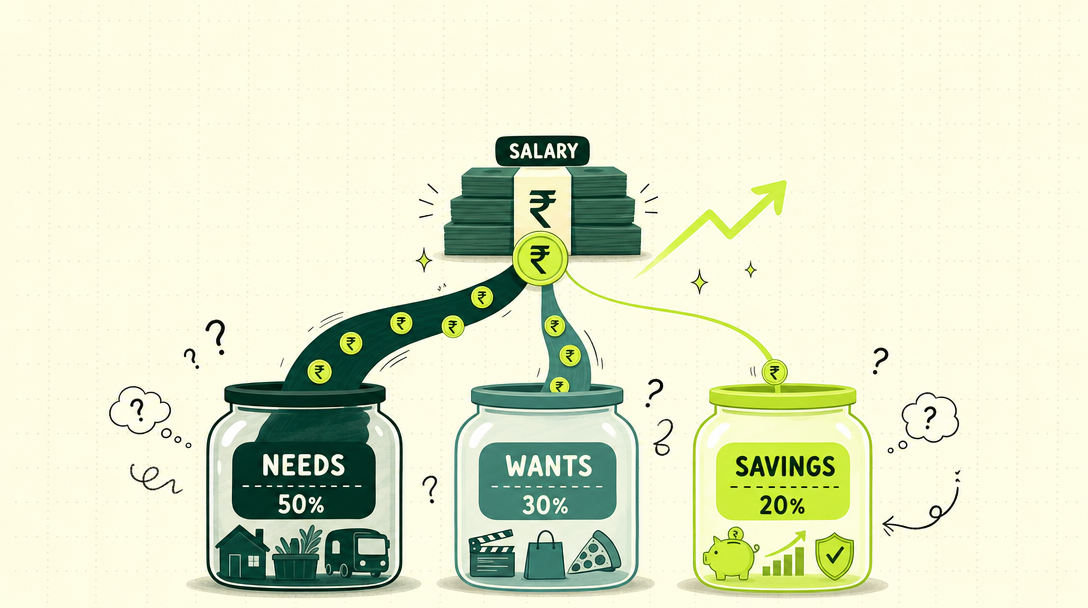
The 50-30-20 budget rule splits your take-home income into three parts. 50% for needs, 30% for wants, and 20% for savings and debt repayment. This guide explains how to apply it practically, with an Indian salary and cost-of-living context.
What the 50-30-20 Rule Actually Means
This is a simple, widely used framework for organizing your monthly income, without needing complex spreadsheets or detailed tracking of every rupee. It divides your net, take-home salary into three broad categories, each with a target percentage.
The 50%: Needs
This covers essential expenses you genuinely can’t avoid. Rent or home loan EMI, groceries, utilities, transportation to work, insurance premiums, and minimum debt payments. If your rent or EMI alone consumes a huge share of your income, especially common in expensive Indian cities, this category can be the hardest to keep within its target.
The 30%: Wants
This covers discretionary spending that improves your quality of life, but isn’t strictly essential. Dining out, entertainment, subscriptions, shopping beyond basic needs, travel, and hobbies. This is usually the easiest category to trim if you’re trying to free up more money for savings or debt repayment.
The 20%: Savings and Debt Repayment
This covers building your financial future. Emergency fund contributions, investments, retirement savings, and any extra debt repayment beyond your minimum EMIs. This category is often the first to get squeezed when the other two run over budget, which is exactly the pattern this rule tries to prevent.
Applying This Rule to an Indian Salary
Take a net monthly salary of ₹60,000. Under the 50-30-20 split, that’s roughly ₹30,000 for needs, ₹18,000 for wants, and ₹12,000 for savings and extra debt repayment.
In many Indian cities, rent alone can consume a large share of the needs category, sometimes pushing needs above 50% of income entirely. This is a common, realistic adjustment many households need to make to the rule’s exact percentages.
Why the Exact Percentages Don’t Always Fit Perfectly
The 50-30-20 rule was developed with a general cost-of-living context in mind, and doesn’t always map cleanly onto every city or income level in India. High rent in metro cities, larger family size, or supporting extended family financially are all common factors that can shift the realistic proportions.
Treat the framework as a useful starting structure, not a rigid rule you must hit exactly every single month.
A More Realistic Indian Adjustment: 60-20-20 or 50-20-30
Many financial advisors suggest Indian households consider a modified split, perhaps 60% needs, 20% wants, and 20% savings, particularly in high-cost cities, or a 50-20-30 split that prioritizes savings even more heavily, for those specifically working to build an emergency fund or pay down debt faster.
The core principle, dividing income intentionally rather than spending reactively, matters more than hitting the exact original percentages.
How This Framework Helps With EMI Management
If you’re carrying loan EMIs, they typically fall under the “needs” category. If your total EMIs, combined with other essential expenses, push your needs category well above 50%, that’s a clear, structural signal worth addressing directly, rather than just trying to cut back on the “wants” category to compensate.
This is often where a borrower first recognizes that consolidating multiple EMIs into one, lower-cost payment could meaningfully rebalance their entire budget structure, not just trim discretionary spending around the edges.
A Step-by-Step Way to Start
Calculate your actual net monthly income first, the amount that actually reaches your bank account. List every expense from the last month, categorizing each into needs, wants, or savings, as honestly as possible. Compare your actual percentages against the 50-30-20 target, and identify the biggest gap. Then make one deliberate adjustment at a time, rather than trying to overhaul your entire spending pattern at once.
Common Obstacles to Sticking With This Rule
Irregular income. Self-employed individuals or those with variable income need to average across several months, rather than applying the rule strictly to any single month’s earnings.
Underestimating needs. Many people initially classify too much spending as “needs” when it’s genuinely closer to “wants,” which can make the budget feel impossible to stick to. Being honest about this distinction matters.
No buffer for irregular expenses. Annual costs like insurance renewals or festival spending don’t fit neatly into a monthly framework, and are worth planning for separately, rather than letting them disrupt your regular monthly split.
Using This Framework Alongside Debt Repayment
If a meaningful share of your “needs” category is going toward multiple, separate EMIs, review whether your total debt structure itself could be more efficient. A high blended interest rate across several debts often means you’re paying more than necessary within your needs category, room that could otherwise go toward your savings and future-focused 20%.
Making the Rule Work Long-Term
The 50-30-20 rule, or any adjusted version of it, works best as an ongoing habit, not a one-time exercise. Revisit your actual spending against your target split every few months, adjusting as your income, city, or life circumstances change. Small, consistent course corrections matter more than perfect adherence in any single month.
Frequently Asked Questions
It’s a useful starting framework, though many Indians, especially in expensive cities, need to adjust the exact percentages to reflect higher rent and cost-of-living realities.
Needs are essential, unavoidable expenses: rent, groceries, utilities, minimum debt payments. Wants are discretionary spending that improves quality of life but isn’t essential: dining out, entertainment, non-essential shopping.
This is a strong signal that your debt structure may need attention, potentially through consolidation or restructuring, rather than simply cutting other spending to compensate.
Yes, averaging income across several months rather than applying the rule strictly to any single month, given more variable earnings typically.
Yes. The 50-30-20 rule is a flexible budgeting framework, not a strict requirement. If you’re saving for a home, building an emergency fund, or paying off debt, you can adjust the percentages—for example, 50-20-30 or 60-20-20—to better match your financial priorities.
Conclusion
The 50-30-20 budget rule is a simple and effective way to manage your monthly income without creating a complicated budget. By dividing your take-home salary into needs, wants, and savings, you can spend more intentionally, avoid overspending, and make steady progress toward your financial goals.
While the exact percentages may need to be adjusted for India’s cost of living or your personal circumstances, the underlying principle remains the same: give every rupee a purpose. Regularly reviewing your budget and making small adjustments over time can help you build better financial habits, reduce debt, and increase your long-term savings.