





A salary slip is the lender’s shortcut. It shows who pays you, how much, and how regularly in a single page. Many earners in India don’t have one: staff at small firms without formal payroll, people in their first month at a new job, contract workers, and self-employed professionals.
Searching for a personal loan without a salary slip often leads to apps that promise money “without documents”. That is the wrong frame. What you actually need is a different way to prove the same income.
This guide sets out which documents lenders accept in place of a slip, how they convert a bank statement into an eligible income figure, what it does to your loan amount and rate, and which offers to walk away from.
Why lenders ask for salary slips
A salary slip answers three questions at once: is the employer real, what is the net take-home pay after deductions, and is the income regular? Lenders use it to work out how much EMI you can carry.
This check is not optional. The RBI (Digital Lending) Directions, 2025 require the regulated lender to obtain information on the borrower’s economic profile, “including, at a minimum, age, occupation and income details”, before lending (RBI, Digital Lending Directions, 8 May 2025, para 7). Any lender that claims to skip income assessment is either not regulated or not telling you the full story.
So the useful question is not “can I avoid proving income?” but “which other document proves it well enough?” The answer differs for salaried and self-employed borrowers.
Personal loan without salary slip: who needs this route
Four groups search for a personal loan without a salary slip most often:
- Salaried staff at small employers. Shops, clinics, small agencies and family businesses often pay by bank transfer but never issue a formal slip.
- New joiners. Someone two weeks into a job has an offer letter and perhaps one credit, but no payslip history.
- Contract and consultancy workers. Payment arrives as professional fees, sometimes with TDS deducted, rather than as salary.
- Self-employed borrowers. Doctors, lawyers, traders and freelancers have no employer at all. For this group, the ITR does the job of a slip.
If your income itself cannot be documented in any form, that is a different problem, covered in our guide to a personal loan without income proof. This article assumes you earn a regular income and simply lack the standard paperwork.
Personal loan without salary slip for salaried borrowers
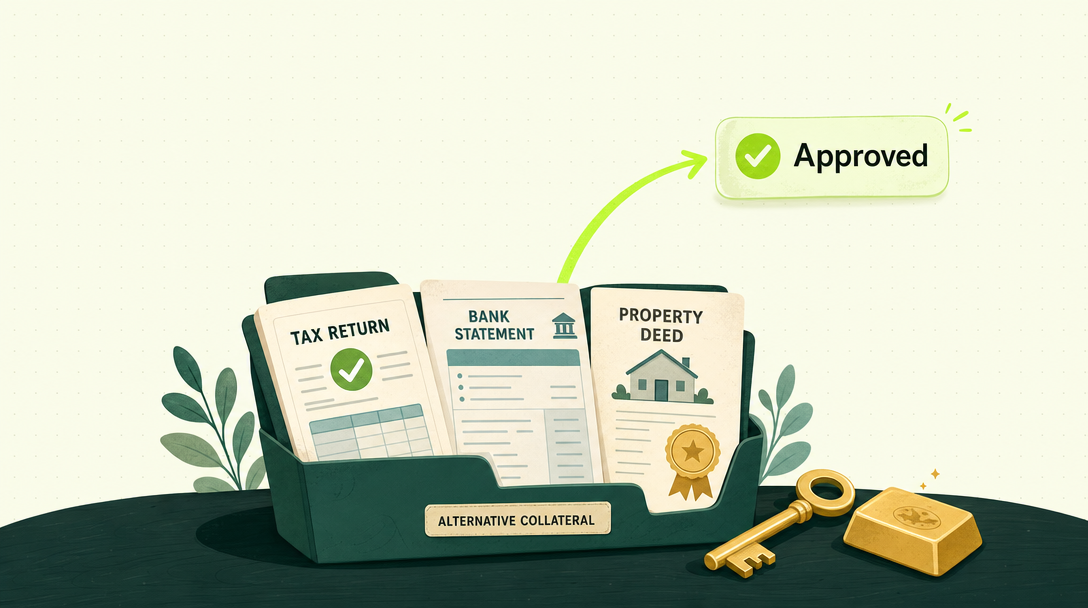
Lenders typically want two things from a substitute: proof of the employer relationship and proof of the amount. One document rarely covers both, so plan to submit a combination.
Bank statement with salary credits
This is the strongest substitute. Six months of statements showing a regular credit from the same employer, ideally with the employer’s name or “SAL” in the transaction narration, tells the lender who pays you and how much. Lenders can also fetch the statement digitally through the RBI-regulated Account Aggregator framework if you give consent.
Form 16, Form 26AS or AIS
If your employer deducts TDS, Form 16 shows gross salary and tax for the year. The Annual Information Statement (AIS) or Form 26AS confirms it from the tax department’s side.
Under the Income-tax Act, 2025 and the draft Income-tax Rules, 2026, Form 16 is due to become Form 130 and Form 26AS Form 168 from 1 April 2026 (Free Press Journal, 16 Feb 2026). [compliance review: Form 16 and Form 26AS are being renumbered Form 130 and Form 168 under the Income-tax Rules, 2026; confirm final names before publishing]
Appointment letter and employer verification
An appointment or offer letter on company letterhead states your designation, joining date, and CTC. Many lenders then verify employment by calling HR or by an email from an official company domain. A salary certificate signed by an authorised person can fill the same gap.
EPF passbook
If your employer contributes to EPF, the passbook available through your UAN shows monthly contributions under the employer’s name. It proves continuity of employment, though not the exact net salary.
Table: documents for a personal loan without a salary slip and what each proves
| Document | Proves employer | Proves amount | Typical period |
|---|---|---|---|
| Bank statement with salary credits | Partly (via narration) | Yes | 3–6 months |
| Form 16 / AIS | Yes | Yes (annual) | Last financial year |
| Appointment letter | Yes | CTC only | Current |
| Employer verification or salary certificate | Yes | Yes | Current |
| EPF passbook | Yes | No | 6–12 months |
| ITR with computation of income (self-employed) | Not applicable | Yes (annual) | Last 2 years |
| GST returns, GSTR-3B (self-employed, if registered) | Business registration | Turnover, not profit | 6–12 months |
The last two rows apply to self-employed applicants and are explained in the next section.
Personal loan without salary slip for the self-employed
Self-employed borrowers never have salary slips, so a personal loan without a salary slip is simply the normal route for them. Lenders build a different file:
- Income tax returns for the last two years with the computation of income. This is the primary income proof.
- GST returns (GSTR-3B) if you are registered, which show turnover month by month.
- Bank statements for six to twelve months, preferably of the business current account and the personal savings account.
- Business proof: Udyam registration, shop and establishment licence, or professional registration.
- Audited financials, if your turnover requires a tax audit.
Lenders also look at business vintage and how stable the banking surplus is
How lenders calculate income from bank statements
When there is no slip, the lender builds its own income figure from your statement. Typically it:
- Counts only credits that recur from the same source, on roughly the same date.
- Excludes cash deposits, transfers from your own accounts, refunds and one-off credits.
- Takes the regular amount, or the smallest of the recent months, rather than the largest.
- Subtracts existing EMIs visible as debits, including EMIs on loans you may have forgotten, such as a phone on EMI.
It then applies a FOIR (fixed obligation to income ratio) cap, the share of monthly income that all EMIs together may take. FOIR caps vary by lender and income band; see how FOIR is calculated for the method.
Worked example: personal loan without salary slip, from bank-statement credits
Riya works at a 20-person design studio in Pune that pays by NEFT but issues no payslips. Her last six statements show credits of ₹46,500, ₹46,500, ₹51,200, ₹46,500, ₹46,500 and ₹46,500. She pays ₹7,500 a month on a two-wheeler loan.
- Average credit: ₹47,283. A lender would usually treat the ₹51,200 payment as a one-off (it included an incentive) and use ₹46,500.
- Illustrative FOIR cap of 50%: ₹23,250 for all EMIs.
- Room for a new EMI: ₹23,250 − ₹7,500 = ₹15,750.
- At an illustrative 14% for 48 months, ₹15,750 supports a loan of about ₹5,76,364. At an illustrative 18%, the same EMI supports about ₹5,36,170.
Rates are illustrative rates assumed for the calculation, not a lender quote. EMIs use the reducing-balance method with no processing fee included.
If Riya borrows ₹3,00,000 for 48 months, the EMI is ₹8,198 at 14% (total interest ₹93,501) or ₹8,812 at 18% (total interest ₹1,23,000). The four-point rate difference costs her ₹29,499 over the loan, which is the real price of a thinner document file.
What changes when you apply without salary slips
A personal loan without a salary slip is usually available, but the terms can move against you in four ways:
- Lower sanctioned amount. Lenders often cap the loan at a smaller multiple of income when it is inferred from credits rather than certified.
- Higher rate. Pricing reflects how confident the lender is about your income and employer. A smaller, unlisted employer often falls into a lower employer category.
- Shorter tenure. Some lenders limit the tenure, which raises the EMI.
- More conditions. You may be asked for a co-applicant, a longer statement history, or an office address check.
The cost of each offer is shown in the Key Fact Statement, which lenders must give before you sign.
The KFS states the annual percentage rate (APR), which includes interest and all charges the lender levies, and a lender cannot later impose a charge that is not in the KFS without your explicit consent (RBI, Key Facts Statement for Loans and Advances, 15 Apr 2024, effective 1 Oct 2024). [compliance review: confirm current Master Direction reference after RBI’s 28 Nov 2025 consolidation]
Your repayment record also travels fast. Lenders report credit information to credit bureaus at least fortnightly (RBI, 8 Aug 2024, effective 1 Jan 2025), so a missed EMI on a stretched loan shows up on your report within weeks.
Personal loan without salary slip: red flags in “no documents” offers
Searches such as “urgent cash loan without salary slip” and “instant loan without salary slip” attract apps that skip verification and recover the risk through fees, very high rates, or harassment. In August 202,6 the Indian Cybercrime Coordination Centre (I4C) flagged six loan apps that posed as lenders, charged exorbitant interest, st and harvested users’ Aadhaar, contacts,cts and photos; Google was asked to remove them (Outlook Business, 12 Aug 2026, reporting an I4C notice of 7 Aug 2026).
Walk away if an app or agent:
- Asks for an upfront “processing” or “file charge” before sanction.
- Wants access to your contacts or gallery.
- Cannot name the RBI-regulated bank or NBFC that is lending.
- Does not give you a KFS, or disburses into an account other than yours. Under the Digital Lending Directions, disbursal must go into the borrower’s own bank account (para 9).
You can check whether an entity is regulated on the RBI’s Sachet portal, and report loan-app fraud on the national cybercrime helpline 1930 or at cybercrime.gov.in.
Checking your options before you apply
Lenders differ widely in how they treat an application for a personal loan without a salary slip. One bank may refuse a borrower without three payslips; an NBFC may accept six months of salary credits plus employer verification. Applying to each in turn costs you hard enquiries on your credit report and time.
A better sequence:
- Gather the substitutes you have: statements, Form 16/AIS, appointment letter, EPF passbook or ITRs.
- Work out your eligible EMI using the method above.
- Compare lenders that accept your document mix, using a soft check first so you can [internal link: check eligibility without a CIBIL impact
- Apply to one lender, and read the KFS and APR before you accept.
Use cases: three borrower scenarios
Salaried at a small firm, Indore
Arjun, 29, earns ₹38,000 a month by bank transfer from a 12-person logistics firm and wants a personal loan without a salary slip. No slips, no Form 16 because his income is below the TDS threshold. He has no other EMIs. With six months of credit and an HR verification email, his illustrative FOIR room is ₹19,000. A ₹3 lakh loan over 36 months at an illustrative 16% would need an EMI of about ₹10,547, well within that room.
New joiner, Bengaluru
Sneha, 33, moved jobs three weeks ago. She has an appointment letter showing ₹1.1 lakh monthly CTC, one partial salary credit, and Form 16 from her previous employer. Some lenders will consider her now with employer verification; others will ask her to wait for two or three credits. Comparing before applying avoids a rejection on her report.
Self-employed consultant, Jaipur
Vikram, 41, runs an IT consultancy with ITR income of ₹9.6 lakh and pays ₹10,000 a month on a car loan. On his ITR income of ₹80,000 a month and an illustrative 50% FOIR, he has ₹30,000 of EMI room. ₹6 lakh over 48 months costs ₹16,698 a month at an illustrative 15% (total interest ₹2,01,526) and ₹17,625 at 18% (₹2,46,000).
How TapTap helps
Offer: a free lender-fit check for borrowers who want a personal loan without salary slips.
TapTap Loans, a loan advisory platform that matches borrowers with 20+ banks and NBFCs, works out which lenders accept your document mix before you apply.
What happens after you submit: – We run a soft credit check to assess your profile. It does not affect your credit score; a hard enquiry happens only after you choose to proceed with a specific lender. – We match you with lenders whose policies fit your documents, whether that is salary credits and employer verification or ITR and GST returns. – We tell you exactly which documents to share, digitally, with no branch visit. – We submit the application and follow up with the lender until disbursal. You get a callback after your enquiry and can also reach us on WhatsApp.
Have ready: PAN, Aadhaar, six months of bank statements, and whichever substitutes you hold (Form 16/AIS, appointment letter, EPF UAN, or two years of ITR and GST returns).
Cost: nothing for TapTap’s advisory service. Lender fees such as the processing fee still apply and are shown in the lender’s KFS.
TapTap Loans is a loan advisory platform. Loans are offered and approved by RBI-regulated banks and NBFCs at their discretion; rates, fees, and tenures vary by lender and borrower profile.
Key takeaways
- A personal loan without a salary slip is possible, but every regulated lender must still assess your income under the RBI’s Digital Lending Directions.
- Salaried borrowers can substitute bank-statement salary credits, Form 16/AIS, an appointment letter, employer verification, or an EPF passbook; a combination works better than any single document.
- For the self-employed, a personal loan without a salary slip rests on two years of ITR, GST returns, bank statements, and business proof.
- Lenders count only recurring credits and apply a FOIR cap; in the worked example, ₹46,500 of credits supports roughly ₹5.4–5.8 lakh over 48 months at illustrative rates.
- Expect a lower amount or higher rate with thinner documents; compare offers on APR in the KFS.
- Treat any “no documents, instant money” offer as a red flag and check the lender on RBI Sachet.
Frequently Asked Questions
Submit evidence that does the slip’s job: six months of bank statements showing salary credits, Form 16 or AIS, and an appointment letter or employer verification. Self-employed borrowers submit ITR, GST returns, and bank statements. Compare lenders that accept your mix before applying for a personal loan without a salary slip, so you avoid unnecessary hard enquiries.
Sometimes. A salaried borrower with regular salary credits in a bank statement and employer verification may qualify without either, since ITR is not mandatory for every salaried earner. A self-employed borrower without ITR will find most unsecured lenders unwilling; a secured option such as a loan against a fixed deposit is more realistic.
Only if it comes from, or on behalf of, an RBI-regulated bank or NBFC that issues a Key Fact Statement and disburses into your own account. Apps that ask for upfront fees, contact access, or no income evidence at all carry high fraud and harassment risk. Check the lender on RBI Saheli.t
Yes, for many lenders. They read the statement for regular credits from the same employer, ignore cash deposits and one-off transfers, deduct existing EMIs, and apply a FOIR cap. Credits that carry the employer’s name in the narration are far more persuasive than unexplained transfers.
Conclusion
A personal loan without a salary slip depends on substitution, not shortcuts. The lender still needs to know who pays you, how much, and how reliably; your task is to answer those questions with the documents you do have, and to present them to lenders whose policies accept them.
Build the file first: statements, tax records, employer proof. Work out your EMI room with the FOIR method, then compare offers on APR rather than on the headline rate. That sequence protects both your credit report and your budget.