





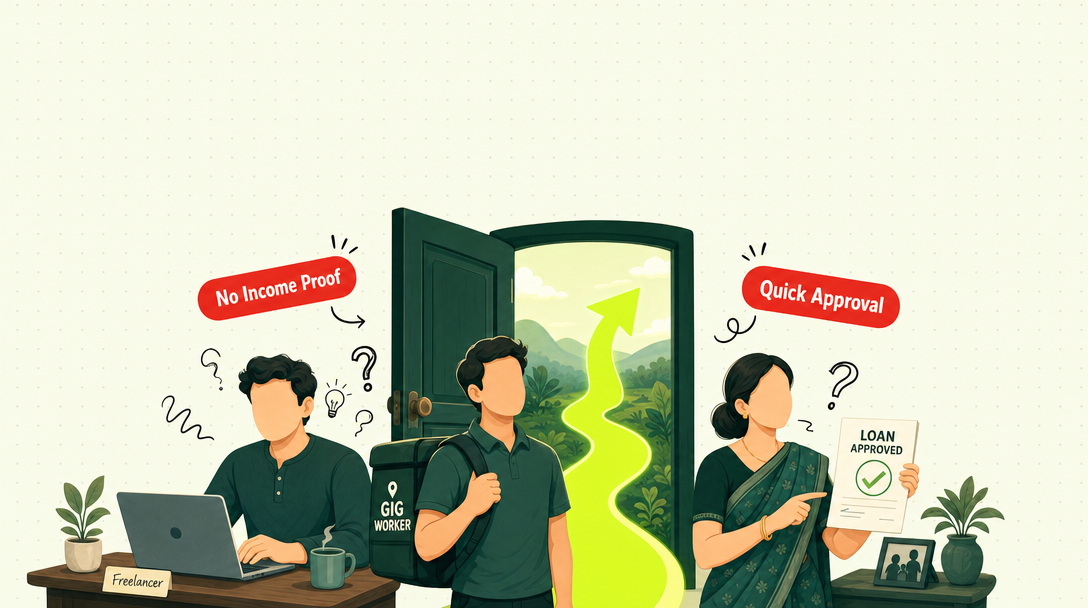
Traditional banks design personal loan applications around one borrower: a salaried employee at a recognised company with 2 years of salary slips and ITRs. Anyone else — a freelance designer earning through UPI, a Swiggy delivery partner, a homemaker with rental income, a YouTuber whose income is irregular but real — hits a wall.
This wall isn’t legal. It is operational — the bank’s risk model doesn’t know how to read your income. In 2026, five real paths exist for non-traditional earners to access personal loans in India. Each has different rate, ticket size, and conditions. This guide walks through all five so you can find the one that fits your situation.
Why Traditional Income Proof Is Required
Banks ask for salary slips and ITR for two reasons: to verify your income exists, and to verify it is stable enough to support an EMI for the loan tenure. Without ITR or salary slips, the bank cannot do either through its standard process. So they reject. But “doesn’t fit standard process” is not the same as “isn’t lendable.” Several lenders have built alternative underwriting models that look at different signals.
The 5 Borrower Types This Blog Covers
- Type 1: Gig workers — Swiggy, Zomato, Uber, Ola, Rapido, Urban Company.
- Type 2: Freelancers — designers, writers, developers, consultants, content creators.
- Type 3: Daily wage earners — informal sector workers receiving cash or UPI payments.
- Type 4: Housewives with their own income — small business, tutoring, rental, online sales.
- Type 5: Retirees — pension income but no salary slips.
Path 1: UPI / Bank-Statement-Based Lending
Fintech lenders like Fi, Niyo, Slice, CASHe, and KreditBee underwrite based on bank statement and UPI data — not ITR. They use machine learning to read 6–12 months of your bank statement and infer income stability.
Best for: Gig workers, freelancers, small business owners with UPI receipts.
Typical rate: 16–26% p.a.
Loan amount: ₹25,000 to ₹5L.
Required: 3–6 months of clean bank statement, minimum ₹15,000–20,000 average monthly inflow.
Path 2: Loan Against Asset
If you have an FD, mutual fund, gold, or LIC policy, you can borrow against it. Your income is not the primary factor — the asset value is.
Best for: Anyone with even ₹50,000 worth of savings, gold, or investments.
Typical rate: 9–12% p.a. — the cheapest unsecured-adjacent route.
Loan amount: 50–90% of asset value.
Required: Valid asset ownership. CIBIL is rarely the gate.
See our complete guides: Loan against FD, Loan against mutual fund, and Loan against LIC policy.
Path 3: Co-Applicant Loan
Adding a co-applicant or guarantor with formal income transforms your application. The bank assesses the joint applicant’s income, your shared liabilities, and the combined FOIR.
Best for: Anyone with a salaried family member willing to be co-applicant.
Typical rate: Same as a regular salaried personal loan — 11–16% p.a.
Loan amount: Up to the joint eligibility, often ₹10–25L.
Required: Co-applicant with stable income, good CIBIL, and willingness to share liability.
Risk: If you default, the co-applicant’s CIBIL is hit and they become legally liable.
Path 4: Credit Card to Personal Loan Conversion
If you have a credit card with available limit, you can convert it into an EMI loan without fresh income verification. The card issuer has already underwritten your credit — they’re just converting outstanding to a structured loan.
Best for: Anyone with an existing credit card with unused limit.
Typical rate: 13–18% p.a. for structured EMI; revolving credit can be 36%+.
Loan amount: Limited by card credit limit.
Required: Existing credit card from major issuer (HDFC, ICICI, SBI Card, Axis).
Path 5: P2P Lending and Specialised Platforms
RBI-registered P2P lending platforms (Faircent, LenDenClub, Lendbox, i2iFunding) connect individual lenders with borrowers. Underwriting is more flexible than traditional NBFCs.
Best for: Borrowers with documented but irregular income; CIBIL between 650–720.
Typical rate: 12–28% p.a. depending on profile.
Loan amount: ₹50,000 to ₹10L.
Required: Platform-specific KYC, bank statement, alternative income proofs.
Red Flags: Who NOT to Borrow From
Non-traditional earners are targets for predatory lenders. Avoid:
- Apps offering “no documents at all” — they will charge 100%+ APR.
- Lenders demanding “processing fee” before disbursal in cash or to a personal UPI ID.
- Anyone promising “guaranteed approval despite low CIBIL” for an upfront fee.
- WhatsApp-only lenders with no website, no registered office.
- Loan offers via SMS asking you to click unknown links.
How Interest Rate Scales Without Income Proof
The trade-off for flexible underwriting is higher rate. Approximate rates by path:
| Path | Typical Rate (2026) | Approval Speed |
|---|---|---|
| Loan against FD/MF/LIC | 9–12% | Same day |
| Co-applicant loan | 11–16% | 3–7 days |
| Credit card to EMI | 13–18% | Instant |
| P2P lending | 12–28% | 2–7 days |
| UPI/bank-statement lending | 16–26% | 30 minutes–same day |
Frequently Asked Questions
Yes, through bank-statement-based lending (Fi, Niyo, Slice, CASHe), loan against asset, co-applicant route, or P2P lending.
Loan against asset (gold, FD, MF, insurance policy) is usually the best. If she has income from rentals or business, bank-statement-based lending also works.
Yes — NBFCs like Bajaj Finance, Poonawalla, and Tata Capital accept bank statements + business proof in lieu of ITR for newer businesses.
Yes. Specialised lenders like KreditBee, CASHe, MoneyView, and Slice underwrite based on UPI income and platform earnings data.
Yes, if the platform is RBI-registered. Faircent, LenDenClub, Lendbox, and i2iFunding are the main RBI-licensed P2P platforms in India.
Bottom Line
Non-traditional income is not a barrier to borrowing in 2026 — it just requires a non-traditional path. The right path depends on your asset base, your relationships, and your urgency. Start with the cheapest applicable route (loan against asset) and move up only if that doesn’t fit.
TapTap Loans helps non-traditional earners find lenders who consider alternative data — without rejection-based hard inquiries.